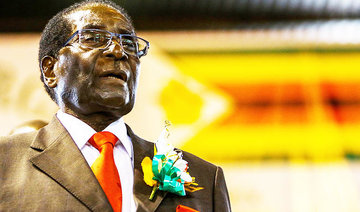
HARARE: Zimbabwean President Robert Mugabe clung to the vestiges of office on Sunday, using a TV address to maintain he was still in power despite a military takeover and a mounting clamour for his autocratic 37-year rule to end.
“The (ruling ZANU-PF) party congress is due in a few weeks and I will preside over its processes,” Mugabe said, pitching the country into deep uncertainty.
Many Zimbabweans had expected Mugabe, 93, to announce his resignation after the army seized power, opened the floodgates of citizen protest and his once-loyal party told him to quit.
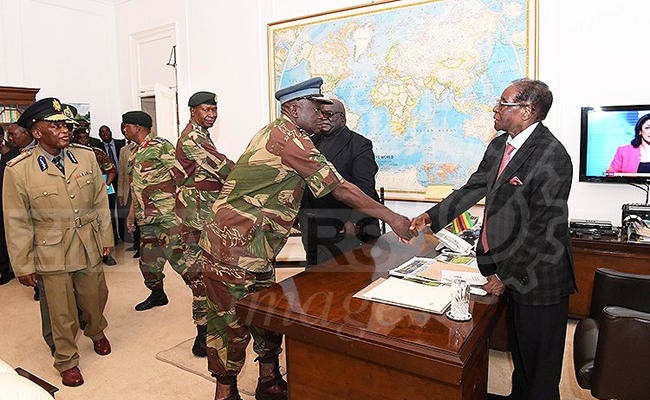
But Mugabe, sitting alongside the uniformed generals who were behind the military intervention, delivered a speech that conveyed he was unruffled by the turmoil.
Speaking slowly and occasionally stumbling as he read from the pages, Mugabe talked of the need for solidarity to resolve national problems — business-as-usual rhetoric that he has deployed over decades.
He made no reference to the chorus for him to resign and shrugged off last week’s dramatic military intervention.
“The operation I have alluded to did not amount to a threat to our well-cherished constitutional order nor did it challenge my authority as head of state, not even as commander in chief,” he said.
Instead he urged harmony and comradeship.
“Whatever the pros and cons of how they (the army) went about their operation, I... do acknowledge their concerns,” said Mugabe.
“We must learn to forgive and resolve contradictions, real or perceived, in a comradely Zimbabwean spirit.”
His address provoked immediate anger, and raised concerns that Zimbabwe could be at risk of a violent reaction to the political turmoil.
“That speech has nothing to do with realities. We will go for impeachment and we are calling people back to the streets,” Chris Mutsvangwa, head of the influential war veterans’ association, told AFP.
It was not immediately clear from his remarks when and where the protests would take place.
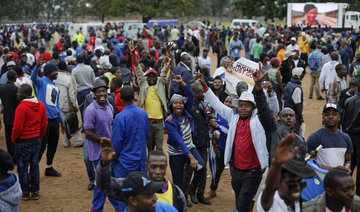
On Saturday, in scenes of public elation not seen since Zimbabwe’s independence in 1980, huge crowds had marched and sang their way through Harare, believing Mugabe was about to step down.
Fired by his party
Highlighting the contradictions in Zimbabwean politics, the ruling ZANU-PF party sacked Mugabe as its leader earlier on Sunday and told him to resign as head of state, naming ousted vice president Emmerson Mnangagwa as the new party chief.
Analysts say the military stepped in last week after Mugabe’s wife Grace, 52, secured prime position to succeed him as president following a bitter power struggle with Mnangagwa, who has close ties to the army.
The majority of Zimbabweans have only known life under Mugabe — the world’s oldest head of state — during a reign defined by violent suppression, economic collapse and international isolation.
Sources suggest Mugabe has been battling to delay his exit and to secure a deal guaranteeing future protection for him and his family.
“What you saw yesterday, it shows that the people have spoken,” Mordecai Makore, 71, a retired teacher told AFP about Saturday’s marches.
“All we want is peace, a good life with a working economy that creates jobs for our people. We will continue praying for that. I want my children and grandchildren to live a normal good life.”
The factional succession race that triggered Zimbabwe’s sudden crisis was between party hard-liner Mnangagwa — known as the Crocodile — and a group called “Generation 40,” or “G40,” because its members are generally younger, which campaigned for Grace’s cause.
The president, who is feted in parts of Africa as the continent’s last surviving independence leader, is in fragile health.
But he previously said he would stand in elections next year that would see him remain in power until he was nearly 100 years old.
He became prime minister on Zimbabwe’s independence from Britain in 1980 and then president in 1987.
Zimbabwe’s economic output has halved since 2000 when many white-owned farms were seized, leaving the key agricultural sector in ruins.

Zimbabwe war vets vow to impeach Mugabe as he defies expectations of resignation
Greece backs coast guard after latest deadly migrant crash
ATHENS: The Greek government has firmly backed its coast guard, insisting it is “not a welcoming committee” as questions grow over a collision in the Aegean Sea this week that killed 15 asylum seekers.
The deadly crash occurred late Tuesday when the high-speed boat the migrants were traveling in collided with a coast guard patrol vessel off the Greek island of Chios, not far from the Turkish coast.
Four women were among the dead, while 24 survivors have been admitted to hospital in Chios.
Rights groups and international media have repeatedly accused Greece of illegally forcing would-be asylum seekers back into Turkish waters, backing their claims with video and witness testimonies.
Greek media and opposition parties have questioned the details of Tuesday’s crash, and the country’s ombudsman has called for “an impartial and thorough investigation,” stressing that the priority should always be “the protection of human life.”
On Thursday, the government said it fully backed the maritime agency.
“We have full confidence in the coast guard and we support them,” government spokesman Pavlos Marinakis told reporters.
Conservative Prime Minister Kyriakos Mitsotakis said he was expecting “a full investigation” into the crash.
In the meantime, he argued that preliminary details showed that “essentially, our coast guard ship was rammed by a much smaller boat.”
“This is a situation that happens quite frequently in the Aegean,” he told Foreign Policy, arguing that smugglers were endangering migrants’ lives.
Had Greek authorities not been present, more people would probably have died, he alleged.
The coast guard was “not a welcoming committee” for people seeking asylum in the European Union, he told the magazine.
- Questions -
Following the crash the coast guard said the pilot of the migrant boat had ignored signals and “made a U-turn maneuver” before colliding with the Greek patrol boat.
“Under the force of the impact, the speedboat capsized and then sank, throwing everyone on board into the sea,” the agency said.
So far, none of the hospitalized survivors have testified directly.
One of them, a 31-year-old Moroccan man, was to be questioned by police as a possible smuggler.
Several Greek media outlets, including To Vima and private TV channel Mega, have reported the victims died of severe head injuries.
Some news organizations have questioned why the patrol boat’s thermal camera was not switched on.
“The captain of the patrol boat judged it unnecessary because the migrants’ speedboat had already been detected by a camera on shore and a spotlight,” government spokesman Marinakis said.
The port police released photos of the coast guard patrol vessel showing minor damage, but no images of the asylum seekers’ boat.
- ‘Obvious distress’ -
Abusive pushbacks have become the “norm” in Greece, medical charity Doctors Without Borders (MSF) said in 2023.
The crash off Chios was “not an isolated incident,” the Refugee Support Aegean charity said this week.
“Based on the available information and the initial announcement of the Hellenic Coast Guard, it appears that, instead of a search and rescue operation, an interception operation was deployed from the outset,” RSA said in a statement.
“This occurred while the refugees’ boat was in obvious distress, was overcrowded and was located at a short distance from the Greek coast,” the statement added.
It is far from the first time that international organizations have pointed the finger at Greece over how it treats migrant boats.
Eighteen of its coast guard members are being prosecuted for involuntary manslaughter due to negligence in the sinking of the trawler Adriana in June 2023.
The United Nations said around 750 people died in that tragedy — one of the worst migrant shipwrecks in the Mediterranean in the past decade.
In 2022, the European Court of Human Rights condemned Greece for its responsibility in the capsizing of a migrant boat off the islet of Farmakonisi in the Aegean Sea.
Eleven people died, including eight children.
The deadly crash occurred late Tuesday when the high-speed boat the migrants were traveling in collided with a coast guard patrol vessel off the Greek island of Chios, not far from the Turkish coast.
Four women were among the dead, while 24 survivors have been admitted to hospital in Chios.
Rights groups and international media have repeatedly accused Greece of illegally forcing would-be asylum seekers back into Turkish waters, backing their claims with video and witness testimonies.
Greek media and opposition parties have questioned the details of Tuesday’s crash, and the country’s ombudsman has called for “an impartial and thorough investigation,” stressing that the priority should always be “the protection of human life.”
On Thursday, the government said it fully backed the maritime agency.
“We have full confidence in the coast guard and we support them,” government spokesman Pavlos Marinakis told reporters.
Conservative Prime Minister Kyriakos Mitsotakis said he was expecting “a full investigation” into the crash.
In the meantime, he argued that preliminary details showed that “essentially, our coast guard ship was rammed by a much smaller boat.”
“This is a situation that happens quite frequently in the Aegean,” he told Foreign Policy, arguing that smugglers were endangering migrants’ lives.
Had Greek authorities not been present, more people would probably have died, he alleged.
The coast guard was “not a welcoming committee” for people seeking asylum in the European Union, he told the magazine.
- Questions -
Following the crash the coast guard said the pilot of the migrant boat had ignored signals and “made a U-turn maneuver” before colliding with the Greek patrol boat.
“Under the force of the impact, the speedboat capsized and then sank, throwing everyone on board into the sea,” the agency said.
So far, none of the hospitalized survivors have testified directly.
One of them, a 31-year-old Moroccan man, was to be questioned by police as a possible smuggler.
Several Greek media outlets, including To Vima and private TV channel Mega, have reported the victims died of severe head injuries.
Some news organizations have questioned why the patrol boat’s thermal camera was not switched on.
“The captain of the patrol boat judged it unnecessary because the migrants’ speedboat had already been detected by a camera on shore and a spotlight,” government spokesman Marinakis said.
The port police released photos of the coast guard patrol vessel showing minor damage, but no images of the asylum seekers’ boat.
- ‘Obvious distress’ -
Abusive pushbacks have become the “norm” in Greece, medical charity Doctors Without Borders (MSF) said in 2023.
The crash off Chios was “not an isolated incident,” the Refugee Support Aegean charity said this week.
“Based on the available information and the initial announcement of the Hellenic Coast Guard, it appears that, instead of a search and rescue operation, an interception operation was deployed from the outset,” RSA said in a statement.
“This occurred while the refugees’ boat was in obvious distress, was overcrowded and was located at a short distance from the Greek coast,” the statement added.
It is far from the first time that international organizations have pointed the finger at Greece over how it treats migrant boats.
Eighteen of its coast guard members are being prosecuted for involuntary manslaughter due to negligence in the sinking of the trawler Adriana in June 2023.
The United Nations said around 750 people died in that tragedy — one of the worst migrant shipwrecks in the Mediterranean in the past decade.
In 2022, the European Court of Human Rights condemned Greece for its responsibility in the capsizing of a migrant boat off the islet of Farmakonisi in the Aegean Sea.
Eleven people died, including eight children.
© 2026 SAUDI RESEARCH & PUBLISHING COMPANY, All Rights Reserved And subject to Terms of Use Agreement.