AL HOL: Basic services at a camp in northeast Syria holding thousands of women and children linked to Daesh group are returning to normal after government forces captured the facility from Kurdish fighters, a United Nations official said on Thursday.
Forces of Syria’s central government captured Al-Hol camp on Jan. 21 during a weekslong offensive against the Kurdish-led and US-backed Syrian Democratic Forces, or SDF, that had been running the camp near the border with Iraq for a decade. A ceasefire deal has since ended the fighting.
Celine Schmitt, a spokesperson for the UN refugees agency told The Associated Press that the interruption of services occurred for two days during the fighting around the camp.
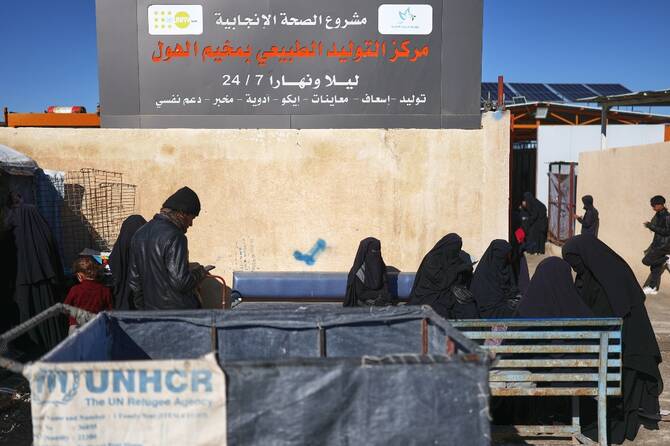
She said a UNHCR team visited the recaptured came to establish “very quickly the delivery of basic services, humanitarian services,” including access to health centers. Schmitt said that as of Jan. 23, they were able to deliver bread and water inside the camp.
Schmitt, speaking in Damascus, said the situation at Al-Hol camp has been calm and some humanitarian actors have also been distributing food parcels. She said that government has named a new administrator for the camp.
Camp residents moved to Iraq
At its peak after the defeat of Daesh in Syria in 2019, around 73,000 people were living at Al-Hol. Since then the number has declined with some countries repatriating their citizens. The camp’s residents are mostly children and women, including many wives or widows of Daesh members.
The camp’s residents are not technically prisoners and most have not been accused of crimes, but they have been held in de facto detention at the heavily guarded facility.
The current population is about 24,000, including 14,500 Syrians and nearly 3,000 Iraqis. About 6,500 from other nationalities are held in a highly secured section of the camp, many of whom are Daesh supporters who came from around the world to join the extremist group.
The US last month began transfering some of the 9,000 Daesh members from jails in northeast Syria to Iraq. Baghdad said it will prosecute the transfered detainees. But so far, no solution has been announced for Al-Hol camp and the similar Roj camp.
Amal Al-Hussein of the Syria Alyamama Foundation, a humanitarian group, told the AP that all the clinics in the camp’s medical facility are working 24 hours a day, adding that up to 150 children and 100 women are treated daily.
She added that over the past 10 days there have been five natural births in the camp while cesarean cases were referred to hospitals in the eastern province of Deir Ezzor or Al-Hol town.
She said that there are shortages of baby formula, diapers and adult diapers in the camp.
A resident of the camp for eight years, who spoke on condition of anonymity due to concerns over the safety of her family, said there have been food shortages, while the worst thing is a lack of proper education for her children.
“We want clothes for the children, as well as canned food, vegetables and fruits,” she said, speaking inside a tent surrounded by three of her daughters, adding that the family has not had vegetables and fruits for a month because the items are too expensive for most of the camp residents.
‘Huge material challenges’
Mariam Al-Issa, from the northern Syrian town of Safira, said she wants to leave the camp along with her children so that thy can have proper education and eat good food.
“Because of the financial conditions we cannot live well,” she said. “The food basket includes lentils but the children don’t like to eat it any more.”
“The children crave everything,” Al-Issa said, adding that food at the camp should be improved from mostly bread and water. “It has been a month since we didn’t have a decent meal,” she said.
Thousands of Syrians and Iraqis have returned to their homes in recent years, but many only return to find destroyed homes and no jobs as most Syrians remain living in poverty as a result of the conflict that started in March 2011.
Schmitt said investment is needed to help people who return home to feel safe. “They need to get support in order to have a house, to be able to rebuild a house in order to have an income,” she said.
“Investments to respond and to overcome the huge material challenges people face when they return home,” she added.


Basic services resume at Syrian camp housing Daesh families as government takes control
https://arab.news/zwkq5
Basic services resume at Syrian camp housing Daesh families as government takes control

- Recently a UNHCR team visited the recaptured camp to establish “very quickly the delivery of basic services, humanitarian services,” including access to health centers


Battered by Gaza war, Israel’s tech sector in recovery mode
- “High-tech companies had to overcome massive staffing cuts, because 15 to 20 percent of employees, and sometimes more, were called up” to the front as reservists, IIA director Dror Bin told
JERUSALEM: Israel’s vital tech sector, dragged down by the war in Gaza, is showing early signs of recovery, buoyed by a surge in defense innovation and fresh investment momentum.
Cutting-edge technologies represent 17 percent of the country’s GDP, 11.5 percent of jobs and 57 percent of exports, according to the latest available data from the Israel Innovation Authority (IIA), published in September 2025.
But like the rest of the economy, the sector was not spared the knock-on effects of the war, which began in October 2023 and led to staffing shortages and skittishness from would-be backers.
Now, with a ceasefire largely holding in Gaza since October, Israel’s appeal is gradually returning, as illustrated in mid-December, when US chip giant Nvidia announced it would create a massive research and development center in the north that could host up to 10,000 employees.
“Investors are coming to Israel nonstop,” Prime Minister Benjamin Netanyahu said at the time.
After the war, the recovery can’t come soon enough.
“High-tech companies had to overcome massive staffing cuts, because 15 to 20 percent of employees, and sometimes more, were called up” to the front as reservists, IIA director Dror Bin told AFP.
To make matters worse, in late 2023 and 2024, “air traffic, a crucial element of this globalized sector, was suspended, and foreign investors froze everything while waiting to see what would happen,” he added.
The war also sparked a brain drain in Israel.
Between October 2023 and July 2024, about 8,300 employees in advanced technologies left the country for a year or more, according to an IIA report published in April 2025.
The figure represents around 2.1 percent of the sector’s workforce.
The report did not specify how many employees left Israel to work for foreign companies versus Israeli firms based abroad, or how many have since returned to Israel.
- Rise in defense startups -
In 2023, the tech sector far outpaced GDP growth, increasing by 13.7 percent compared to 1.8 percent for GDP.
But the sector’s output stagnated in 2024 and 2025, according to IIA figures.
Industry professionals now believe the industry is turning a corner.
Israeli high-tech companies raised $15.6 billion in private funding in 2025, up from $12.2 billion in 2024, according to preliminary figures published in December by Startup Nation Central (SNC), a non-profit organization that promotes Israeli innovation.
Deep tech — innovation based on major scientific or engineering advances such as artificial intelligence, biotech and quantum computing — returned in 2025 to its pre-2021 levels, according to the IIA.
The year 2021 is considered a historic peak for Israeli tech.
The past two years have also seen a surge in Israeli defense technologies, with the military engaged on several fronts from Lebanon and Syria to Iran, Yemen, Gaza and the occupied West Bank.
Between July 2024 and April 2025, the number of startups in the defense sector nearly doubled, from 160 to 312, according to SNC.
Of the more than 300 emerging companies collaborating with the research and development department of Israel’s defense ministry, “over 130 joined our operations during the war,” Director General Amir Baram said in December.
Until then, the ministry had primarily sourced from Israel’s large defense firms, said Menahem Landau, head of Caveret Ventures, a defense tech investment company.
But he said the war pushed the ministry “to accept products that were not necessarily fully finished and tested, coming from startups.”
“Defense-related technologies have replaced cybersecurity as the most in-demand high-tech sector,” the reserve lieutenant colonel explained.
“Not only in Israel but worldwide, due to the war between Russia and Ukraine and tensions with China.”


