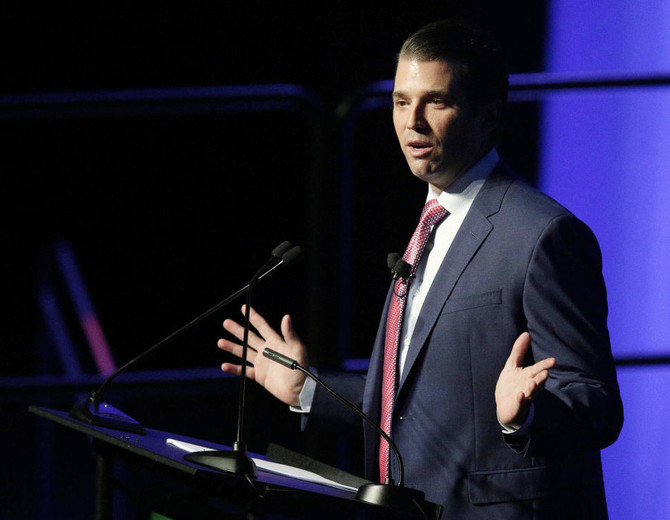
WASHINGTON: President Donald Trump’s oldest son on Monday released a series of private Twitter exchanges between himself and WikiLeaks during and after the 2016 election, including pleas from the website to publicize its leaks.
Donald Trump Jr.’s release of the messages on Twitter came hours after The Atlantic first reported them. In the exchanges — some of them around the time that the website was releasing the stolen emails from Democrat Hillary Clinton’s campaign chairman — WikiLeaks praises his father’s positive comments about WikiLeaks and asks Trump Jr. to release his father’s tax returns to the site.
The revelations are sure to increase calls in Congress to have Trump Jr. testify publicly as part of several committee probes into Russian interference in the 2016 election. And they add a new element to the investigations that have been probing for months whether Trump’s campaign colluded in any way with the Russian government.
In an intelligence assessment released last January, the NSA, CIA and FBI concluded that Russian military intelligence provided hacked information from the DNC and “senior Democratic officials” to WikiLeaks. WikiLeaks has denied that Russia was the source of emails it released, including those from Clinton’s campaign chairman, John Podesta.
The private messages released by Trump Jr. show him responding to the WikiLeaks account three times, at one point agreeing to “ask around” about a political action committee WikiLeaks had mentioned. He also asked the site about a rumor about an upcoming leak. The messages began in September 2016 and ran through July.
Trump Jr. downplayed the exchanges as he released them.
“Here is the entire chain of messages with @wikileaks (with my whopping 3 responses) which one of the congressional committees has chosen to selectively leak,” he tweeted. “How ironic!“
Trump Jr.’s lawyers had released the exchanges to three congressional committees that have been investigating Russian intervention in the 2016 election and whether there were any links to Trump’s campaign.
In a statement, Trump Jr.’s lawyer said thousands of documents had been turned over to the committees.
“Putting aside the question as to why or by whom such documents, provided to Congress under promises of confidentiality, have been selectively leaked, we can say with confidence that we have no concerns about these documents and any questions raised about them have been easily answered in the appropriate forum,” said Alan Futerfas.
Futerfas didn’t say which forum he was referring to, but Trump Jr. was interviewed behind closed doors by Senate Judiciary Committee staff in September. A person familiar with that meeting said the private Twitter messages were discussed. The person declined to be identified because the transcript of that interview hasn’t been made public.
In one message dated Oct. 3, 2016, the WikiLeaks Twitter account sent Trump Jr. an article that included critical comments Clinton had made about WikiLeaks editor Julian Assange and said “it’d be great if you guys could comment on/push this story.”
Trump Jr. replied: “Already did that earlier today. It’s amazing what she can get away with.”
Two minutes later, Trump Jr. sent another message: “What’s behind this Wednesday leak I keep reading about?“
Longtime Trump associate Roger Stone had tweeted the day before that on Wednesday, “Hillary Clinton is done,” referencing WikiLeaks.
The WikiLeaks Twitter account never responded, but days later WikiLeaks started rolling out Podesta’s stolen emails. After the emails were released, WikiLeaks sent Trump Jr. a searchable link of the emails. Trump Jr. tweeted that link two days later, on Oct. 14, 2016, The Atlantic noted.
The rest of the messages are one-sided, with WikiLeaks sending Trump Jr. messages through July 2017. They include praise for his father for mentioning them on the campaign trail, a plea to release Trump’s taxes to the site and advice on Election Day that Trump should not concede if he lost. One message suggested Trump encourage Australia to appoint Assange as US ambassador.
In July, the Twitter account messaged Trump Jr. to ask him to give the site emails surrounding a meeting he and other Trump associates held with Russians during the campaign. Trump Jr. then released them himself.
Vice President Mike Pence responded quickly to the revelations, issuing a statement through his press secretary that he knew nothing about the situation.
“The vice president was never aware of anyone associated with the campaign being in contact with WikiLeaks,” said spokeswoman Alyssa Farah. “He first learned of this news from a published report earlier tonight.”
Assange tweeted after The Atlantic report that he couldn’t confirm the messages but then defended them after Trump Jr. released them.
“WikiLeaks appears to beguile some people into transparency by convincing them that it is in their interest,” Assange tweeted.
Democrats swiftly reacted to the report, saying Trump Jr. should provide more information. California Rep. Adam Schiff, the top Democrat on the House intelligence committee, says it “demonstrates once again a willingness by the highest levels of the Trump campaign to accept foreign assistance.”
Schiff also pointed to Cambridge Analytica, a data firm that worked for Trump’s campaign and reached out to WikiLeaks before the election about obtaining emails related to Clinton, according to the company’s CEO.
Democratic Sen. Richard Blumenthal, a member of the Senate Judiciary Committee, said that panel should subpoena the documents and force Trump Jr. to publicly testify.
“There seems to be no reasonable explanation for these messages,” Blumenthal said.
Senate Judiciary Committee Chairman Chuck Grassley had said he would call Trump Jr. to publicly testify after the private interview in September. But negotiations over witnesses broke down last month amid disagreements with Democrats on the panel.
The House and Senate intelligence committees are also expecting to interview Trump Jr., but those interviews are expected to be behind closed doors.

Trump Jr. messaged with WikiLeaks during 2016 campaign
Afghan returnees in Bamiyan struggle despite new homes
- More than five million Afghans have returned home since September 2023, according to the International Organization for Migration
BAMIYAN, Afghanistan: Sitting in his modest home beneath snow-dusted hills in Afghanistan’s Bamiyan province, Nimatullah Rahesh expressed relief to have found somewhere to “live peacefully” after months of uncertainty.
Rahesh is one of millions of Afghans pushed out of Iran and Pakistan, but despite being given a brand new home in his native country, he and many of his recently returned compatriots are lacking even basic services.
“We no longer have the end-of-month stress about the rent,” he said after getting his house, which was financed by the UN refugee agency on land provided by the Taliban authorities.
Originally from a poor and mountainous district of Bamiyan, Rahesh worked for five years in construction in Iran, where his wife Marzia was a seamstress.
“The Iranians forced us to leave” in 2024 by “refusing to admit our son to school and asking us to pay an impossible sum to extend our documents,” he said.
More than five million Afghans have returned home since September 2023, according to the International Organization for Migration (IOM), as neighboring Iran and Pakistan stepped up deportations.
The Rahesh family is among 30 to be given a 50-square-meter (540-square-foot) home in Bamiyan, with each household in the nascent community participating in the construction and being paid by UNHCR for their work.
The families, most of whom had lived in Iran, own the building and the land.
“That was crucial for us, because property rights give these people security,” said the UNHCR’s Amaia Lezertua.
Waiting for water
Despite the homes lacking running water and being far from shops, schools or hospitals, new resident Arefa Ibrahimi said she was happy “because this house is mine, even if all the basic facilities aren’t there.”
Ibrahimi, whose four children huddled around the stove in her spartan living room, is one of 10 single mothers living in the new community.
The 45-year-old said she feared ending up on the street after her husband left her.
She showed AFP journalists her two just-finished rooms and an empty hallway with a counter intended to serve as a kitchen.
“But there’s no bathroom,” she said. These new houses have only basic outdoor toilets, too small to add even a simple shower.
Ajay Singh, the UNHCR project manager, said the home design came from the local authorities, and families could build a bathroom themselves.
There is currently no piped water nor wells in the area, which is dubbed “the dry slope” (Jar-e-Khushk).
Ten liters of drinking water bought when a tanker truck passes every three days costs more than in the capital Kabul, residents said.
Fazil Omar Rahmani, the provincial head of the Ministry of Refugees and Repatriation Affairs, said there were plans to expand the water supply network.
“But for now these families must secure their own supply,” he said.
Two hours on foot
The plots allocated by the government for the new neighborhood lie far from Bamiyan city, which is home to more than 70,000 people.
The city grabbed international attention in 2001, when the Sunni Pashtun Taliban authorities destroyed two large Buddha statues cherished by the predominantly Shia Hazara community in the region.
Since the Taliban government came back to power in 2021, around 7,000 Afghans have returned to Bamiyan according to Rahmani.
The new project provides housing for 174 of them. At its inauguration, resident Rahesh stood before his new neighbors and addressed their supporters.
“Thank you for the homes, we are grateful, but please don’t forget us for water, a school, clinics, the mobile network,” which is currently nonexistent, he said.
Rahmani, the ministry official, insisted there were plans to build schools and clinics.
“There is a direct order from our supreme leader,” Hibatullah Akhundzada, he said, without specifying when these projects will start.
In the meantime, to get to work at the market, Rahesh must walk for two hours along a rutted dirt road between barren mountains before he can catch a ride.
Only 11 percent of adults found full-time work after returning to Afghanistan, according to an IOM survey.
Ibrahimi, meanwhile, is contending with a four-kilometer (2.5-mile) walk to the nearest school when the winter break ends.
“I will have to wake my children very early, in the cold. I am worried,” she said.
Rahesh is one of millions of Afghans pushed out of Iran and Pakistan, but despite being given a brand new home in his native country, he and many of his recently returned compatriots are lacking even basic services.
“We no longer have the end-of-month stress about the rent,” he said after getting his house, which was financed by the UN refugee agency on land provided by the Taliban authorities.
Originally from a poor and mountainous district of Bamiyan, Rahesh worked for five years in construction in Iran, where his wife Marzia was a seamstress.
“The Iranians forced us to leave” in 2024 by “refusing to admit our son to school and asking us to pay an impossible sum to extend our documents,” he said.
More than five million Afghans have returned home since September 2023, according to the International Organization for Migration (IOM), as neighboring Iran and Pakistan stepped up deportations.
The Rahesh family is among 30 to be given a 50-square-meter (540-square-foot) home in Bamiyan, with each household in the nascent community participating in the construction and being paid by UNHCR for their work.
The families, most of whom had lived in Iran, own the building and the land.
“That was crucial for us, because property rights give these people security,” said the UNHCR’s Amaia Lezertua.
Waiting for water
Despite the homes lacking running water and being far from shops, schools or hospitals, new resident Arefa Ibrahimi said she was happy “because this house is mine, even if all the basic facilities aren’t there.”
Ibrahimi, whose four children huddled around the stove in her spartan living room, is one of 10 single mothers living in the new community.
The 45-year-old said she feared ending up on the street after her husband left her.
She showed AFP journalists her two just-finished rooms and an empty hallway with a counter intended to serve as a kitchen.
“But there’s no bathroom,” she said. These new houses have only basic outdoor toilets, too small to add even a simple shower.
Ajay Singh, the UNHCR project manager, said the home design came from the local authorities, and families could build a bathroom themselves.
There is currently no piped water nor wells in the area, which is dubbed “the dry slope” (Jar-e-Khushk).
Ten liters of drinking water bought when a tanker truck passes every three days costs more than in the capital Kabul, residents said.
Fazil Omar Rahmani, the provincial head of the Ministry of Refugees and Repatriation Affairs, said there were plans to expand the water supply network.
“But for now these families must secure their own supply,” he said.
Two hours on foot
The plots allocated by the government for the new neighborhood lie far from Bamiyan city, which is home to more than 70,000 people.
The city grabbed international attention in 2001, when the Sunni Pashtun Taliban authorities destroyed two large Buddha statues cherished by the predominantly Shia Hazara community in the region.
Since the Taliban government came back to power in 2021, around 7,000 Afghans have returned to Bamiyan according to Rahmani.
The new project provides housing for 174 of them. At its inauguration, resident Rahesh stood before his new neighbors and addressed their supporters.
“Thank you for the homes, we are grateful, but please don’t forget us for water, a school, clinics, the mobile network,” which is currently nonexistent, he said.
Rahmani, the ministry official, insisted there were plans to build schools and clinics.
“There is a direct order from our supreme leader,” Hibatullah Akhundzada, he said, without specifying when these projects will start.
In the meantime, to get to work at the market, Rahesh must walk for two hours along a rutted dirt road between barren mountains before he can catch a ride.
Only 11 percent of adults found full-time work after returning to Afghanistan, according to an IOM survey.
Ibrahimi, meanwhile, is contending with a four-kilometer (2.5-mile) walk to the nearest school when the winter break ends.
“I will have to wake my children very early, in the cold. I am worried,” she said.
© 2026 SAUDI RESEARCH & PUBLISHING COMPANY, All Rights Reserved And subject to Terms of Use Agreement.