After Kenya vote drama, secessionist talk enters mainstream

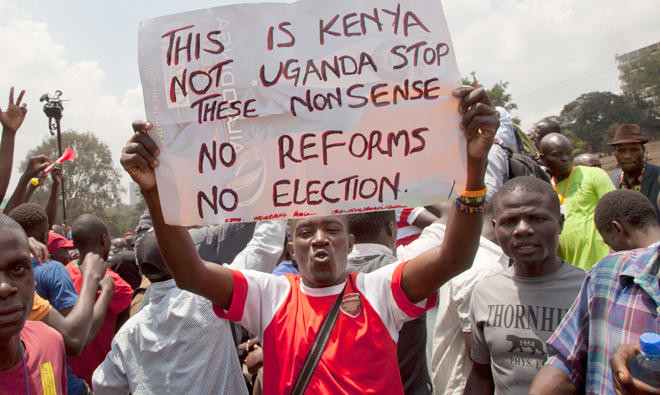
Opposition activists demonstrate in Nairobi, Kenya, in this file photo. (AP)
Updated 08 November 2017
Follow

After Kenya vote drama, secessionist talk enters mainstream

JOHANNESBURG, South Africa: During Kenya’s election upheaval, a few protesters displayed images of the flag of the “People’s Republic of Kenya,” a notional breakaway state. Some posted online images of Kenya divided into two nations along ethnic lines, reflecting a growing sense of marginalization in some opposition strongholds despite some progress in allocating more rights and resources to aggrieved communities.
In another new challenge, Mombasa Gov. Hassan Joho, another governor and more than a dozen lawmakers have revived old calls for coastal counties to secede, alleging discrimination by the national government since Kenya’s independence from British rule in 1963. Critics have dismissed the call as political posturing in the wake of President Uhuru Kenyatta’s disputed election win on Oct. 26, but the rhetoric highlights the skepticism of some Kenyans about the unity of one of Africa’s most influential nations.
However unlikely, secession is “an idea that was extremely marginal, and now it’s gone mainstream,” said Abdullahi Boru, a political analyst in Kenya.
Recent independence bids in Spain’s Catalonia region and Iraq’s autonomous Kurdish area ran up against the power of the state, and the bloodshed that accompanied the path to statehood in African nations, including Eritrea and South Sudan, is a measure of the toll of some secessionist bids.
Separatists in Kenya are likely to encounter immense political pressures, legal obstacles and a possible crackdown by security forces even if they can organize effectively. Meanwhile, Kenyan officials note, even counties where opposition thrives continue to work with the capital, Nairobi, on development and other projects spurred by a 2010 constitution that seeks to give local areas more clout and funding.
Secession is a rallying cry in the camp of opposition leader Raila Odinga, an ethnic Luo who boycotted the October election after challenging the victory of Kenyatta, a Kikuyu, in an August vote nullified by the Supreme Court because of flaws. Odinga has said he is forming a peaceful “resistance movement.”
The October election is also being challenged in court. Odinga says yet another vote should be held within 90 days, capitalizing on the frustration of supporters who say Kikuyus and their Kalenjin allies have dominated the country for too long.
“Let them divide Kenya into two” if another election is not held, said Veronica Akoth, an Odinga supporter in the western city of Kisumu, an opposition stronghold. Some Kisumu protesters have chanted, “Kisumu si Kenya,” which means “Kisumu is not Kenya” in Swahili.
The slogan is a variation on “The Coast is not Kenya,” a saying that maintains coastal communities are different from the rest of the East African nation, partly because of their history as a territory under the authority of Zanzibar’s sultanate.
Joho, the governor of Mombasa County that includes the major Indian Ocean port of the same name, belongs to an opposition coalition formed by Odinga. He and his allies have indicated that their secession campaign would be lengthy, requiring consultations with community leaders. However, the governors of four out of six coastal counties have not joined Joho’s call.
Secessionist violence plagued Kenya shortly after independence, when security forces fought Somali insurgents seeking to join with neighboring Somalia. In the late 1990s, opposition leader Mwai Kibaki suggested secession for central Kenya after an election period marred by violence. Kibaki was elected president in 2002 and became a staunch advocate of the Kenyan state.
“At the core of the call for secession is the failure by successive governments to address the issues of historical land injustices, exclusion from development, etc. Historically, presidents in Kenya often rewarded those loyal to them with development and those who showed any signs or forms of dissent with exclusion,” Natasha Kimani, an analyst at the Chatham House research center in Britain, wrote in an email to The Associated Press.
The idea of secession, however, is unlikely to take root because Kenyans have largely embraced decentralization, seeing it “as a way to bring resources and services closer to the people,” Kimani said. She cited development successes in “marginalized areas” such as Turkana, Marsabit, Mandera and Lamu.
Kenya’s election turmoil, including violence that left dozens dead, created a “very polarized and ethnically divided environment that we haven’t seen for quite a long time,” said John Tomaszewski, regional director for Africa at the Washington-based International Republican Institute. But he doubted that secession can succeed in the near term, saying: “I don’t see that we’re at a stage yet where something like this could be carried out.”


Reference to Trump’s impeachments is removed from the display of his Smithsonian photo portrait

Updated 12 January 2026
Follow

Reference to Trump’s impeachments is removed from the display of his Smithsonian photo portrait

  • For now, references to Presidents Andrew Johnson and Bill Clinton being impeached in 1868 and 1998, respectively, remain as part of their portrait labels, as does President Richard Nixon’s 1974 resignation as a result of the Watergate scandal

WASHINGTON: President Donald Trump’s photo portrait display at the Smithsonian’s National Portrait Gallery has had references to his two impeachments removed, the latest apparent change at the collection of museums he has accused of bias as he asserts his influence over how official presentations document US history.
The wall text, which summarized Trump’s first presidency and noted his 2024 comeback victory, was part of the museum’s “American Presidents” exhibition. The description had been placed alongside a photograph of Trump taken during his first term. Now, a different photo appears without any accompanying text block, though the text was available online. Trump was the only president whose display in the gallery, as seen Sunday, did not include any extended text.
The White House did not say whether it sought any changes. Nor did a Smithsonian statement in response to Associated Press questions. But Trump ordered in August that Smithsonian officials review all exhibits before the nation celebrates the 250th anniversary of the Declaration of Independence on July 4. The Republican administration said the effort would “ensure alignment with the president’s directive to celebrate American exceptionalism, remove divisive or partisan narratives, and restore confidence in our shared cultural institutions.”
Trump’s original “portrait label,” as the Smithsonian calls it, notes Trump’s Supreme Court nominations and his administration’s development of COVID-19 vaccines. That section concludes: “Impeached twice, on charges of abuse of power and incitement of insurrection after supporters attacked the US Capitol on January 6, 2021, he was acquitted by the Senate in both trials.”
Then the text continues: “After losing to Joe Biden in 2020, Trump mounted a historic comeback in the 2024 election. He is the only president aside from Grover Cleveland (1837– 1908) to have won a nonconsecutive second term.”
Asked about the display, White House spokesman Davis Ingle celebrated the new photograph, which shows Trump, brow furrowed, leaning over his Oval Office desk. Ingle said it ensures Trump’s “unmatched aura ... will be felt throughout the halls of the National Portrait Gallery.”
The portrait was taken by White House photographer Daniel Torok, who is credited in the display that includes medallions noting Trump is the 45th and 47th president. Similar numerical medallions appear alongside other presidents’ painted portraits that also include the more extended biographical summaries such as what had been part of Trump’s display.
Sitting presidents are represented by photographs until their official paintings are commissioned and completed.
Ingle did not answer questions about whether Trump or a White House aide, on his behalf, asked for anything related to the portrait label.
The gallery said in a statement that it had previously rotated two photographs of Trump from its collection before putting up Torok’s work.
“The museum is beginning its planned update of the America’s Presidents gallery which will undergo a larger refresh this Spring,” the gallery statement said. “For some new exhibitions and displays, the museum has been exploring quotes or tombstone labels, which provide only general information, such as the artist’s name.”
For now, references to Presidents Andrew Johnson and Bill Clinton being impeached in 1868 and 1998, respectively, remain as part of their portrait labels, as does President Richard Nixon’s 1974 resignation as a result of the Watergate scandal.
And, the gallery statement noted, “The history of Presidential impeachments continues to be represented in our museums, including the National Museum of American History.”
Trump has made clear his intentions to shape how the federal government documents US history and culture. He has offered an especially harsh assessment of how the Smithsonian and other museums have featured chattel slavery as a seminal variable in the nation’s development but also taken steps to reshape how he and his contemporary rivals are depicted.
In the months before his order for a Smithsonian review, he fired the head archivist of the National Archives and said he was firing the National Portrait Gallery’s director, Kim Sajet, as part of his overhaul. Sajet maintained the backing of the Smithsonian’s governing board, but she ultimately resigned.
At the White House, Trump has designed a notably partisan and subjective “Presidential Walk of Fame” featuring gilded photographs of himself and his predecessors — with the exception of Biden, who is represented by an autopen — along with plaques describing their presidencies.
The White House said at the time that Trump himself was a primary author of the plaques. Notably, Trump’s two plaques praise the 45th and 47th president as a historically successful figure while those under Biden’s autopen stand-in describe the 46th executive as “by far, the worst President in American History” who “brought our Nation to the brink of destruction.”