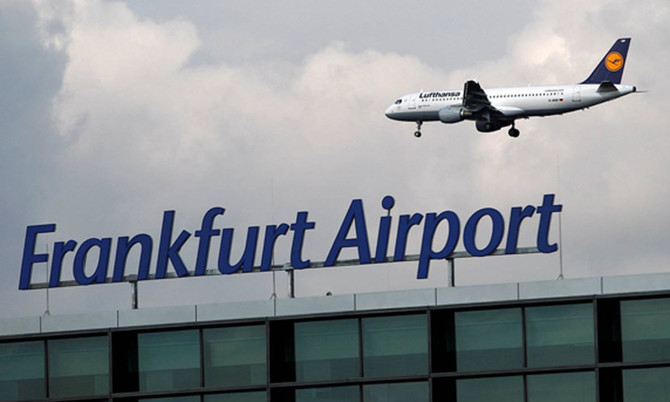
Lufthansa, Ryanair to drive Frankfurt passenger numbers this winter

Fraport has been wooing low-cost airlines to boost passenger numbers, although a row has broken out with its largest customer Lufthansa over discounts offered to Ryanair. (Reuters)
Updated 02 November 2017
Follow

Lufthansa, Ryanair to drive Frankfurt passenger numbers this winter

BERLIN: Airport operator Fraport expects passenger numbers at Frankfurt airport to rise around 5 percent this year, with Lufthansa and Ryanair set to bring the strongest growth in destinations and passenger volumes this winter.
Fraport has been wooing low-cost airlines to boost passenger numbers, although a row has broken out with its largest customer Lufthansa over discounts offered to Ryanair. The two are currently in talks over ways to bring down costs for Lufthansa, which also owns an 8.4 percent stake in Fraport.
Passengers numbers at Frankfurt rose 6.3 percent in October, taking year-to-date growth to 4.8 percent, Fraport said as it reported in-line third-quarter core profit.
“We are also achieving solid growth in Frankfurt again, where we made the necessary strategic decisions at the right time,” Fraport Chief Executive Stefan Schulte said in a statement.
Still, low-cost carriers currently account for only 2.8 percent of traffic at Frankfurt. The DLR German aerospace center said in a study last month that low-cost carriers made up 25 percent of traffic from German airports this summer.
Fraport on Thursday reported third-quarter earnings before interest, tax, depreciation and amortization of €387.7 million, in line with the average estimate in a Reuters poll.
However, net retail revenue per passenger at Frankfurt dropped 4.7 percent to €3.02 in the quarter, which Fraport said was partly due to the euro’s strength against some currencies but also because it saw a stronger increase in European traffic in the period. Customers on European routes tend to spend less than long-haul passengers.
Fraport maintained a forecast for 2017 core profit of about €980 million to €1.02 billion. Analysts on average expect €1.013 billion, down 3.9 percent on last year.


India and US release a framework for an interim trade agreement to reduce Trump tariffs

Updated 58 min 25 sec ago
Follow

India and US release a framework for an interim trade agreement to reduce Trump tariffs

  • Under the deal, tariffs on goods from India would be lowered to 18 percent, from 25 percent, after Indian Prime Minister Narendra Modi agreed to stop buying Russian oil, Trump had said.

NEW DELHI: India and the United States released a framework for an interim trade agreement to lower tariffs on Indian goods, which Indian opposition accused of favoring Washington.
The joint statement, released Friday, came after US President Donald Trump announced his plan last week to reduce import tariffs on the South Asian country, six months after imposing steep taxes to press New Delhi to cut its reliance on cheap Russian crude.
Under the deal, tariffs on goods from India would be lowered to 18 percent, from 25 percent, after Indian Prime Minister Narendra Modi agreed to stop buying Russian oil, Trump had said.
The two countries called the agreement “reciprocal and mutually beneficial” and expressed commitment to work toward a broader trade deal that “will include additional market access commitments and support more resilient supply chains.” The framework said that more negotiations will be needed to formalize the agreement.
India would also “eliminate or reduce tariffs” on all US industrial goods and a wide range of food and agricultural products, Friday’s statement said.
The US president had said that India would start to reduce its import taxes on US goods to zero and buy $500 billion worth of American products over five years, part of the Trump administration’s bid to seek greater market access and zero tariffs on almost all American exports.
Trump also signed an executive order on Friday to revoke a separate 25 percent tariff on Indian goods he imposed last year.
Indian Prime Minister Narendra Modi thanked Trump “for his personal commitment to robust ties.”
“This framework reflects the growing depth, trust and dynamism of our partnership,” Modi said on social media, adding it will “further deepen investment and technology partnerships between us.”
India’s opposition political parties have largely criticized the deal, saying it heavily favors the US and negatively impacts sensitive sectors such as agriculture. In the past, New Delhi had opposed tariffs on sectors such as agriculture and dairy, which employ the bulk of the country’s population.
Meanwhile, Piyush Goyal, Indian Trade Minister, said the deal protects “sensitive agricultural and dairy products” including maize, wheat, rice, ethanol, tobacco, and some vegetables.
“This (agreement) will open a $30 trillion market for Indian exporters,” Goyal said in a social media post, referring to the US annual GDP. He said the increase in exports was likely to create hundreds of thousands of new job opportunities.
Goyal also said tariffs will go down to zero on a wide range of Indian goods exported to the US, including generic pharmaceuticals, gems and diamonds, and aircraft parts, further enhancing the country’s export competitiveness.
India and the European Union recently reached a free trade agreement that could affect as many as 2 billion people after nearly two decades of negotiations. That deal would enable free trade on almost all goods between the EU’s 27 members and India, covering everything from textiles to medicines, and bringing down high import taxes for European wine and cars.
India also signed a comprehensive economic partnership agreement with Oman in December and concluded talks for a free trade deal with New Zealand.