

Not Italy’s Devil’s Island: Sardinia bristles at mafia inmate plan

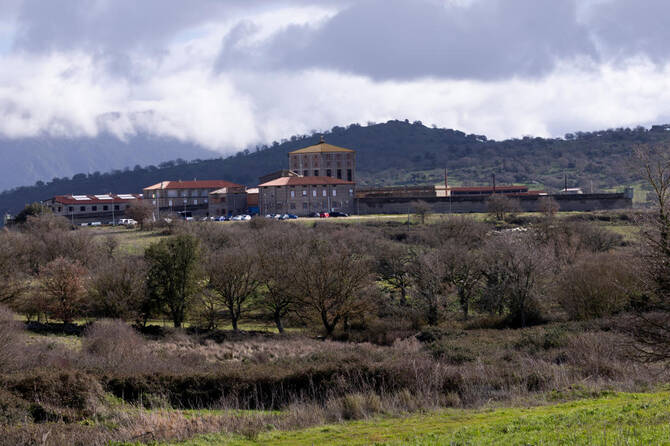
Above, Clouds move over the Badu’e Carros prison in Nuoro on Feb. 1, 2026. Sardinia is no longer seen as a dumping ground for criminals, instead building an international reputation around tourism, but that could change soon. (Reuters)
Short Url
Updated 07 February 2026
Follow

Not Italy’s Devil’s Island: Sardinia bristles at mafia inmate plan

  • A third of top-risk mafia prisoners could go to Sardinia
  • Officials say clans may follow relatives and infiltrate economy

NUORO: In Nuoro, a remote city on the Italian island of Sardinia, a high stone wall rings the local prison, a fortress-like complex once renowned for holding high-profile mobsters and convicted terrorists far from the mainland.

Only a handful of top mafiosi remain detained there and Sardinia is no longer seen as a dumping ground for criminals, instead building an international reputation around tourism.

But that could change under a plan of Prime Minister Giorgia Meloni’s government which has alarmed residents. In December, a justice undersecretary said about 750 prisoners held under the rigid “41bis” regime would be concentrated in just a few dedicated facilities across Italy, overseen by special guard units to improve security.

Sardinia has been told it may get nearly a third of them, split between Sassari in the north, already housing about 90, the capital Cagliari, where around 90 are due to arrive this month, and Nuoro — reviving old stigma concerns.

“Sardinia does not deserve to be seen as Italy’s Cayenne,” said Governor Alessandra Todde, invoking the notorious former French Guiana penal colony on Devil’s Island.

Worries of Mafia infiltration

Italy’s 41bis regime, named after the law that regulates it, is among the most restrictive in Europe. Introduced in 1992 after the murder of anti-mafia ‌judge Giovanni Falcone, ‌it imposes near-total isolation on prisoners and was designed to stop bosses running their operations from behind ‌bars.

The ⁠law says it should “preferably” ‌be enforced on Italy’s islands. The late boss of the Sicilian mafia, Salvatore “Toto” Riina, was among those once held in Sardinia.

Locals and authorities fear the government plan could prompt mafia clans to move from mainland Italy to be near jailed relatives, creating opportunities to launder illicit money and infiltrate business, particularly in less developed areas, such as Nuoro, a city of 30,000 people.

Silvio Lai, a Sardinian lawmaker with the opposition Democratic Party, visited the city prison last month and said renovation work was already ongoing, potentially making room for at least 30 new maximum-security inmates.

“Weak economies can be infiltrated easily, and Nuoro is about an hour’s drive from the Costa Smeralda,” Lai said, suggesting a mafia foothold in the city could swiftly spread to the island’s luxurious tourist resort.

The Justice Ministry did not respond to a request to comment on the work.

Improving ⁠national security

Autonomous mafia groups have never emerged in sparsely populated Sardinia, but magistrates say investigations have been opened into alleged clan penetration in the north of the island, possibly encouraged by the presence of detained ‌mobsters.

“Prosecutors are keeping a close watch on the phenomenon of Camorra (a mafia group based around Naples) ‍investments... especially in the tourism, hospitality and restaurant sectors,” said Cagliari chief prosecutor ‍Luigi Patronaggio.

At a December meeting with regional officials, Justice Undersecretary Andrea Delmastro Delle Vedove downplayed the risk of a mass move to Sardinia, minutes show, ‍arguing that families of 41bis detainees do not typically leave clan-controlled areas.

“This (plan) will ensure greater national security... will make individual prisons safer because only specialized prison guard units will be deployed,” Delmastro said.

However, Maria Cristina Ornano, head of the sentence enforcement tribunal in Cagliari, said police and the judiciary will need increased security resources if more mobsters arrive.

“Once organized crime takes root here, we will not be able to get rid of it. We can see it in parts of southern Italy, which are among the most


Cambodia takes back looted historic artifacts handled by British art dealer

Updated 28 February 2026
Follow

Cambodia takes back looted historic artifacts handled by British art dealer

  • The objects were returned under a 2020 agreement between the Ministry of Culture and Fine Arts and the family of the late Douglas Latchford, a British art collector and dealer who allegedly had the items smuggled out of Cambodia

PHNOM PENH, Cambodia: Cambodian officials on Friday received more than six dozen historic artifacts described as part of the country’s cultural heritage that had been looted during decades of war and instability.
At a ceremony attended by Deputy Prime Minister Hun Many, the 74 items were unveiled at the National Museum in Phnom Penh after their repatriation from the United Kingdom.
The objects were returned under a 2020 agreement between the Ministry of Culture and Fine Arts and the family of the late Douglas Latchford, a British art collector and dealer who allegedly had the items smuggled out of Cambodia.
“This substantial restitution represents one of the most important returns of Khmer cultural heritage in recent years, following major repatriations in 2021 and 2023 from the same collection,” the Culture Ministry said in a statement. “It marks a significant step forward in Cambodia’s continued efforts to recover, preserve, and restore its ancestral legacy for future generations.”
The artifacts were described as dating from the pre-Angkorian period through the height of the Angkor Empire, including “monumental sandstone sculptures, refined bronze works, and significant ritual objects.” The Angkor Empire, which extended from the ninth to the 15th century, is best known for the Angkor Wat archaeological site, the nation’s biggest tourist attraction.
Latchford was a prominent antiquities dealer who allegedly orchestrated an operation to sell looted Cambodian sculptures on the international market.
From 1970 to the 1980s, during Cambodia’s civil wars and the communist Khmer Rouge ‘s brutal reign, organized looting networks sent artifacts to Latchford, who then sold them to Western collectors, dealers, and institutions. These pieces were often physically damaged, having been pried off temple walls or other structures by the looters.
Latchford was indicted in a New York federal court in 2019 on charges including wire fraud and conspiracy. He died in 2020, aged 88, before he could be extradited to face charges.
Cambodia, like neighboring Thailand, has benefited from a trend in recent decades involving the repatriation of art and archaeological treasures. These include ancient Asian artworks as well as pieces lost or stolen during turmoil in places such as Syria, Iraq and Nazi-occupied Europe. New York’s Metropolitan Museum of Art is one of the prominent institutions that has been returning illegally smuggled art, including to Cambodia.
“The ancient artifacts created and preserved by our ancestors are now being returned to Cambodia, bringing warmth and joy, following the country’s return to peace,” said Hun Many, who is the younger brother of Prime Minister Hun Manet.