

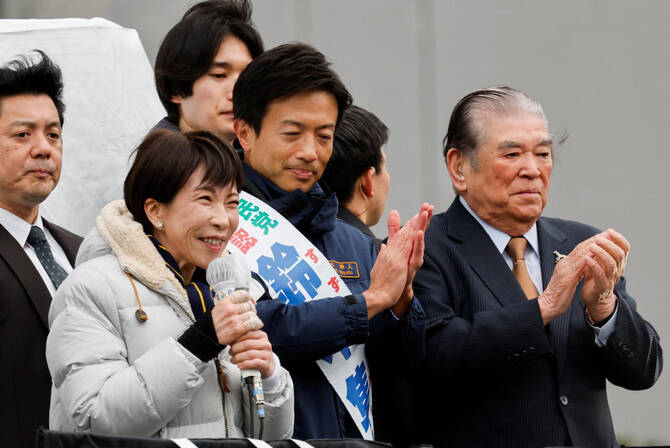

TOKYO: Prime Minister Sanae Takaichi pledged Saturday to make Japan “more prosperous and safer,” including through tougher immigration screening, in a final appeal to voters on the eve of snap elections.
Opinion polls suggest that Takaichi’s ruling bloc, led by the Liberal Democratic Party, could romp home in Sunday’s vote and secure a two-thirds majority in the powerful lower house.
“Pushing the button for growth is the Takaichi cabinet’s job. Japan will become more and more prosperous and safer,” Takaichi, 64, told a campaign rally attended by thousands in Tokyo.
“This is the year in which we want to turn the anxieties people feel about their lives today and about the future into hope,” she said.
The arch-conservative Takaichi, a heavy metal drummer in her youth and an admirer of Margaret Thatcher, became Japan’s fifth premier in as many years in October.
This followed a string of calamitous elections for the once-mighty Liberal Democratic Party (LDP), leaving it short of a majority in both houses of parliament.
With ordinary Japanese, especially younger ones, Takaichi has enjoyed sky-high popularity ratings, becoming something of a fashion icon and a hit on social media.
Her tough talk on immigration appears, for now, to have slowed the sharp rise of the populist “Japanese first” Sanseito party, which did well in upper house elections last year.
Immigration screening “has already become a little stricter, so that terrorists, and also industrial spies, cannot enter easily,” Takaichi said Saturday.
“We must properly examine whether (foreigners) are paying taxes, whether they are paying their health insurance premiums,” Takaichi said.
She added that she wanted “a Japanese archipelago where, no matter where you live, you can live safely, where you can receive the medical care and welfare support you need, where you can receive high-quality education, and where proper workplaces and jobs exist.”
“But in order to do that, we have to make the economy stronger. Healthcare costs money. Welfare costs money. Education also requires investment. So we must build a strong economy,” she said.
‘Strong mandate’
Surveys ahead of the election indicate — with some caution due to undecided voters — that the LDP will easily win more than the 233 seats needed to regain a majority.
Together with the LDP’s coalition partner, the Japan Innovation Party (JIP), Takaichi’s ruling bloc could even win a two-thirds majority.
The last time this happened was in 2017 under assasisinated ex-premier Shinzo Abe — Takaichi’s mentor.
The new Centrist Reform Alliance of the main opposition Constitutional Democratic Party (CDP) and the LDP’s previous partner Komeito could shed half of their 167 seats.
“I came just to have a look at her. I think she is amazing,” said Yuka Ando, 17, a high-school student who came with her mother to the rally despite the cold weather that has dumped heavy snow across northern Japan.
“As she is the first woman PM, it makes her look special, too. Thanks to her, I became interested in politics,” Ando told AFP.
Jeff Kingston, professor of history at Temple University Japan, told AFP he expects Takaichi’s gamble of calling elections to pay off.
“She will gain a strong mandate and probably a standalone majority that will help her enact an ambitious array of economic and security reforms,” he said.
China watching
China though, will be watching.
When she was barely two weeks in office, Takaichi suggested that Japan would intervene militarily if Beijing sought to take self-ruled Taiwan by force.
China has never ruled democratic Taiwan, but Beijing claims the island as part of its territory and has not ruled out force to annex it.
China summoned Tokyo’s ambassador, warned its citizens against visiting Japan and conducted joint air drills with Russia around the archipelago.
Takaichi’s economic policies, including a $135-billion stimulus package, have also worried investors.
Last month, yields on long-term Japanese bonds hit record highs after Takaichi pledged temporarily to exempt food from a consumption tax to ease the pain of inflation on households.


