BAGHDAD: Iraq’s prime minister on Monday called for calm in the self-ruled northern Kurdish region after rioting the previous night following the Kurdish regional president’s decision to effectively step down.
In his statement, Prime Minister Haider Al-Abadi said the central government is closely monitoring what he described as “attempts to create chaos and disorder” in Irbil and Dahuk, two cities in the Kurdish region.
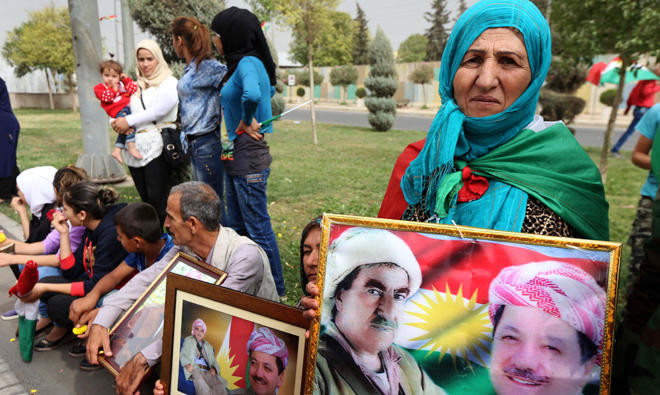
On Sunday, Kurdish leader Masoud Barzani told the regional Parliament in a letter read to lawmakers that he would not seek re-election after last month’s controversial Kurdish independence referendum that he had spearheaded sparked a crisis with Baghdad and neighboring countries.
As the Kurdish regional Parliament was discussing Barzani’s request to have his powers dissolved, dozens of his supporters rioted outside, apparently angry over the developments and trying to express their support for him.
The protesters broke into the assembly and attacked lawmakers and journalists until the police subdued them. They also attacked an office of a rival political party and an opposition TV station.
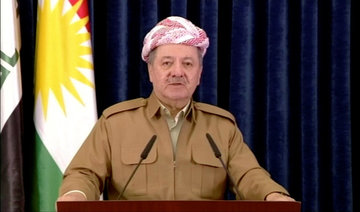
Barzani in a televised speech Sunday addressed the Kurdish region, his first appearance since the crisis erupted.
He blamed the central government in Baghdad, which had dismissed the Kurdish vote as illegal, accusing it of escalating tensions. He also lambasted rival Kurdish political parties and said they were guilty of “treason,” referring to Patriotic Union of Kurdistan (PUK) which had allegedly struck a deal with Baghdad to withdraw Kurdish forces from the disputed oil-rich city of Kirkuk, retaken by Iraqi forces earlier this month.
The PUK, the Movement for Change and Gorran said in separate statements several of their offices in the Duhok region, north of the Kurdish capital Irbil, were looted or burned overnight. No casualties were reported.
The semi-autonomous Kurdistan Regional Government (KRG) in northern Iraq said it had ordered the local police forces, known as Asayish, to stop the attacks.
The Iraqi body in charge of supervising media in Baghdad issued on Sunday a ban on two major Kurdish TV channels close to Barzani’s KDP: Rudaw and Kurdistan 24.
The Baghdad-based Communication and Media Commission accused the two networks of “inciting violence and hatred.”
“This is an assault on freedom of press and expression,” replied Irbil-based Kurdistan 24’s management in a letter to the International Federation of Journalists.
Rudaw accused Iranian-backed Iraqi paramilitaries who are operating alongside government forces on Monday of killing a Kurdish journalist, Arkan Sharif, in the region of Kirkuk.
Barzani’s request, which was approved by the regional Parliament late Sunday, was to distribute his presidential powers among the Kurdish prime minister, the Kurdish Parliament and the judiciary.
The move prompted speculation on whether it was Barzani’s exit from politics but his senior assistant, Hemin Hawrami, said on Sunday that Barzani “will stay in Kurdish politics and lead the high political council,” though as of Nov. 1, he will no longer be president of the region.
Kurdish presidential elections that were due in November have been postponed indefinitely.
“We call for adhering to the law and for calm,” Al-Abadi said from Baghdad, adding that the “political differences” on display in the Kurdish region should not negatively impact the Kurdish citizens of Iraq.
Iran said it will reopen all its border crossings with Iraq’s Kurdistan region in the coming days, lifting restrictions imposed after last month’s vote, its chief of staff said on Monday.
“Border restrictions between Iran and Iraq’s Kurdish region will be lifted in coming days,” Iran’s Chief of Staff Maj. Gen. Mohammed Baqeri was quoted as saying by ISNA
Tehran already re-opened the Bashmagh crossing last week.
Baqeri also said if Kurdistan implemented its plan to break away from Iraq, “there would be bloodshed in Iraq and neighboring countries would be affected.”
Abadi wants to take control of the border crossings between the Kurdish region and Turkey, Iran and Syria, including one through which an oil export pipeline crosses into Turkey.


![]()
Iraqi PM urges for calm in Kurdish region after riots
Iraqi PM urges for calm in Kurdish region after riots

Latest updates


© 2026 SAUDI RESEARCH & PUBLISHING COMPANY, All Rights Reserved And subject to Terms of Use Agreement.