Palestinian factions agree on committee members to run Gaza

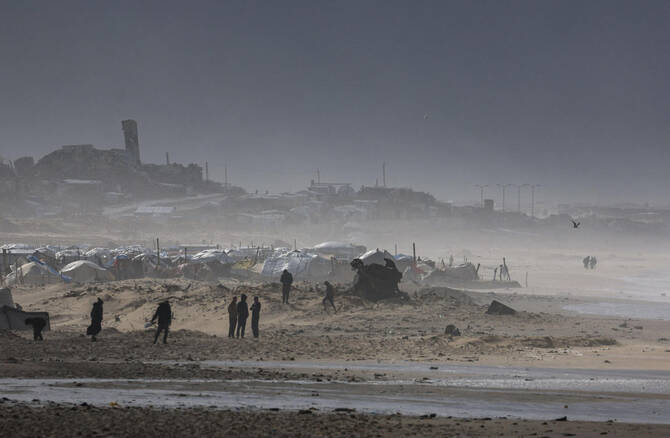
Palestinians gather near tents sheltering displaced people, amid a windstorm, in Gaza City on Tuesday. (Reuters)
Short Url
Updated 14 January 2026
Follow

Palestinian factions agree on committee members to run Gaza

  • Egypt says all Palestinian groups approved make-up of the Palestinian National Transitional Committee
  • The committee will be supervised by the 'Board of Peace,' to be chaired by Trump

CAIRO: : Egypt said Wednesday that all the members of a 15-person Palestinian technocratic committee meant to administer post-war Gaza had been agreed upon by all Palestinian factions, who swiftly offered their support.
Under a 20-point Gaza truce plan brokered by US President Donald Trump in October, the Palestinian territory would be governed by the committee operating under the supervision of a so-called “Board of Peace,” to be chaired by Trump himself.
Hamas officials said earlier in the day that the group had opened talks with Egyptian mediators in Cairo on the committee, which forms part of Trump’s truce plan for Gaza.
“We hope that following this agreement, the committee will be announced soon... and will then be deployed to the Gaza Strip to manage daily life and essential services,” Abdelatty said.
The majority of the Palestinian factions offered their support to the committee after Abdelatty’s announcement.
In a statement, the factions including Hamas and Islamic Jihad said they had agreed “to support the mediators’ efforts in forming the Palestinian National Transitional Committee to administer the Gaza Strip, while providing the appropriate environment” for it to begin its work.
The Ramallah-based Palestinian presidency also announced its support in official media, with a source from the office telling AFP the statement “reflects the position of the Fatah movement because President (Mahmud) Abbas is also the head of Fatah.”
The Cairo meeting aimed to address the formation of the committee and its operational mechanisms, a senior Hamas official had previously told AFP on condition of anonymity.

Potential committee heads

Separately, the Hamas delegation was also to hold talks in Cairo with leaders of other Palestinian factions on “political, national and field developments” and the state of the Gaza ceasefire, the official added.
Hamas has repeatedly said it does not seek a role in any future governing authority in the Palestinian territory, and would limit its role to monitoring governance to ensure stability and facilitate reconstruction.
Talks with Egyptian mediators were also focused on the withdrawal of Israeli forces from Gaza, the reopening of the Rafah crossing, the entry of aid currently stockpiled on the Egyptian side of the border, and preparations for launching the second phase of the ceasefire plan, the official said.
Abdelatty did not name any of the agreed-upon committee members.
But two names circulating as potential heads were Ali Shaath, a former deputy minister of planning in the Palestinian Authority, and Majed Abu Ramadan, the current minister of health, the second official said.
The Trump proposed Board of Peace is expected to be led on the ground by Bulgarian diplomat and politician Nickolay Mladenov, who has recently held talks with Israeli and Palestinian officials.
Mladenov previously served as the United Nations envoy for the Middle East peace process from early 2015 until the end of 2020.
Media reports say Trump is expected to announce the members of the Board of Peace in the coming days, with the body set to include around 15 world leaders.


Sudan Quintet urges ‘those with influence’ to halt weapons flow, deescalate conflict ahead of Ramadan

RSF fighters hold weapons and celebrate in the streets of El-Fasher in Sudan's Darfur. (File/AFP)
Updated 43 min 2 sec ago
Follow

Sudan Quintet urges ‘those with influence’ to halt weapons flow, deescalate conflict ahead of Ramadan

  • Group of 5 organizations condemns ‘increasingly destructive means of warfare’ in Sudan’s civil war, warns that civilians bear the brunt of fighting
  • UN spokesperson describes ‘horrific’ situation on the ground, expresses ‘deep alarm’ at escalating attacks on civilian and humanitarian infrastructure

NEW YORK CITY: A group of five international and regional organizations on Wednesday called for an immediate end to flows of weapons and fighters into Sudan, and for coordinated action to deescalate the war in the country and protect civilians as the third anniversary of the start of the conflict approaches.

The so-called Sudan Quintet — comprising the African Union, the Intergovernmental Authority on Development, the League of Arab States, the EU and the UN — said those with influence over the warring factions must act to “halt the flow of weapons, fighters and other forms of support that sustain violence and contribute to the fragmentation of Sudan.”

In a joint statement, the Quintet expressed “grave concern at the continued escalation of the conflict” and called for “the immediate halting of any further military escalation, including the use of increasingly destructive means of warfare.” Civilians are bearing the brunt of the fighting, it warned.

The conflict began in April 2023 when tensions between rival military factions the Sudanese Armed Forces and the paramilitary Rapid Support Forces escalated into full-scale war in the capital Khartoum and spread across the country.

The war has killed tens of thousands of people; US intelligence officials and independent analysts have suggested the true death toll could be in the hundreds of thousands.

The conflict has also triggered what the UN describes as one of the worst humanitarian crises in the world. More than 33 million people are in need of humanitarian assistance, and more than 13.6 million have been displaced by the fighting, 9.3 million of them within Sudan and about 4.3 million to neighboring countries.

The Quintet said the rapidly deteriorating situation in the Kordofan region and Blue Nile State was particularly alarming, citing reports of deadly drone strikes, the tightening grip of sieges around major population centers, and attacks on critical infrastructure such as hospitals, schools and humanitarian assets.

It also highlighted issues such as forced displacements, severe constraints on humanitarian access, and attacks on aid convoys. These developments “underscore the urgency of immediate action to prevent atrocities,” it said.

Recalling “the horrors witnessed in El-Fasher” and earlier warnings that went unheeded, the Quintet said civilians “must no longer bear the cost of ongoing hostilities.” The organizations stressed that the protection of civilians and critical infrastructure was a fundamental obligation under international law, and that the principles of international humanitarian law applies to all parties to the conflict.

“Civilians and civilian infrastructure must be protected, international humanitarian law must be respected, and safe, rapid and unhindered humanitarian access to all areas in need must be ensured,” they said.

“Serious violations of international humanitarian law cannot go unaddressed,” they added, and perpetrators must be held accountable.

With the start of the holy month of Ramadan only a week away, the Quintet urged all sides to embrace efforts to broker a humanitarian truce and “immediately deescalate hostilities” so as to prevent further loss of life and enable life-saving assistance to reach those in need.

The organizations reaffirmed their commitment to the sovereignty, unity and territorial integrity of Sudan, and said they remain committed to efforts to facilitate a Sudanese-owned, inclusive political dialogue with the aim of ending the war and paving the way for a peaceful political transition.

The situation on the ground in Sudan continues to be “horrific,” UN spokesperson Stephane Dujarric said on Wednesday as he expressed “deep alarm” at “the escalating attacks that we’re seeing in the country, where aerial strikes are placing civilians at grave risk and directly hitting humanitarian and public infrastructure.”

A drone strike on a mosque in the city of Al-Rahat in North Kordofan state at dawn on Wednesday killed two children and injured 13, all of them students attending a school at the mosque.

This followed drone strikes on a primary school in the town of Dilling in South Kordofan late on Tuesday, where injuries were also reported. The same night, a World Food Programme warehouse in Kadugli, the state capital of Kordofan, was struck by a suspected rocket attack that caused significant damage to buildings and mobile storage units.

In recent days drone strikes been reported in other parts of South Kordofan, North Kordofan and West Kordofan, Dujarric said, all of them close to key supply routes connecting the city of El-Obeid in North Kordofan with Dilling and Kadugli in South Kordofan.

“This is endangering civilians, including humanitarian workers,” Dujarric told reporters in New York. “The fact that we have to reiterate almost every day that civilians, civilian infrastructure, places of worship, schools and hospitals cannot and should not be targeted is a tragedy unto itself.

“Yet we have to keep reminding the parties of this almost every day, and that they need to respect international humanitarian law amid these deeply concerning developments.”