Iceland heads to coalition talks after vote; Populists gain

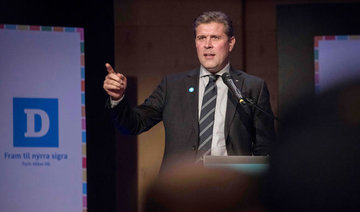
The ruling Independence Party took the largest share of the vote in the Iceland’s parliamentary election. (REUTERS/Geirix)
Updated 29 October 2017
Follow

Iceland heads to coalition talks after vote; Populists gain

REYKJAVIK, Iceland: Iceland’s ruling Independence Party took the largest share of the vote in the island nation’s parliamentary election but faces difficult negotiations to form a new government after populist candidates showed unexpected strength.
A record eight parties won seats in Saturday’s vote as the 2008 global financial crisis continues to roil the island’s politics.
Despite topping the poll, the Independence Party saw its support dip to 25 percent. The three-party governing coalition lost a total of 12 seats, leaving it 11 seats shy of a majority in parliament, known as the Althingi. The opposition Left Green Movement finished second with 17 percent, despite predictions it could win the election.
“Everyone lost,” said political analyst Gunnar Smari Egilsson said. “The current opposition gained no seats while the ruling coalition lost 12 seats. Populists alone triumphed.”
The upstart Center Party and People’s Party both exceeded expectations, winning 11 percent and 7 percent of the vote, respectively, with promises to work for the average Icelander. That proved appealing at a time when many working-class people feel they’ve been left behind by the island’s tourism boom.
Iceland became a poster-child for the global financial meltdown in 2008, when its debt-laden banks collapsed. That triggered political as well as economic chaos on this North Atlantic island of 330,000 people, with around 40 percent of the sitting members of parliament losing their seats in each election since the crisis. The current government, which had been in power only a year, collapsed in September amid allegations that the prime minister’s father backed an effort to help the job prospects of a convicted pedophile.
Voters took to social media Sunday to lament the country’s third government in four years — though some joked that the position of prime minister was probably the most unstable job in the gig economy.
Tourism has bolstered Iceland’s economy in recent years, largely because of the publicity surrounding the 2010 eruption of the Eyjafjallajokull volcano. While ash spewed into the air by the eruption initially stranded millions of travelers worldwide, tourists later flocked to the island to see its pristine glaciers, fjords and the Northern Lights.
Despite that growth, many Icelanders fear the financial crisis is not yet over. On social media, debate centered on those still struggling after the “hrunid,” or the collapse.
Egilsson — the former editor-in-chief of Frettabladid, Iceland’s largest daily — said left-wing parties missed an opportunity this weekend to defeat the “most unpopular government in history.”
“The left focused on middle-class politics, which did not resonate with the vast number of people excluded from the current economic boom,” Egilsson said.
The populists promised change and cash.
The People’s Party, founded by Inga Saeland, a former contestant on “The X Factor,” capitalized on anger and frustration over corruption. Although she has been criticized for Islamophobic statements and critical remarks about refugees, Saeland sidestepped immigration questions during the campaign.
The Center Party, meanwhile, promised to give a windfall to “every Icelander” by distributing shares in government-owned banks to the public.
That put the party over the 5 percent threshold needed to win seats in the Althingi, even though party founder Sigmundur David Gunnlaugsson was ousted as prime minister only last year after documents leaked as part of the Panama Papers showed his wife held an account in an offshore tax haven.
On election night, spirits were high among Center Party supporters who gathered in Reykjavik, the capital. The predominantly middle-aged men attending the celebration reflected the party’s electoral base.
Tour guide Magnus Kjartansson said he voted for Center because he supported Gunnlaugsson and believes the media has smeared the former prime minister.
“He is going to solve issues the rest of them are not brave enough to tackle,” he said.


Starmer arrives in China to defend ‘pragmatic’ partnership

Updated 4 sec ago
Follow

Starmer arrives in China to defend ‘pragmatic’ partnership

  • British Prime Minister Keir Starmer arrived in Beijing on Wednesday to meet with Chinese leader Xi Jinping, hoping to restore long fraught relations

BEIJING: British Prime Minister Keir Starmer arrived in Beijing on Wednesday to meet with Chinese leader Xi Jinping, hoping to restore long fraught relations.
It is the first visit to China by a UK prime minister since 2018 and follows a string of Western leaders courting Beijing in recent weeks, pivoting from a mercurial United States.
Starmer, who is also expected to visit Shanghai on Friday, will later make a brief stop in Japan to meet with Prime Minister Sanae Takaichi.
For Xi, the trip is an opportunity to show Beijing can be a reliable partner at a time when President Donald Trump’s policies have rattled historic ties between Washington and its Western allies.
Starmer is battling record low popularity polls and hopes the visit can boost Britain’s beleaguered economy.
The trip has been lauded by Downing Street as a chance to boost trade and investment ties while raising thorny issues such as national security and human rights.
Starmer will meet with Xi for lunch on Thursday, followed by a meeting with Premier Li Qiang.
The British leader said on Wednesday this visit to China was “going to be a really important trip for us,” vowing to make “some real progress.”
There are “opportunities” to deepen bilateral relations, Starmer told reporters traveling with him on the plane to China.
“It doesn’t make sense to stick our head in the ground and bury in the sand when it comes to China, it’s in our interests to engage and not compromise on national security,” he added.
China, for its part, “is willing to take this visit as an opportunity to enhance political mutual trust,” foreign ministry spokesman Guo Jiakun reiterated Wednesday during a news briefing.
Starmer is the latest Western leader to be hosted by Beijing in recent months, following visits by Canadian Prime Minister Mark Carney and French President Emmanuel Macron.
Faced with Trump’s threats to impose tariffs on Canada for signing a trade agreement with China, and the US president’s attempts to create a new international institution with his “Board of Peace,” Beijing has been affirming its support for the United Nations to visiting leaders.
Reset ties 
UK-China relations plummeted in 2020 after Beijing imposed a sweeping national security law on Hong Kong, which severely curtailed freedoms in the former British colony.
They soured further since with both powers exchanging accusations of spying.
Starmer, however, was quick to deny fresh claims of Chinese spying after the Telegraph newspaper reported Monday that China had hacked the mobile phones of senior officials in Downing Street for several years.
“There’s no evidence of that. We’ve got robust schemes, security measures in place as you’d expect,” he told reporters on Wednesday.
Since taking the helm in 2024, Starmer has been at pains to reset ties with the world’s second-largest economy and Britain’s third-biggest trade partner.
In China, he will be accompanied by around 60 business leaders from the finance, pharmaceutical, automobile and other sectors, and cultural representatives as he tries to balance attracting vital investment and appearing firm on national security concerns.
The Labour leader also spoke to Xi on the sidelines of the G20 summit in Brazil in November 2024.
Jimmy Lai
The prime minister is also expected to raise the case of Hong Kong media mogul and democracy supporter Jimmy Lai, 78, a British national facing years in prison after being found guilty of collusion charges in December.
When asked by reporters about his plans to discuss Lai’s case, Starmer avoided specifics, but said engaging with Beijing was to ensure that “issues where we disagree can be discussed.”
“You know my practice, which is to raise issues that need to be raised,” added Starmer, who has been accused by the Conservative opposition of being too soft in his approach to Beijing.
Reporters Without Borders urged Starmer in a letter to secure Lai’s release during his visit.
The British government has also faced fierce domestic opposition after it approved this month contentious plans for a new Chinese mega-embassy in London, which critics say could be used to spy on and harass dissidents.
At the end of last year, Starmer acknowledged that China posed a “national security threat” to the UK, drawing flak from Chinese officials.
The countries also disagree on key issues including China’s close ties with Russian President Vladimir Putin amid the war in Ukraine, and accusations of human rights abuses in China.