

China to unveil new leadership line-up as Xi cements power

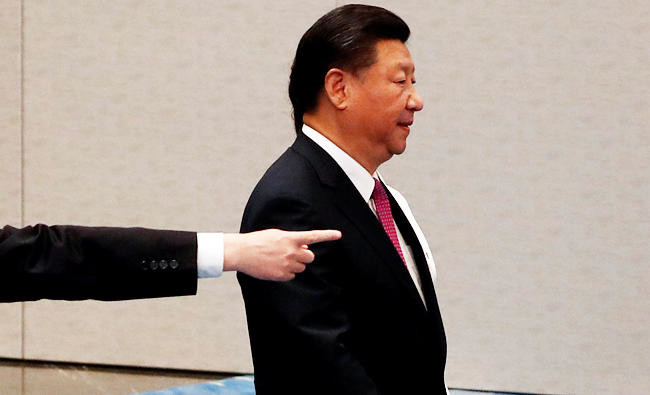
Chinese President Xi Jinping attends the welcoming banquet for the BRICS (Brazil, Russia, India, China and South Africa) Summit, in Xiamen, China, in this September 4, 2017 photo. (REUTERS)
Updated 25 October 2017
Follow

China to unveil new leadership line-up as Xi cements power

BEIJING: China is set Wednesday to unveil its new ruling council with President Xi Jinping firmly at the helm after stamping his authority on the country by engraving his name on the Communist Party’s constitution.
In a highly choreographed event, the members of the elite Politburo Standing Committee will appear in public at the palatial Great Hall of the People after they are selected by 204 party officials in conclave.
Xi, 64, is certain to emerge with a second five-year term as the party’s general secretary, with an even stronger mandate to accomplish his ambition of turning China into a global superpower with a world-class military by mid-century.
Premier Li Keqiang, 62, is also expected to retain his seat but the five other men on the current committee are supposed to step down under an unofficial retirement age and be replaced.
But whoever walks out behind Xi will likely have much less influence than their predecessors after the party congress enshrined the Chinese leader’s name in the Communist charter on Tuesday.
The honor has put him in the rarefied company of the nation’s founder Mao Zedong, and Deng Xiaoping, the architect of its economic reforms, and could set the stage for him to stay in power past his second term.
“Xi Jinping’s thought will be China’s signature ideology and the new communism,” the official Xinhua news service wrote in a commentary Tuesday.
The accolade firmly establishes Xi as the country’s locus of power, potentially upending the collective model of leadership promoted by Deng and embraced by Xi’s two predecessors, Hu Jintao and Jiang Zemin.
In the past two administrations, decisions were the result of horse-trading and consultation among members of the standing committee, the council of party elders which has led China since Deng’s death in 1997.
But with his name in the constitution, Xi has become the nation’s ultimate authority, likely giving him the last word on all major decisions.

All eyes will be on who appears when the new standing committee walks out shortly before noon (0400 GMT) following the secret vote by the party’s 204-member Central Committee.
Analysts have been divided about who will fill out the committee’s roster, and whether an heir apparent will appear. Xi himself was elevated to the committee in 2007 and succeeded Hu Jintao as general secretary and president five years later.
Although the new members may not exercise much real power, the results — which are largely expected to be guided by Xi’s preferences — will give some hints about his priorities and his attitude toward the party’s norms.
Even “Mao was not a one-man show,” said Mattias Stepan of Germany’s Mercator Institute for China Studies.
“Xi still needs capable people to stand next to him to promote his agenda.”
At least one important figure will not make the cut.
Xi’s right-hand man Wang Qishan was not on the list of Central Committee members who were elected by the congress Tuesday, meaning he will vacate his seat on the standing committee.
Analysts had thought the 69-year-old leader of the country’s anti-corruption campaign might be kept on in defiance of the party’s unofficial guideline that cadres retire at 68, setting up Xi to stay on after he himself turns 69 in 2022.
Some of the names that have been invoked as contenders for a committee job include vice premier Wang Yang, 62, Xi adviser Li Zhanshu, 67, and top Central Committee official Wang Huning, 62.
Their ages would likely rule them out as potential Xi successors.
Two younger contenders include the new party chief in the mega-city of Chongqing, long-time Xi ally Chen Miner, 57, and Hu Chunhua, 54, who oversees the southern economic powerhouse of Guangdong province.
Only 10 women were elected to the Central Committee, making it unlikely that one of them will become the first woman to join the ruling council since the Communists took power in 1949.

Afghan returnees in Bamiyan struggle despite new homes

Updated 58 min 44 sec ago
Follow

Afghan returnees in Bamiyan struggle despite new homes

  • More than five million Afghans have returned home since September 2023, according to the International Organization for Migration

BAMIYAN, Afghanistan: Sitting in his modest home beneath snow-dusted hills in Afghanistan’s Bamiyan province, Nimatullah Rahesh expressed relief to have found somewhere to “live peacefully” after months of uncertainty.
Rahesh is one of millions of Afghans pushed out of Iran and Pakistan, but despite being given a brand new home in his native country, he and many of his recently returned compatriots are lacking even basic services.
“We no longer have the end-of-month stress about the rent,” he said after getting his house, which was financed by the UN refugee agency on land provided by the Taliban authorities.
Originally from a poor and mountainous district of Bamiyan, Rahesh worked for five years in construction in Iran, where his wife Marzia was a seamstress.
“The Iranians forced us to leave” in 2024 by “refusing to admit our son to school and asking us to pay an impossible sum to extend our documents,” he said.
More than five million Afghans have returned home since September 2023, according to the International Organization for Migration (IOM), as neighboring Iran and Pakistan stepped up deportations.
The Rahesh family is among 30 to be given a 50-square-meter (540-square-foot) home in Bamiyan, with each household in the nascent community participating in the construction and being paid by UNHCR for their work.
The families, most of whom had lived in Iran, own the building and the land.
“That was crucial for us, because property rights give these people security,” said the UNHCR’s Amaia Lezertua.
Waiting for water
Despite the homes lacking running water and being far from shops, schools or hospitals, new resident Arefa Ibrahimi said she was happy “because this house is mine, even if all the basic facilities aren’t there.”
Ibrahimi, whose four children huddled around the stove in her spartan living room, is one of 10 single mothers living in the new community.
The 45-year-old said she feared ending up on the street after her husband left her.
She showed AFP journalists her two just-finished rooms and an empty hallway with a counter intended to serve as a kitchen.
“But there’s no bathroom,” she said. These new houses have only basic outdoor toilets, too small to add even a simple shower.
Ajay Singh, the UNHCR project manager, said the home design came from the local authorities, and families could build a bathroom themselves.
There is currently no piped water nor wells in the area, which is dubbed “the dry slope” (Jar-e-Khushk).
Ten liters of drinking water bought when a tanker truck passes every three days costs more than in the capital Kabul, residents said.
Fazil Omar Rahmani, the provincial head of the Ministry of Refugees and Repatriation Affairs, said there were plans to expand the water supply network.
“But for now these families must secure their own supply,” he said.
Two hours on foot
The plots allocated by the government for the new neighborhood lie far from Bamiyan city, which is home to more than 70,000 people.
The city grabbed international attention in 2001, when the Sunni Pashtun Taliban authorities destroyed two large Buddha statues cherished by the predominantly Shia Hazara community in the region.
Since the Taliban government came back to power in 2021, around 7,000 Afghans have returned to Bamiyan according to Rahmani.
The new project provides housing for 174 of them. At its inauguration, resident Rahesh stood before his new neighbors and addressed their supporters.
“Thank you for the homes, we are grateful, but please don’t forget us for water, a school, clinics, the mobile network,” which is currently nonexistent, he said.
Rahmani, the ministry official, insisted there were plans to build schools and clinics.
“There is a direct order from our supreme leader,” Hibatullah Akhundzada, he said, without specifying when these projects will start.
In the meantime, to get to work at the market, Rahesh must walk for two hours along a rutted dirt road between barren mountains before he can catch a ride.
Only 11 percent of adults found full-time work after returning to Afghanistan, according to an IOM survey.
Ibrahimi, meanwhile, is contending with a four-kilometer (2.5-mile) walk to the nearest school when the winter break ends.
“I will have to wake my children very early, in the cold. I am worried,” she said.