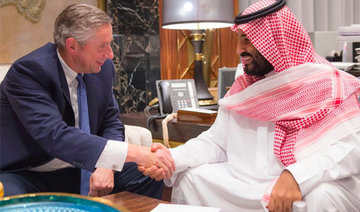
RIYADH: Saudi Arabia’s Public Investment Fund (PIF), the country’s main sovereign wealth fund, will contribute $20 billion to a $40 billion fund with US private equity firm Blackstone, its managing director said on Tuesday.
The fund will invest in “conventional economy” including sectors such as medical care and education, Yasir Al Rumayyan said at a major investment conference in the capital Riyadh.
PIF and US private equity firm Blackstone announced the fund in May with the execution of a memorandum of understanding for the launch of an infrastructure investment vehicle with an anchor $20 billion contribution by PIF.
As part of Saudi Arabia’s economic reforms announced last year, the Saudi government plans to expand PIF, founded in 1971, to finance development projects in the country.
PIF expects to create over 20,000 jobs by 2020 through its projects, Al Rumayyan also said on Tuesday.
“With our short term plans, we will have more than 20,000 jobs in 2020 and beyond it’s going to be a lot more.”
The Public Investment Fund has a portfolio made up of listed holdings, but also unlisted equity investments, international investments, real estate, loans, bonds and sukuk.

Saudi Arabia’s PIF commits $20 billion to $40 billion education, health care fund with Blackstone

Silver crosses $77 mark while gold, platinum stretch record highs
- Spot silver touched an all-time high of $77.40 earlier today, marking a 167% year-to-date surge driven by supply deficits
- Spot platinum rose 9.8% to $2,437.72 per ounce, while palladium surged 14 percent to $1,927.81, its highest level in over 3 years
Silver breached the $77 mark for the first time on Friday, while gold and platinum hit record highs, buoyed by expectations of US Federal Reserve rate cuts and geopolitical tensions that fueled safe-haven demand.
Spot silver jumped 7.5% to $77.30 per ounce, as of 1:53 p.m. ET (1853 GMT), after touching an all-time high of $77.40 earlier today, marking a 167% year-to-date surge driven by supply deficits, its designation as a US critical mineral, and strong investment inflows.
Spot gold was up 1.2% at $4,531.41 per ounce, after hitting a record $4,549.71 earlier. US gold futures for February delivery settled 1.1% higher at $4,552.70.
“Expectations for further Fed easing in 2026, a weak dollar and heightened geopolitical tensions are driving volatility in thin markets. While there is some risk of profit-taking before the year-end, the trend remains strong,” said Peter Grant, vice president and senior metals strategist at Zaner Metals.
Markets are anticipating two rate cuts in 2026, with the first likely around mid-year amid speculation that US President Donald Trump could name a dovish Fed chair, reinforcing expectations for a more accommodative monetary stance.
The US dollar index was on track for a weekly decline, enhancing the appeal of dollar-priced gold for overseas buyers.
On the geopolitical front, the US carried out airstrikes against Daesh militants in northwest Nigeria, Trump said on Thursday.
“$80 in silver is within reach by year-end. For gold, the next objective is $4,686.61, with $5,000 likely in the first half of next year,” Grant added.
Gold remains poised for its strongest annual gain since 1979, underpinned by Fed policy easing, central bank purchases, ETF inflows, and ongoing de-dollarization trends.
On the physical demand side, gold discounts in India widened to their highest in more than six months this week as a relentless price rally curbed retail buying, while discounts in China narrowed sharply from last week’s five-year highs.
Elsewhere, spot platinum rose 9.8% to $2,437.72 per ounce, having earlier hit a record high of $2,454.12 while palladium surged 14% to $1,927.81, its highest level in more than three years.
All precious metals logged weekly gains, with platinum recording its strongest weekly rise on record.