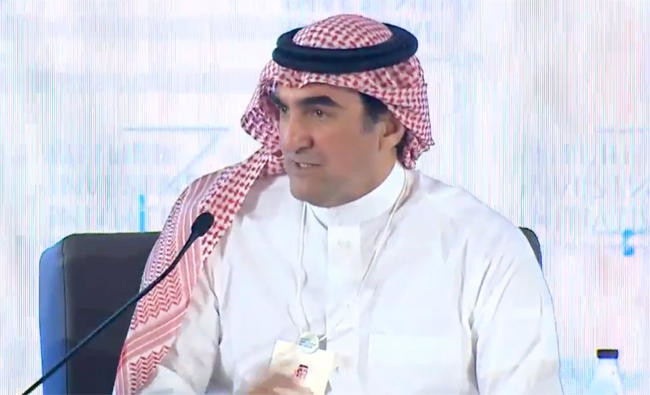
LONDON: Saudi Arabia’s Public Investment Fund (PIF) is targeting annual returns of between 3 and 9 percent across its portfolios in the long term, its managing director said on Tuesday.
Yasir Al-Rumayyan was speaking at the opening session of a major conference hosted by the PIF in Riyadh.
Panelists included BlackRock Chairman Larry Fink, IMF Managing Director Christine Lagarde and Victor Chu, CEO of First Eastern Investment Group.
They were quizzed on their outlook for investment returns as individuals and states worldwide grapple with how to ensure sufficient retirement fund during an extended period of low growth across global economies.
Al-Rumayyan said that some assets could reach annual returns in the low teens.
“We don’t want to be a sitting duck to be shot down by only being in conventional investments. We want to go beyond – that is what Vision 2030 is all about.”
He also revealed that he wants the Future Investment Initiative to become an annual event which would help the Kingdom prepare for the future.
BlackRock’s Fink warned: “Long term growth rates are decelerating quite rapidly and this is going to present pension funds with bigger liability issues – but this is also one of the reasons we have to address this issue of retirement today with expected returns — whether it’s 4, 6 or 8 (percent).
“It means you have to put money away sooner to get to the expected pool of money you want in retirement.”
Asked about his own forecasts for what was possible and realistic as an investment return, he said: “The BlackRock Investor Institute came out with a 10-year forecast of 4 percent – with a balanced portfolio. I tend to think it will be closer to 6 percent. We’re in a world of low inflation.”
Dozens of the biggest names in global business have arrived in the Kingdom for the Future Investment Initiative (FII), which is being hosted by the Public Investment Fund (PIF) — the body that is spearheading a slew of economic reforms.
Saudi Arabia is undergoing unprecedented economic and social reforms as the Kingdom seeks to reduce reliance on oil and gas revenues while creating thousands of new jobs for a youthful population.

PIF and BlackRock chiefs reveal investment targets in Riyadh
Saudi Cabinet condemns ‘blatant’ Iranian aggression; affirms Kingdom’s right to respond to threats
RIYADH: Saudi Arabia has warned it reserves the “full right” to respond to Iranian aggression following a series of “blatant and cowardly” strikes targeting the capital and the Eastern Province.
The warning came during a late-night Cabinet session on Tuesday, chaired by Crown Prince and Prime Minister Mohammed bin Salman via videoconference, according to the Saudi Press Agency (SPA).
During the session, the Cabinet “reaffirmed Saudi Arabia’s full solidarity with the brotherly countries whose territories were subjected to blatant Iranian aggression”, signaling a united front against regional threats.
The session followed a dramatic escalation of hostilities, including a direct drone attack on the US Embassy in Riyadh.
Major General Turki al-Malki, spokesperson for the Ministry of Defense, confirmed that while air defenses intercepted multiple threats, the embassy compound sustained a “limited fire and minor material damage.”
General Al-Malki further announced that Saudi forces successfully intercepted and destroyed eight additional drones targeting the cities of Riyadh and Al-Kharj early Tuesday morning.
In a sharp rebuke of the embassy strike, the Saudi Ministry of Foreign Affairs (MOFA) cited a flagrant violation of the 1949 Geneva Convention and the 1961 Vienna Convention on Diplomatic Relations.
“The repetition of this flagrant Iranian behavior... will push the region toward further escalation,” the Ministry stated, underscoring that these provocations occurred despite Riyadh’s explicit policy of not allowing its airspace or territory to be used as a launchpad for strikes against Iran.
Global condemnation and solidarity
The Cabinet expressed deep appreciation for the wave of international support as world leaders condemned Tehran’s “indiscriminate” behavior.
In a joint show of force, the US and GCC member states (Bahrain, Kuwait, Qatar, Saudi Arabia and the UAE) along with Jordan stood united, labeling the strikes a “dangerous escalation” and reaffirming a collective right to self-defense.
Leaders from the United Kingdom, France, and India. — including Prime Minister Narendra Modi — voiced strong solidarity with the Kingdom. The UK government confirmed its forces are engaged in “defensive actions” to maintain regional stability.
Amid the heightened military tension, the Cabinet reviewed the Kingdom’s hospitality efforts for GCC citizens currently stranded at Saudi airports due to regional airspace closures. The crown prince reaffirmed that the state would mobilize all capabilities to support brotherly nations in any measures they take to restore regional peace and stability.