

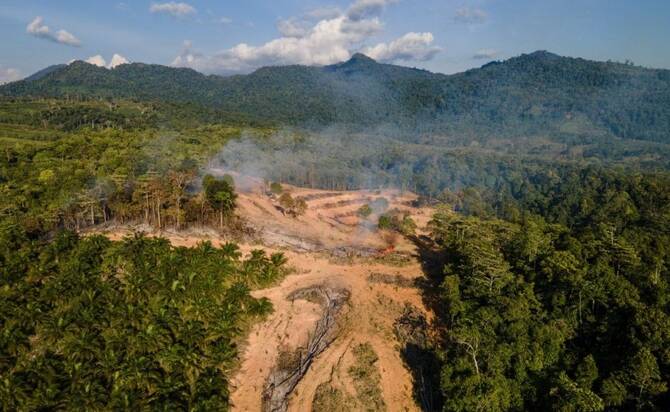

JAKARTA: Indonesia, home to the world’s third-largest rainforest, is recording its highest forest loss in years, new data shows, as environmentalists blame weak protections and the government’s food and energy self-sufficiency drive.
One of the world’s most biodiverse regions, Indonesia had its highest rate of deforestation in 2016, when more than a million hectares were cleared. However, forest loss has been declining since 2017 and fell to a historic low in 2021, when it stood at around 229,000 hectares.
But in 2025, Indonesia lost more than 433,000 hectares of forest, nearly six times the size of Singapore, according to a report published by conservation NGO Auriga Nusantara last week.
Indonesia’s massive forest loss has been driven by the government’s current policy priorities, environmentalists say.
“It’s clear that the government lacks a strong commitment to address or reduce deforestation in Indonesia,” Kiki Taufik, global head of Greenpeace Indonesia’s Forest Campaign, told Arab News.
“The tendency toward higher deforestation rate in Indonesia is real, especially because of the government’s policies, which have been clearly focused on the National Strategic Projects.”
Under President Prabowo Subianto, the Indonesian government has allocated 20.6 million hectares of forest areas for programs related to food, energy and water security.
About 78,000 hectares, or 18 percent of the country’s total deforestation, were cleared in 2025 for food production, according to Auriga’s calculations, while more than 41,100 hectares of forest were converted into coal, gold and nickel concessions.
Auriga’s researchers, who used high-quality satellite images and applied field verification to about 49,000 hectares of forest across 16 provinces, found that among Indonesia’s main islands, forests were shrinking fastest in Borneo, followed by Sumatra and Papua.
The highest rates of deforestation were recorded in Central Kalimantan, East Kalimantan and Aceh, with the second province being the location of Indonesia’s planned new capital, Nusantara.
In a statement, Auriga said that the government must improve regulation to ensure better protection for natural forests and expand areas of preservation outside of forest estates.
Environmentalists also pointed to how such high deforestation is likely to increase the severity of natural disasters, which are expected to occur more frequently due to climate change.
Last year, destructive floods and landslides triggered by extreme weather hit the Indonesian provinces of Aceh, North Sumatra and West Sumatra, killing more than 1,200 people and destroying more than 300,000 houses.
“Those three provinces are among the top 10 areas with the highest rate of deforestation,” Taufik said.
“All of these points to a lack of commitment to reduce deforestation, while putting into question the government’s efforts in addressing climate change and its commitment to accords such as the Paris Agreement.”
Rapid forest loss is also threatening the survival of endemic and endangered species such as orangutans and the Sumatran tigers, he added.
“Some orangutan and tiger habitats in Sumatra have already been destroyed, and (a faster deforestation rate) will lead to their extinctions,” Taufik said.
“Lastly, Indonesia’s reputation, in terms of its commitment to the environment, will also be lost at the international level.”


