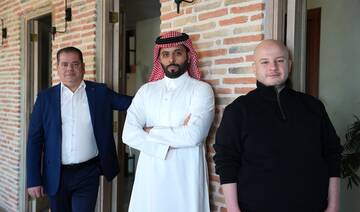
DUBAI: Saudi Arabia is on the verge of a consumer revolution and Majed Al-Tahan is in the vanguard of that transformation.
The founder and CEO of AYM Commerce, the e-commerce arm of the Danube supermarkets chain, is aiming to change the way Saudis shop, and in the process help to contribute to the momentous economic changes underway in the Kingdom.
As a budding architect in London, Al-Tahan got used to online shopping, and realized that the retail market back home had no equivalent.
“I realized there was a gap in the market for online home delivery of fresh food and groceries when I lived in London as a student and used Ocado a lot,” he said. “When I got back to the Middle East I saw there was nobody really doing it in the region. I also saw the big Saudi market, which had a number of challenges.”
So he gave up his aspirations to be an architect, and began talking to the Bindawood retail giant, which owns the 58-store strong Danube chain.
Since then he has barely had time to look back.
Despite the slowdown in the overall economy as a result of lower oil prices and some government-imposed “austerity” measures, retailing is still expected to be a growth sector.
The image of the typical Saudi shopper — all designer brands, consumer electronics and luxury items — hides a reality where essentials such as food, groceries and everyday household products remain a fast-growing sector.
Al-Tahan is well aware of this trend, and last year he launched the AYM app, which enables consumers to shop using their mobile phones. It is one of the most downloaded apps in the Kingdom, with 750,000 users and a target of one million by the end of the year.
“There was a sudden leap just recently in the downloads which we think coincided with the return to school,” he said. “Now we are the No. 1 app for food and drink, and the most downloaded outside the big social media giants like Facebook and Instagram.”
He reeled off the names of the global online giants he seeks to emulate.

“AYM is looking to be for Saudi what Ocado is for the UK, or Big Basket is for India, or Red Mart is in the US,” he said. “We are the biggest online grocery company in the Middle East. There are a few smaller players but we are the biggest.”
He linked up with Danube courtesy of contacts at Bindawood, which has owned Danube since 2001.
“I’m so grateful to the Bindawood group for the opportunity to do their e-commerce platform,” he said. “I approached them and they trusted somebody so young to lead them from the old-fashioned bricks and mortar into e-commerce.”
The heritage goes back a long way, however. Bindawood opened the first supermarket in Makkah, and has since spread to dominate the western region with a significant presence in the rest of the country.
“Danube is not the biggest of the Saudi supermarkets, but it is the most upmarket. Panda is bigger with 280 stores but is more mass-market,” he said.
Danube’s headquarters is in Jeddah, where about 200 people work on the AYM operation. Al-Tahan said that about 80 percent of them are Saudi citizens, with a high proportion of women.
“We have a policy of hiring women for the picking and packing side of the business. Women know about shopping and know how to do that kind of thing better than men,” he said.
Employment policies are also guided by the Kingdom’s policy of Saudization, with incentives for hiring nationals. “The Ministry of Labor and Social Development is helping with the hiring and training, as part of the plans to increase the proportion of citizens in employment in the private sector. They pay 50 percent of the salary for two years while people are training,” Al-Tahan said.
“We’re fully in support of the transformation program underway in the Kingdom. We are working closely with the ministry, and we are a platinum member of the corporates who have signed up to support the economic transformation program, the highest tier of the ratings,” Al-Tahan said.
In the more mundane but essential aspect of fulfilment, all the picking and packing is done via Danube stores throughout the Kingdom.
But the executive offices are in Dubai, where Al-Tahan said it was easier to hire senior staff, and from where executives make the weekly commute to Saudi Arabia. There are plans, too, to roll out the app in the UAE, the second-biggest retailing market in the Arabian Gulf.
One crucial ally in the development of AYM is the Irish e-commerce entrepreneur Paul Kenny, who founded and launched the online vouchers business Cobone and then expanded into online travel.
Kenny eventually sold Cobone to American investment firm Tiger Global, which was also a crucial player in the sale of Souq.com to Amazon for $650 million, the biggest e-commerce deal yet to hit the Middle East.
The involvement of such big hitters underlines the fact that the e-commerce space is getting crowded in the region. Not only does Souq have the financial muscle of Amazon behind it, but Noon, the startup by Mohamed Alabbar of Dubai and backed by the Saudi Public Investment Fund, is also active and ambitious in the e-commerce sector. Does Al-Tahan feel threatened by such serious competitors?
“The e-commerce space is very crowded but we are in quite a focused area of it,” he said. “We specialize in a unique area that is hard to replicate. So it would be difficult for anybody to compete easily with us. But somebody will eventually come into the same space, which is good because we believe in the benefits of competition.
“It would be very difficult for somebody outside the retail business to start up. They would have to invent a whole infrastructure of produce, warehousing and distribution.”
Meanwhile, he and Kenny are endeavouring to stay at the cutting edge of e-commerce technology. They were in Dubai to attend the Gitex technology exhibition and signed up with one Japanese company which has developed technology that can be applied in the AYM call center in Jeddah.
“It allows you to tell the mood of both the agent and the customer, before, during and after the conversation,” Al-Tahan said. “The aim is that we can measure the effectiveness of our call center. It’s quite revolutionary.”
That will add another layer to AYM’s already sophisticated technology, which aims to fulfil consumer needs across the board, but with a significant focus on fresh produce. “We’re marketing as ‘all your grocery needs’, supplying everything in the grocery space, but with a big emphasis on fresh food and produce,” Al-Tahan said.
“People are doing big transactions three to six times a month, but can do smaller ones for perishable foodstuff more frequently. The technology allows us to remember the last order and the pattern of recent orders, so if you want to have the monthly big shop remembered and automated, we can do that too.”
The next expansion will be in the payment systems used in the app. The service was launched as cash-on-delivery payment, but that is changing fast. “We’ve been moving toward an Uber-type solution which we’re rolling out now through the Sadat payment platform the government uses for all public payments,” Al-Tahan said. “It’s the biggest payment system in the country and will be a big boost to business.”
So some time soon Saudis will be able to fulfil all their shopping requirements from the comfort of their living room through the ease of their smartphone. But will they not miss out on the social and leisure aspects of mall shopping, which is a major factor in the Kingdom’s cultural life?
Al-Tahan has thought of that too. “In Saudi, going to the mall is an experience. People like to hang out in Danube, but we will help them fulfil their routine daily shopping needs from the app. If they really want the supermarket experience without taking up so much time, they can select via the app and arrange for in-store pick-up. That will actually enhance their leisure time in the mall,” he said.
Like many in the Kingdom, he expects a big boost to all economic activity from the recent decision to allow women to drive. “Women driving will have a big effect on the supermarket and malls business. It will lead to greater footfall,” he said.
Al-Tahan sees his business as a key part of the economic transformation underway in Saudi Arabia as part of the Vision 2030 strategy to escape oil dependence, but does not believe the time scale for implementation should be set in stone.
“The new leadership in Riyadh is young and understands the mindset. The leadership is working 24 hours a day, seven days a week to achieve the transformation. There is always somebody working in the Royal Court, no matter what the hour.
“It is a very large country with some 30 million people and it is changing a lot in a short space of time. It does not matter if there is a small delay in the transformation process. A delay gives people the opportunity to get used to the idea of change,” he added.