

France wants to take action to tackle Iran’s ‘destabilizing’ behavior: Defense minister

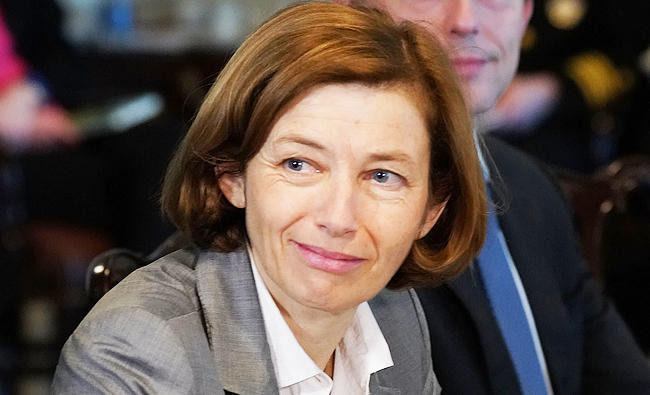
France's Minister of the Armed Forces Florence Parly participates in a meeting with U.S. Defense Secretary James Mattis at the Pentaon on Friday in Arlington, Virginia. (AFP)
Updated 21 October 2017
Follow

France wants to take action to tackle Iran’s ‘destabilizing’ behavior: Defense minister

WASHINGTON: France wants to take action to tackle Iran’s missile program and “destabilizing” behavior, but believes scrapping the 2015 nuclear deal would help hard-liners and be a step toward future war, France’s Defense Minister Florence Parly said on Friday.
“We need the JCPOA. Scrapping it would be a gift to Iran’s hard-liners, and a first step toward future wars,” Parly said in a speech at a Washington think tank, referring to the nuclear deal known as the Joint Comprehensive Plan of Action.
“But we should also be very serious about the destabilizing ballistic and regional activities. We are working on it.”
Parly spoke as Russia’s Foreign Minister Sergey Lavrov said the nuclear deal could be amended only as long as his country and other signatories agreed to proposed changes.
President Donald Trump last week threatened to pull the US out of the deal week unless US lawmakers amend the law that allows and spells out the terms of Washington’s participation in the international accord.
Trump alone cannot actually terminate the 2015 agreement, which lifted sanctions that had choked Iran’s economy in exchange for Tehran rolling back its nuclear program. But withdrawal by the US would render it virtually meaningless.
Speaking at a conference in Moscow, Lavrov said on Friday that any unilateral changes to the deal “could bury this agreement, which is vital for strategic stability and nuclear non-proliferation.”

Nuclear proliferation
Former US Secretary of State John Kerry said Trump risked driving Iran toward nuclear proliferation and worsening a standoff with North Korea if Washington ended a nuclear deal with Tehran.
Kerry, who negotiated the 2015 deal, was speaking in a private lecture delivered at Geneva’s Graduate Institute.
“If you want to negotiate with (North Korean leader) Kim Jong-un, and your goal is to avoid war and try to be able to have a diplomatic resolution, the worst thing you can do is first threaten to destroy his country in the United Nations,” Kerry said.
“And secondly, screw around with the deal that has already been made because the message is, don’t make a deal with the United States, they won’t keep their word,” he said.
The nuclear deal places Iran under tough restraints, including inspections, round-the-clock surveillance and tracking every ounce of uranium produced, Kerry said. “We would notice an uptick in their enrichment, like that,” he said, snapping his fingers.
“And nobody that I know of with common sense can understand what the virtue is in accelerating a confrontation with the possibility that they might decide they want to break out and make it (a nuclear bomb) now instead of 10 or 15 or 25 years from now.”
Kerry, a former senator who headed the US Senate Foreign Relations Committee, told Swiss media that Trump’s leaving the Iranian deal’s fate to Congress was “very dangerous” and opened the door to “party politics.”
Congress cannot unilaterally renegotiate a multilateral accord, the Geneva daily Le Temps quoted him as saying. “It is possible that Congress would make an unreasonable decision that would put Iran’s Supreme Leader Ayatollah Ali Khamenei in a very complicated political situation that could force him to retaliate. It’s a slippery slope.”
Khamenei said on Wednesday that Tehran would stick to its accord as long as the other signatories respected it, but would “shred” the deal if Washington pulled out, state TV reported.
If Iran violated the accord, UN sanctions would snap back into place, Kerry told the audience.
“Moreover, at that point in time folks, we have a year of break-up. We have all the time that we need in the world to be able to bomb their facilities into submission.”
Ending the deal could lead to Iran hiding fissile production facilities “deep in a mountain where we have no insight.”
“So the scenario that Trump opens up by saying ‘let’s get rid of the deal’ is actually proliferation, far more damaging and dangerous,” Kerry said.

WHO chief says reasons US gave for withdrawing ‘untrue’

Updated 25 January 2026
Follow

WHO chief says reasons US gave for withdrawing ‘untrue’

  • US Secretary of State Marco Rubio and US Health Secretary Robert F. Kennedy Jr. announced in a joint statement Thursday that Washington had formally withdrawn from the WHO
  • And in a post on X, Tedros added: “Unfortunately, the reasons cited for the US decision to withdraw from WHO are untrue”

GENEVA: The head of the UN’s health agency on Saturday pushed back against Washington’s stated reasons for withdrawing from the World Health Organization, dismissing US criticism of the WHO as “untrue.”
Tedros Adhanom Ghebreyesus warned that US announcement this week that it had formally withdrawn from the WHO “makes both the US and the world less safe.”
And in a post on X, he added: “Unfortunately, the reasons cited for the US decision to withdraw from WHO are untrue.”
He insisted: “WHO has always engaged with the US, and all Member States, with full respect for their sovereignty.”
US Secretary of State Marco Rubio and US Health Secretary Robert F. Kennedy Jr. announced in a joint statement Thursday that Washington had formally withdrawn from the WHO.
They accused the agency, of numerous “failures during the Covid-19 pandemic” and of acting “repeatedly against the interests of the United States.”
The WHO has not yet confirmed that the US withdrawal has taken effect.

- ‘Trashed and tarnished’ -

The two US officials said the WHO had “trashed and tarnished” the United States, and had compromised its independence.
“The reverse is true,” the WHO said in a statement.
“As we do with every Member State, WHO has always sought to engage with the United States in good faith.”
The agency strenuously rejected the accusation from Rubio and Kennedy that its Covid response had “obstructed the timely and accurate sharing of critical information that could have saved American lives and then concealed those failures.”
Kennedy also suggested in a video posted to X Friday that the WHO was responsible for “the Americans who died alone in nursing homes (and) the small businesses that were destroyed by reckless mandates” to wear masks and get vaccinated.
The US withdrawal, he insisted, was about “protecting American sovereignty, and putting US public health back in the hands of the American people.”
Tedros warned on X that the statement “contains inaccurate information.”
“Throughout the pandemic, WHO acted quickly, shared all information it had rapidly and transparently with the world, and advised Member States on the basis of the best available evidence,” the agency said.
“WHO recommended the use of masks, vaccines and physical distancing, but at no stage recommended mask mandates, vaccine mandates or lockdowns,” it added.
“We supported sovereign governments to make decisions they believed were in the best interests of their people, but the decisions were theirs.”

- Withdrawal ‘raises issues’ -

The row came as Washington struggled to dislodge itself from the WHO, a year after US President Donald Trump signed an executive order to that effect.
The one-year withdrawal process reached completion on Thursday, but Kennedy and Rubio regretted in their statement that the UN health agency had “not approved our withdrawal and, in fact, claims that we owe it compensation.”
WHO has highlighted that when Washington joined the organization in 1948, it reserved the right to withdraw, as long as it gave one year’s notice and had met “its financial obligations to the organization in full for the current fiscal year.”
But Washington has not paid its 2024 or 2025 dues, and is behind around $260 million.
“The notification of withdrawal raises issues,” WHO said Saturday, adding that the topic would be examined during WHO’s Executive Board meeting next month and by the annual World Health Assembly meeting in May.
“We hope the US will return to active participation in WHO in the future,” Tedros said Saturday.
“Meanwhile, WHO remains steadfastly committed to working with all countries in pursuit of its core mission and constitutional mandate: the highest attainable standard of health as a fundamental right for all people.”