India’s ride-hailing company Ola raises $1.1 billion from investors led by Tencent, SoftBank

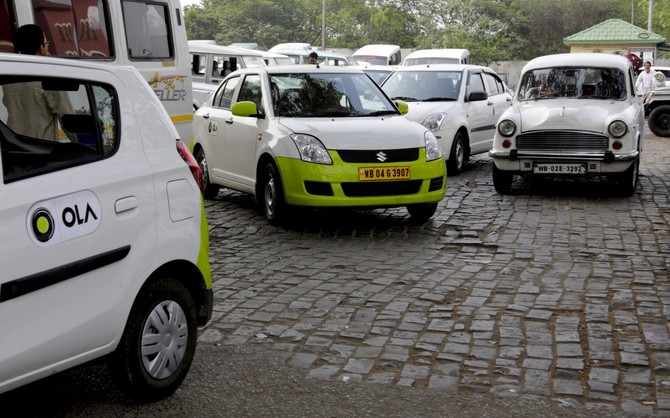
Ola and Uber have been in a fierce battle to gain riders in India’s booming market. (Reuters)
Updated 11 October 2017
Follow

India’s ride-hailing company Ola raises $1.1 billion from investors led by Tencent, SoftBank

BANGALORE: Uber’s Indian rival Ola said Wednesday it has raised $1.1 billion (SR4.12 billion) from investors led by Tencent, the first time the Chinese tech giant has put money into the ride-hailing company.
Ola and Uber have been in a fierce battle to gain riders and retain drivers and have spent millions of dollars to increase their share of the booming market.
Ola said existing investor SoftBank was among those providing fresh funds, and that it was seeking to raise another $1 billion.
It currently operates in 100 Indian cities and said it planned to use the funds for further expansion.
It will also invest in technology to find better ways to tackle the country’s congested roads, it said.
Tencent President Martin Lau said the investment in Ola would enable the company to be part of India’s “fast-growing ride-hailing space.”
Ride-hailing apps have risen rapidly to become a booming industry in India’s congested cities, but face stiff resistance from traditional taxis and bans over safety concerns.
The country’s growing taxi app market is projected to be worth $7 billion by 2020.


Saudi POS spending jumps 28% in final week of Jan: SAMA

Updated 06 February 2026
Follow

Saudi POS spending jumps 28% in final week of Jan: SAMA

RIYADH: Saudi Arabia’s point-of-sale spending climbed sharply in the final week of January, rising nearly 28 percent from the previous week as consumer outlays increased across almost all sectors. 

POS transactions reached SR16 billion ($4.27 billion) in the week ending Jan. 31, up 27.8 percent week on week, according to the Saudi Central Bank. Transaction volumes rose 16.5 percent to 248.8 million, reflecting stronger retail and service activity. 

Spending on jewelry saw the biggest uptick at 55.5 percent to SR613.69 million, followed by laundry services which saw a 44.4 percent increase to SR62.83 million. 

Expenditure on personal care rose 29.1 percent, while outlays on books and stationery increased 5.1 percent. Hotel spending climbed 7.4 percent to SR377.1 million. 

Further gains were recorded across other categories. Spending in pharmacies and medical supplies rose 33.4 percent to SR259.19 million, while medical services increased 13.7 percent to SR515.44 million. 

Food and beverage spending surged 38.6 percent to SR2.6 billion, accounting for the largest share of total POS value. Restaurants and cafes followed with a 20.4 percent increase to SR1.81 billion. Apparel and clothing spending rose 35.4 percent to SR1.33 billion, representing the third-largest share during the week. 

The Kingdom’s key urban centers mirrored the national surge. Riyadh, which accounted for the largest share of total POS spending, saw a 22 percent rise to SR5.44 billion from SR4.46 billion the previous week. The number of transactions in the capital reached 78.6 million, up 13.8 percent week on week. 

In Jeddah, transaction values increased 23.7 percent to SR2.16 billion, while Dammam reported a 22.2 percent rise to SR783.06 million. 

POS data, tracked weekly by SAMA, provides an indicator of consumer spending trends and the ongoing growth of digital payments in Saudi Arabia.  

The data also highlights the expanding reach of POS infrastructure, extending beyond major retail hubs to smaller cities and service sectors, supporting broader digital inclusion initiatives.  

The growth of digital payment technologies aligns with Saudi Arabia’s Vision 2030 objectives, promoting electronic transactions and contributing to the Kingdom’s broader digital economy.