

Meet Mumbai’s first women rickshaw drivers

1 / 5
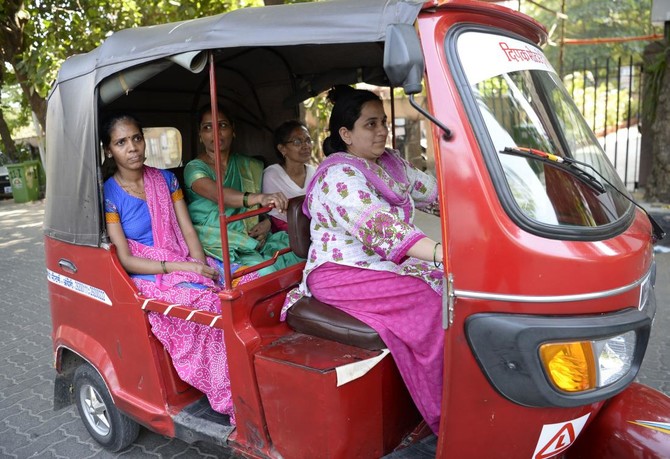
An Indian woman rickshaw driver taking part in a training session in Mumbai. Chaya Mohite slowly turns the accelerator as she carefully edges the salmon-colored rickshaw forward, one of Mumbai’s first female auto drivers to make use of a government scheme aimed at empowering women. (AFP/PUNIT PARANJPE)
2 / 5
An Indian woman rickshaw driver taking part in a training session in Mumbai. Chaya Mohite slowly turns the accelerator as she carefully edges the salmon-colored rickshaw forward, one of Mumbai’s first female auto drivers to make use of a government scheme aimed at empowering women. (AFP/PUNIT PARANJPE)
3 / 5
An Indian woman rickshaw driver taking part in a training session in Mumbai. Chaya Mohite slowly turns the accelerator as she carefully edges the salmon-colored rickshaw forward, one of Mumbai’s first female auto drivers to make use of a government scheme aimed at empowering women. (AFP/PUNIT PARANJPE)
4 / 5
An Indian woman rickshaw driver taking part in a training session in Mumbai. Chaya Mohite slowly turns the accelerator as she carefully edges the salmon-colored rickshaw forward, one of Mumbai’s first female auto drivers to make use of a government scheme aimed at empowering women. (AFP/PUNIT PARANJPE)
5 / 5
An Indian woman rickshaw driver taking part in a training session in Mumbai. Chaya Mohite slowly turns the accelerator as she carefully edges the salmon-colored rickshaw forward, one of Mumbai’s first female auto drivers to make use of a government scheme aimed at empowering women. (AFP/PUNIT PARANJPE)
Updated 13 April 2017
Follow

Meet Mumbai’s first women rickshaw drivers

MUMBAI: Chaya Mohite slowly turns the accelerator as she carefully edges the salmon-colored rickshaw forward, one of Mumbai’s first female auto drivers to make use of a government scheme aimed at empowering women.
The 45-year-old was one of 19 women who recently started jobs ferrying passengers through the notoriously congested streets of India’s financial capital in their new three-wheelers.
“This job is much better than doing household work. I can make more money and it helps us secure our futures,” Mohite told AFP as she got in some last minute practice.
The mother of three has spent the past two months learning how to drive at a training center in Mumbai’s eastern suburbs and is thrilled with her new skills and financial prospects.
“I couldn’t even ride a bicycle but today I can drive an auto rickshaw. I’m independent and it makes me happy,” says Mohite, who hopes to earn 1,000 rupees ($15) a day.
She is benefitting from a scheme introduced by the state government of Maharashtra, of which Mumbai is the capital, that reserves five percent of rickshaw permits for women.
It announced the plan in early 2016, saying that 465 licenses would be made available for women in Mumbai and the neighboring district of Thane.
Unlike similar schemes in New Delhi and Ranchi, where some pink autos are driven by women for women as a safety initiative, the Maharashtra drivers take both male and female passengers.
Services started in Thane last year but Mohite and her new colleagues, who will sport white lab-coat-like uniforms, are the first to ply the streets of India’s most populated metropolis.
“I’ve taught them the A to Z of auto-rickshaw driving. They are now experts and have passed an official RTO (Regional Transport Office) test,” Sudhir Dhoipode, the women’s instructor, told AFP.

WATCH: Mumbai's first female auto rickshaw drivers take to the streets

Dhoipode says he is currently teaching more than 40 women how to drive while around 500 others have expressed an interest in learning despite some community opposition in the conservative country.
“People mocked us for leaving our homes and choosing to drive rickshaws but we hope we can inspire other women to come forward and take advantage of this great initiative,” said driver Anita Kardak.
Rickshaw permits are highly sought after in Mumbai and can be big business, with owners often renting them out for a fee or lending them to others when their shift has finished.
Transport officials say they decided the women should have a different colored rickshaw to the ubiquitous black and yellow ones to stop male relatives from taking them over.
It has led to some fears the women will be at risk because they will stand out, but Mohite isn’t concerned.
“I don’t think there’s going to be any safety issue as we’re capable of looking after ourselves. Driving the rickshaw is a fun feeling and I’m ready to drive anywhere in Mumbai,” she said.


Sotheby’s to bring coveted Rembrandt lion drawing to Diriyah

Updated 18 January 2026
Follow

Sotheby’s to bring coveted Rembrandt lion drawing to Diriyah

DUBAI: Later this month, Sotheby’s will bring to Saudi Arabia what it describes as the most important Rembrandt drawing to appear at auction in 50 years. Estimated at $15–20 million, “Young Lion Resting” comes to market from The Leiden Collection, one of the world’s most important private collections of 17th-century Dutch and Flemish art.

The drawing will be on public view at Diriyah’s Bujairi Terrace from Jan. 24 to 25, alongside the full contents of “Origins II” — Sotheby’s forthcoming second auction in Saudi Arabia — ahead of its offering at Sotheby’s New York on Feb. 4, 2026. The entire proceeds from the sale will benefit Panthera, the world’s leading organization dedicated to the conservation of wild cats. The work is being sold by The Leiden Collection in partnership with its co-owner, philanthropist Jon Ayers, the chairman of the board of Panthera.

Established in 2006, Panthera was founded by the late wildlife biologist Dr. Alan Rabinowitz and Dr. Thomas S. Kaplan. The organization is actively engaged in the Middle East, where it is spearheading the reintroduction of the critically endangered Arabian leopard to AlUla, in partnership with the Royal Commission for AlUla.

“Young Lion Resting” is one of only six known Rembrandt drawings of lions and the only example remaining in private hands. Executed when Rembrandt was in his early to mid-thirties, the work captures the animal’s power and restless energy with striking immediacy, suggesting it was drawn from life. Long before Rembrandt sketched a lion in 17th-century Europe, lions roamed northwest Arabia, their presence still echoed in AlUla’s ancient rock carvings and the Lion Tombs of Dadan.

For Dr. Kaplan, the drawing holds personal significance as his first Rembrandt acquisition. From 2017 to 2024, he served as chairman of the International Alliance for the Protection of Heritage, of which Saudi Arabia is a founding member.

The Diriyah exhibition will also present, for the first time, the full range of works offered in “Origins II,” a 64-lot sale of modern and contemporary art, culminating in an open-air auction on Jan. 31 at 7.30 pm.