New Uber CEO to meet London transport head in effort to reverse ban

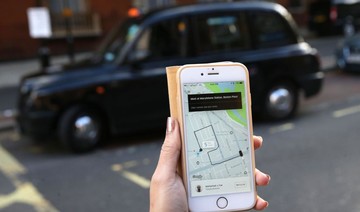
Above, an Uber logo is seen on mobile telephone in London. Transport for London (TfL) decided not to renew Uber’s license to operate on September 22. (Reuters)
Updated 29 September 2017
Follow

New Uber CEO to meet London transport head in effort to reverse ban

LONDON: Dara Khosrowshahi, the new chief executive of Uber Technologies, will meet the head of the London Transport system next Tuesday as the Silicon Valley giant steps up the fight to regain its license in the British capital.
Regulator Transport for London (TfL) stunned the taxi-app company last week when it said it would not renew its license which expires on Saturday due to the firm’s approach to reporting serious criminal offences and background checks on drivers.
Uber, which is valued at about $70 billion and whose investors include Goldman Sachs, has vowed to appeal.
It was given a boost on Thursday when British Prime Minister Theresa May said the decision was “disproportionate”.
“Our new CEO is looking forward to meeting with the commissioner next week,” an Uber spokesman said.
“As he said on Monday, we want to work with London to make things right.”
Khosrowshahi, who is less than a month into his new job, will meet Transport Commissioner Mike Brown. TFL also confirmed the meeting would take place.
The dispute in Britain, one of Uber’s most important global markets, is one of many to confront the new chief executive, who has been brought in to try to clean up the company’s reputation as aggressive and unapologetic, following a string of scandals.
Khosrowshahi has already apologized to Londoners for Uber’s mistakes in a break with the company’s usual combative tone.
Uber can continue to operate until the appeals process is exhausted, which could take months.


Oman inflation at 1.6%, latest figures show

Updated 5 sec ago
Follow

Oman inflation at 1.6%, latest figures show

RIYADH: Oman’s consumer price index rose by 1.6 percent in December compared with the same month a year earlier, reflecting moderate inflationary pressures at year’s end.

Average inflation for the January–December 2025 period increased by 1 percent, according to official data.

Figures released by the National Center for Statistics and Information showed that miscellaneous personal goods and services recorded the sharpest price increase, rising by 10 percent year on year. 

This was followed by transport at 2.8 percent, restaurants and hotels at 2.6 percent, and furniture, household equipment and routine maintenance at 2.4 percent, as well as education at 2.2 percent. 

Food and non-alcoholic beverages prices increased by 1.1 percent, while clothing and footwear rose by 0.2 percent and health by 0.1 percent. In contrast, prices in the culture and recreation group declined by 0.1 percent. 

Housing, water, electricity, gas and other fuels, as well as tobacco and communications, remained unchanged over the period. 

Within the food and non-alcoholic beverages category, December prices compared with the same month of 2024 showed notable increases in fish and seafood at 6 percent and fruits at 4 percent. 

Sugar, jam, honey and confectionery rose by 3.5 percent, milk, cheese and eggs by 2.1 percent, and non-alcoholic beverages by 0.9 percent.

Meat prices increased by 0.8 percent, bread and cereals, oils and fats by 0.7 percent, and other unclassified food products by 0.4 percent, while vegetable prices fell by 5.8 percent. 

Regionally, Al Dhahirah governorate recorded the highest inflation rate at 2.5 percent by the end of December compared with a year earlier. 

Inflation also rose by 2.1 percent in Al Dakhiliyah, 1.7 percent in Muscat and Al Buraimi, and 1.5 percent in South Al Batinah. 

South Al Sharqiyah and Musandam each posted increases of 1.1 percent, while North Al Sharqiyah and North Al Batinah rose by 0.9 percent. Al Wusta and Dhofar recorded inflation of 0.8 percent. 

The report highlights the relative importance of expenditure groups within the consumer price index basket, underscoring why movements in certain categories have a greater impact on overall inflation.

Housing, water, electricity, gas and other fuels carry the largest weight at 31.7, followed by food and non-alcoholic beverages at 20.6 and transport at 14.5.

Together, these three groups account for more than two-thirds of the CPI basket, meaning price stability in housing and utilities can significantly moderate headline inflation even when sharper increases are recorded in smaller-weight categories such as miscellaneous goods and services. 

The analysis also notes that around 56,640 individual price quotations were collected from 3,907 sources across the Sultanate during the reference period. 

In addition, rental data were gathered from a dedicated sample of 1,509 rented housing units, providing a detailed and representative measure of housing costs, which remain the most heavily weighted component of the inflation basket.