

Pakistan says mosque bomber identified, accuses India and Afghanistan of backing attack

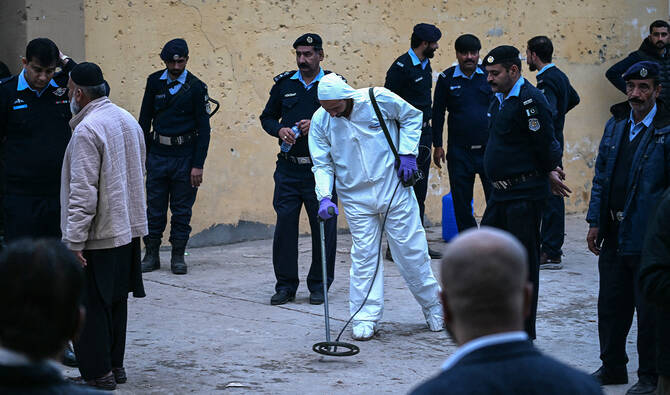
An investigator uses metal detectors to search the blast site following a suicide bombing at the Shiite mosque in Islamabad on February 6, 2026. (AFP)
Short Url
Updated 06 February 2026
Follow

Pakistan says mosque bomber identified, accuses India and Afghanistan of backing attack

  • Suicide bombing at mosque on Islamabad’s outskirts kills at least 31, injures 169
  • Minister says attacker not an Afghan national but had travel history to Afghanistan

ISLAMABAD: Pakistan said on Friday it had identified the suicide bomber responsible for an attack on a mosque on the outskirts of the capital that killed at least 31 people, with the government saying the incident was carried out by militants sponsored by India and supported by Afghanistan.

The explosion took place during Friday prayers in the Tarlai area, a densely populated suburb of the capital, with hundreds of worshippers inside the mosque. Islamabad’s district administration said 169 people were also injured, several of them critically. 

The attack comes amid a renewed surge in militant violence in Pakistan and follows a suicide bombing outside a district court complex in Islamabad in November last year that killed at least 12 people and wounded dozens, underscoring growing security concerns even in heavily guarded urban centers.

Talal Chaudhry, Pakistan’s minister of state for interior, told reporters at the blast site, an imambargah, or a place of worship for the Shi’ite Muslim community, that the attacker had been identified as a suicide bomber following forensic analysis.

“We have now received information about the terrorist who carried out the suicide bombing here,” Chaudhry said. “He is not an Afghan national, but details of how many times he traveled to Afghanistan have been obtained.”

He said investigators were trying to piece together more evidence, though he added he could not share some of the information at this time.

Chaudhry accused neighboring countries of backing militant violence in Pakistan, saying the attack followed a familiar pattern. 

“Those who carried out the attack are the same [groups that are] sponsored and supported by our neighbors, sponsored by India and supported by Afghanistan,” he added.

Islamabad has long accused Kabul of allowing its soil to be used by militant groups and New Delhi of backing their cross-border attacks against Pakistani civilians and security forces. However, the Afghan and Indian governments have consistently denied the allegations.

India also issued a statement during the day, condemning the attack and condoling the loss of life while calling Islamabad’s accusation against it “as baseless as it is pointless.”

However, Chaudhry said the authorities had also detained militants and their facilitators in the past who were linked to earlier attacks in the capital, as he pledged to do the same again.

“Be assured that the previous terrorists and their handlers involved in Islamabad attacks were arrested and are being dealt with according to the law,” he continued, adding those responsible for targeting the mosque would also be arrested.

No militant group has so far claimed responsibility for the attack.

Rescue teams reached the scene within minutes, Chaudhry said, and an emergency was imposed at major hospitals, including the Pakistan Institute of Medical Sciences, Polyclinic Hospital and the Capital Development Authority Hospital. 

Chaudhry said the attackers had deliberately targeted civilians.

Islamabad has generally been less affected by militant attacks than Pakistan’s northwestern and southwestern regions, but the scale of the casualties has heightened concerns about security in the capital amid a broader resurgence of violence nationwide.


Pakistan highlights Gwadar transshipment role as shipping routes face disruption over regional tensions

Updated 05 March 2026
Follow

Pakistan highlights Gwadar transshipment role as shipping routes face disruption over regional tensions

  • Pakistani ports possess “untapped potential” to attract global shipping lines for transshipment operations, says minister
  • Pakistan eyes leveraging Gwadar as regional transshipment hub as Iran’s closure of Strait of Hormuz disrupts global maritime trade

KARACHI: Pakistan’s Maritime Affairs Minister Junaid Anwar Chaudhry on Thursday highlighted the importance of the port city of Gwadar’s transshipment role as major shipping routes, including the Strait of Hormuz, face disruption due to Iran’s ongoing conflict with the US and Israel in the Gulf. 

The meeting takes place as Iran has effectively closed the Strait of Hormuz, a strategic waterway that lies between it and Oman. It is one of the world’s most critical oil transit routes, with roughly 20 percent of global oil supplies passing through it. Iran has vowed it will attack any ship that enters the strait, causing energy prices to rise sharply on Monday amid disruptions to tanker traffic in the waterway.

Gwadar is a deep-sea port in Pakistan’s southwestern Balochistan province that lies close to the Strait of Hormuz. Pakistani officials have in the past highlighted Gwadar’s geostrategic position as the shortest trade route to the Gulf and Central Asia, stressing that it has the potential to become a regional transshipment hub.

Chaudhry chaired a high-level meeting of government officials to assess emerging logistical challenges facing Pakistan’s trade, particularly in the energy sector, amid tensions in the Gulf. 

“Special focus was placed on fully leveraging the potential of Gwadar Port as a regional transshipment hub and positioning it as an alternative of regional instability,” Pakistan’s maritime affairs ministry said in a statement. 

The minister said Pakistani ports possessed “significant untapped potential” to attract international shipping lines for transshipment operations, noting that it could also ensure long-term sustainability and growth of the country’s maritime sector.

Participants of the meeting discussed measures to strengthen Pakistan’s position as a viable alternative transit and transshipment destination, as key waterways are affected by the disruption. 

The committee also reviewed proposals to amend relevant rules and regulations to facilitate international transshipment operations through on-dock and off-dock terminals.

The chairmen of the Port Qasim Authority, Karachi Port Trust and Gwadar Port Authority attended the meeting, briefing committee members on the current operational readiness of their ports. They spoke about the available capacity for container transshipment, bulk cargo handling and refueling services at Pakistani ports. 

The port in Gwadar is a central part of the China-Pakistan Economic Corridor (CPEC), under which Beijing has funneled tens of billions of dollars into massive transport, energy and infrastructure projects in Pakistan.

Pakistan has long eyed the deep-sea port as a key asset that can help boost its trade with Central Asian states, the Gulf region and ensure the country earns valuable foreign exchange.