Myanmar takes first step toward calming communal hatred

Men, women and children attend an interfaith prayer ceremony at a stadium in Yangon on October 10, 2017. (AFP)
Updated 10 October 2017
Follow

Myanmar takes first step toward calming communal hatred

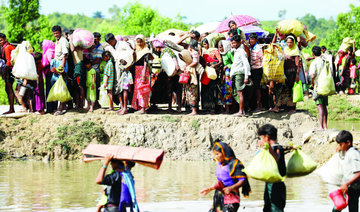
YANGON: Myanmar launched on Tuesday its first bid to improve relations between followers of different religions since an eruption of deadly violence in August inflamed communal tension and triggered an exodus of some 520,000 Muslims to Bangladesh.
Rohingya Muslims are still fleeing, more than six weeks after Rohingya insurgents attacked security forces in western Myanmar’s Rakhine State.
The United Nations has denounced a ferocious military crackdown in response to the attacks as ethnic cleansing aimed at driving out Rohingya.
A new surge of refugees has entered Bangladesh in recent days, including about 11,000 on Monday. Some have told of increasing hunger in Rakhine State as well as of more mob attacks on Muslim villagers.
Despite growing international condemnation of the refugee crisis, the military campaign is popular in Buddhist-majority Myanmar, where there is little sympathy for the Rohingya, and for Muslims in general, and where Buddhist nationalism has surged in recent years.
The party of government leader Aung San Suu Kyi took the first step toward trying to calm communal animosity with inter-faith prayers at a stadium in the biggest city of Yangon, with Buddhists, Muslims, Hindus and Christians.
“This is for peace and stability,” party spokesman Aung Shin told Reuters. “Peace in Rakhine and peace nationwide.”
Traffic was jammed around the stadium as Buddhist monks had nuns packed the stands inside, along with thousands of others.
The Rohingya had pinned hopes for change on Suu Kyi’s party but it has been wary of Buddhist nationalist pressure. Her party did not field a single Muslim candidate in the 2015 election that it swept.
Rohingya are not classified as an indigenous minority in Myanmar and so are denied citizenship under a law that links nationality to ethnicity.
Regarded as illegal immigrants from Bangladesh, they face restrictions and discrimination and are derided by ethnic Rakhine Buddhists in Rakhine State, and by much of the wider population.
The militants of the Arakan Rohingya Salvation Army (ARSA) who launched the Aug. 25 attacks that triggered the latest spasm of violence are demanding full citizenship rights and recognition as an indigenous community.
CEASEFIRE ENDS
A one-month cease-fire the insurgents called in September in order, they said, to ease aid deliveries to Rakhine State, expired at midnight on Monday, but authorities said there was no sign of any new attacks.
The government rebuffed the cease-fire, saying it did not negotiate with terrorists.
Myanmar denies ethnic cleansing. It says more than 500 people have been killed in the violence since late August, most of them ARSA “terrorists.”
Even before the government offensive, the small, lightly armed ARSA appeared only capable of hit-and-run raids and unable to mount any sort of sustained challenge to the army.
The insurgents said on Saturday they were ready to respond to any peace move by the government, even though their cease-fire was ending.
The reports of food shortages in Rakhine will add to the urgency of calls by aid agencies and the international community for unfettered humanitarian access to the conflict zone.
Villagers said food was running out because rice crops were not ready for harvest and authorities had shut village markets and limited food transport, apparently to cut supplies to the militants.
The government has cited worry about food as one of the reasons people have cited for leaving, but a senior state government official on Monday dismissed any suggestion of starvation.
Among those fleeing were more than 30 people on a fishing boat that capsized off the Bangladesh coast on Sunday evening. Twenty-five of them drowned, including 13 children, police said.


Asia rings in 2026 with Australia hosting defiant celebration after mass shooting

Updated 31 December 2025
Follow

Asia rings in 2026 with Australia hosting defiant celebration after mass shooting

  • Australia holds defiant celebrations after its worst mass shooting in nearly 30 years
  • Hong Kong holds a subdued event after a deadly fire in tower blocks

MELBOURNE, Australia: Auckland was the first major city to ring in 2026 with a fireworks display launched from New Zealand’s tallest structure, Sky Tower, followed by a defiant celebration in Australia in the aftermath of its worst mass shooting.
South Pacific countries were the first to bid farewell to 2025. Clocks stuck midnight in Auckland 18 hours before the famous ball drop in New York’s Times Square. The five-minute display involved 3,500 fireworks.

Defiant celebration in Australia after worst mass shooting

Australia’s east coast welcomed 2026 two hours after New Zealand. In Sydney, the country’s largest city, celebrations were held under the pall of Australia’s worst mass shooting in almost 30 years. Two gunmen targeted a Hannukah celebration at Bondi Beach on Dec. 14, killing 15 and wounding 40.
A heavy police presence monitored the thousands who thronged to the waterfront to watch a fireworks show centered on the Sydney Harbor Bridge. Many officers openly carried rapid-fire rifles, a first for the annual event.
An hour before midnight, the massacre victims were commemorated with a minute of silence while images of a menorah were projected on the bridge pylons. The crowd was invited to show solidarity with Australia’s Jewish community.
New South Wales Premier Chris Minns urged Sydney residents not to stay away through fear, saying extremists would interpret smaller crowds at New Year’s Eve festivities as a victory.
“We have to show defiance in the face of this terrible crime and say that we’re not going to be cowered by this kind of terrorism,” he said.

Indonesia and Hong Kong hold subdued events

In Indonesia, one of Australia’s nearest neighbors, cities scaled back festivities as a gesture of solidarity with communities devastated by floods and landslides that struck parts of Sumatra island a month ago, claiming more than 1,100 lives.
The capital, Jakarta, was not ringing in 2026 with its usual fanfare, choosing subdued celebrations with a program centered on prayers for victims, city Gov. Pramono Anung said last week.
Makassar Mayor Munafri Arifuddin urged residents of one of Indonesia’s largest cities to forgo parties, calling for prayer and reflection. “Empathy and restraint are more meaningful than fireworks and crowds,” he said.
Concerts and fireworks on Indonesia’s tourist island of Bali were canceled and replaced with a cultural arts event featuring traditional dances.
Hong Kong, too, was ringing in 2026 without the usual spectacle in the sky over iconic Victoria Harbor, after a massive fire in November killed at least 161 people.
The facades of eight landmarks were turning into giant countdown clocks presenting a three-minute light show at midnight.
Many parts of Asia welcome the new year by observing age-old traditions.
In Japan, crowds were gathering at a Buddhist temple in Tokyo for a bell striking at midnight. In the South Korean capital, Seoul, a bell tolling and countdown ceremony were being held at the Bosingak Pavilion.

Berliners celebrate in snowfall

Tourists and Berliners alike marked the end of 2025 by enjoying snowfall, taking selfies and making snowmen in front of the German capital’s cathedral and the iconic Brandenburg Gate. The Berlin TV Tower was nearly invisible thanks to the falling flakes and fog.
Quieter celebrations in Greece and Cyprus
Greece and Cyprus were ringing in 2026 by turning down the volume, replacing traditional fireworks with low-noise pyrotechnics, light shows and drone displays in capital cities. Low-noise fireworks avoid the explosive bursts that generate the loud cracks of traditional displays.
Officials in the countries said the change is intended to make celebrations more welcoming for children and pets, particularly animals sensitive to loud noise.

Additional security in New York City

Police in New York City will have additional anti-terrorism measures at the Times Square ball drop, with “mobile screening teams” in search of suspicious activity. It is not in response to a specific threat, according to NYPD Commissioner Jessica Tisch.
After the ball drops in Times Square, it will rise once again, sparking in red, white and blue, to mark the country’s upcoming 250th birthday celebration. It will be one of several patriotic flourishes throughout the night, organizers said.
Zohran Mamdani will take office as mayor at the start of 2026. Two swearing-in ceremonies are planned, starting with a private ceremonial event around midnight in an old subway station.