UNHCR on ‘full alert’ as 11,000 Rohingya flee in a day

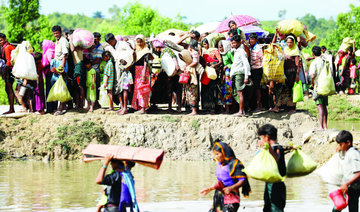
Rohingya refugees cross a canal next to a settlement close to the no man’s land area between the borders of Myanmar and Bangladesh in Tombru Bandarban district on October 10, 2017. (AFP)
Updated 10 October 2017
Follow

UNHCR on ‘full alert’ as 11,000 Rohingya flee in a day

GENEVA: Bangladesh border guards reported more than 11,000 Rohingya refugees crossing into their country from Myanmar on Monday, in a sudden surge, the United Nations refugee agency said.
More than half a million Rohingya have fled Myanmar since Aug. 25 after insurgent attacks on security forces triggered a violent government crackdown, but the rate had slowed to about 2,000 refugees per day last week, aid agencies say.
“We’re back in a situation of full alert as far as influxes are concerned. It is a big increase to see 11,000,” Adrian Edwards, spokesman for the UN High Commissioner for Refugees (UNHCR), told a news briefing in Geneva on Tuesday.
“We have had big numbers coming across by the day over the six weeks of this emergency. So we are back up to approaching some of those peak arrivals. Clearly we have to be prepared for more arrivals,” he said.
Many of the refugees are reported to come from the Buthidaung area in Myanmar’s northern Rakhine state, which is 20-25 kilometers east of Maungdaw.
“Some said they had fled torching and killings back home; one boy was seen with a big gash across his neck,” Edwards said.
“We don’t know at the moment what is driving this,” he added. “Some of these people have fled their homes several days ago and in some cases two weeks ago, so they moved toward the border before coming across.”
There are also indications of more recent problems.
“As you may have seen from media reports which I can’t verify, but there are reports about fires being seen close to the border (and) other problems there,” Edwards said.
Meanwhile, a massive cholera immunization campaign began on Tuesday near Cox’s Bazar, Bangladesh, aimed at protecting newly-arrived Rohingya and host communities from the disease which can be deadly, the World Health Organization (WHO) said.
Some 900,000 oral vaccine doses will be distributed, including 650,000 in an initial 10-day campaign to be followed by a second round from Oct. 31 targeting 250,000 children between one and five years old, the agency said.
There is a “clear and present risk” of the spread of cholera among the population.
“Luckily, we don’t have any confirmed cases of cholera so far,” WHO spokesman Christian Lindmeier said.


Two high-speed trains derail in Spain, police sources say 21 people killed

Updated 19 January 2026
Follow

Two high-speed trains derail in Spain, police sources say 21 people killed

  • The accident happened near Adamuz, in Cordoba province. So far, 21 people ​have been confirmed dead by police

MADRID: A high-speed train derailed and smashed into another oncoming train in southern Spain on Sunday, pushing the second train off the tracks in a collision that police sources confirmed to Reuters had killed at least 21 people.
The accident happened near Adamuz, in Cordoba province. So far, 21 people ​have been confirmed dead by police, with state broadcaster Television Espanola adding that 100 people had been injured, 25 seriously. The driver of one of the trains, which was traveling from Madrid to Huelva, was among those who died, the TV station added.
“The Iryo 6189 Malaga — (to Madrid) train has derailed from the track at Adamuz, crashing onto the adjacent track. The (Madrid) to Huelva train which was traveling on the adjacent track has also derailed,” said Adif, which runs the rail network, in a social media post.
Adif said the accident happened at 6:40 p.m. (1740 GMT), about 10 minutes after the Iryo train left Cordoba heading toward Madrid.
Iryo is a private rail operator, majority-owned by Italian state-controlled railway group Ferrovie dello Stato. The train involved was a Freccia 1000 train which was traveling between ‌Malaga and Madrid, ‌a spokesperson for Ferrovie dello Stato said.
The company said in a statement that it ‌deeply ⁠regretted what ​had happened ‌and had activated all emergency protocols to work closely with the relevant authorities to manage the situation.
The second train was operated by Renfe, which also did not respond to a request for comment.
Adif has suspended all rail services between Madrid and Andalusia.

HORRIFIC SCENE
The Iryo train had more than 300 passengers on board, while the Renfe train had around 100.
Paco Carmona, Cordoba fire chief, told TVE the first train heading to Madrid from Malaga had been evacuated.
The other train’s carriages were badly damaged, he said, with twisted metal and seats. “There are still people trapped. We don’t know how many people have died and the operation is concentrating on getting people out of areas which are very narrow,” he ⁠said. “We have to remove the bodies to reach anyone who is still alive. It is proving to be a complicated task.”
Transport Minister Oscar Puente said he was following events ‌from rail operator Adif’s headquarters in Madrid.
“The latest information is very serious,” ‍he posted on X. “The impact was terrible, causing the first two ‍carriages of the Renfe train to be thrown off the track. The number of victims cannot be confirmed at this time. ‍The most important thing now is to help the victims.”
The mayor of Adamuz, Rafael Moreno, told El Pais newspaper that he had been among the first to arrive at the scene of the accident alongside the local police and saw what he believed to be a badly lacerated body several meters from the accident site.
“The scene is horrific,” he said. “I don’t think they were on the same track, but it’s not clear. Now ​the mayors and residents of the area are focused on helping the passengers.”

CALLS FOR MEDICS
Images on local television showed a reception center set up for passengers in the town of Adamuz, population 5,000, with locals coming ⁠and going with food and blankets amid nighttime temperatures of around 42 degrees Fahrenheit (6 degrees Celsius).
A woman named Carmen posted on X that she had been on board the Iryo train to Madrid. “Ten minutes after departing (from Cordoba) the train started to shake a lot, and it derailed from coach 6 behind us. The lights went out.”
Footage posted by another Iryo train passenger, also on X, showed an Iryo staffer in a fluorescent jacket instructing passengers to remain in their seats in the darkened carriages, and those with first aid training to keep watch over fellow passengers. He also urged people to maintain mobile phone batteries to be able to use their torches when they disembarked.
Salvador Jimenez, a journalist for RTVE who was on board the Iryo train, shared images showing the nose of the rear carriage of the train lying on its side, with evacuated passengers sitting on the side of the carriage facing upwards.
Jimenez told TVE by phone from beside the stricken trains that passengers had used emergency hammers to smash the windows and climb out, and they had seen two people taken ‌out of the overturned carriages on stretchers.
“There’s a certain uncertainty about when we’ll get to Madrid, where we’ll spend the night, we’ve had no message from the train company yet,” he said. “It’s very cold but here we are.”