

Turkey urges US to review visa suspension as lira, stocks tumble

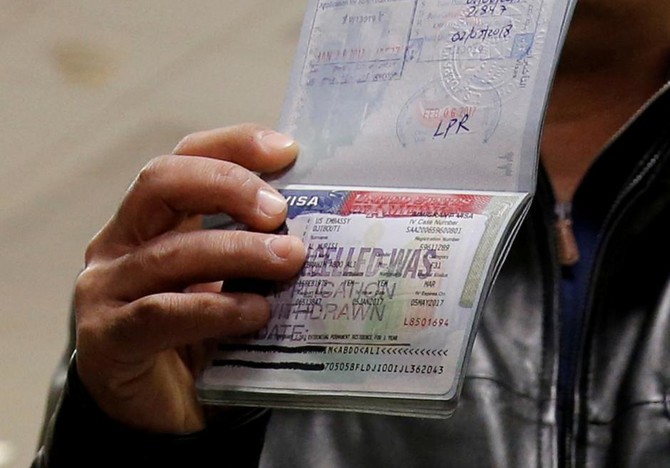
Man denied entry into the U.S. because of the recent travel ban, shows the cancelled visa in their passport from their failed entry to reporters as they successfully arrive to be reunited with their family at Washington Dulles International Airport in Chantilly, Virginia, U.S. February 6, 2017. (REUTERS)
Updated 09 October 2017
Follow

Turkey urges US to review visa suspension as lira, stocks tumble

ANKARA: Turkey urged the United States on Monday to review its suspension of visa services after the arrest of a US consulate employee sharply escalated tensions between the two NATO allies and drove Turkey’s currency and stocks lower.
Relations between Ankara and Washington have been plagued by disputes over US support for Kurdish fighters in Syria, Turkey’s calls for the extradition of a US-based cleric and the indictment of a Turkish former minister in a US court.
But last week’s arrest of a Turkish employee of the US consulate in Istanbul marked a fresh low. Turkey said the employee had links to US-based Muslim cleric Fethullah Gulen, blamed by Ankara for a failed military coup in July 2016.
The US embassy in Ankara condemned those charges as baseless and announced on Sunday night it was halting all non-immigrant visa services in Turkey while it reassessed Turkey’s commitment to the security of its missions and staff.
Within hours, Ankara announced it was taking the same measures against US citizens seeking visas for Turkey.
On Monday the Turkish foreign ministry summoned a US diplomat to urge the United States to lift the visa suspension, saying it was causing “unnecessary tensions.”
Justice Minister Abdulhamit Gul said that if Washington had serious security concerns about its missions in Turkey, steps would be taken to address them.
“But if it’s an issue regarding the arrest of the consulate employee, then this is a decision the Turkish judiciary has made,” Gul told A Haber television. “Trying a Turkish citizen for a crime committed in Turkey is our right.”
State-run Anadolu news agency said another US consulate worker had been summoned to testify over his wife and daughter’s suspected links to Gulen — which it said had emerged during the questioning of Metin Topuz, the employee arrested last week.

Investors rattled
The diplomatic spat spooked investors. The lira dropped 3.4 percent and stood at 3.7385 against the dollar after being quoted overnight as touching a level of 3.9223.
The main BIST 100 stock index fell as much as 4.7 percent, closing the day down 2.73 percent at 101,298 points.
Airline shares were particularly hard hit, with flag carrier Turkish Airlines falling 9 percent.
The central bank said it was following developments closely.
“This looks like a really serious situation,” said Blue Bay Asset Management strategist Timothy Ash, adding that the central bank would need to move quickly to calm market nerves and possibly hike interest rates — something President Tayyip Erdogan has resisted.
Turkey’s leading business association, TUSIAD, warned that the dispute would harm bilateral economic, social and cultural ties, and called for disagreements to be settled calmly.
The dispute with the United States coincides with deep strains in Turkey’s relations with Germany, another key ally, and with Turkish military activity at the Syrian and Iraqi borders, though their market impact has so far been limited.
US-Turkish tensions have risen in recent months over US military support for Kurdish YPG fighters in Syria, considered by Ankara to be an extension of the banned PKK which has waged an insurgency for three decades in southeast Turkey.
Turkey has also pressed, so far in vain, for the United States to extradite Muslim cleric Fethullah Gulen, viewed in Ankara as the mastermind behind the failed coup in which more than 240 people were killed. Gulen denies any involvement.
Friction with the United States has also arisen from the indictment last month by a US court of Turkey’s former economy minister Zafer Caglayan, charged with conspiring to violate US sanctions on Iran.
Sinan Ulgen, an analyst and former Turkish diplomat, said those underlying disputes had created a crisis of confidence which made this latest fallout particularly bitter.
“This harshness is a result of a build-up,” he said. “We should not consider this as solely a reaction to the detentions of consulate employees.”

Israeli forces bulldozed part of war cemetery in Gaza containing Allied graves, satellite images show

Updated 10 sec ago
Follow

Israeli forces bulldozed part of war cemetery in Gaza containing Allied graves, satellite images show

  • Rows of gravestones removed and topsoil churned up by extensive earthworks at Gaza War Cemetery in Al-Tuffah, eastern Gaza City
  • More than 100 Second World War graves, mostly of Australians alongside British and Polish troops, appear to have been flattened, along with 4 sections of British First World War graves

GAZA CITY: Israeli forces bulldozed part of a Gaza cemetery containing the graves of British, Australian and other Allied soldiers killed during the First and Second World Wars, according to satellite imagery and witness testimony.

Satellite images of the Gaza War Cemetery at Al-Tuffah, in eastern Gaza City, reveal extensive earthworks in the southern corner of the graveyard. Rows of gravestones have been removed, topsoil is churned up and a large berm of piled earth cuts through the affected area. The damage appears consistent with the use of heavy machinery.

The destruction was not visible on satellite images from March last year but appears clearly in photographs taken on Aug. 8 and Dec. 13.

While vegetation has regrown across much of the cemetery, certain sections remain bare, with mounds of sand and disturbed soil marking the area where graves once lay.

Essam Jaradah, former caretaker of the cemetery, said bulldozing took place outside and inside the cemetery walls.

“Two bulldozing operations took place at the cemetery,” he said. “The first bulldozing occurred outside the cemetery walls, extending approximately 12 meters around all sides of the cemetery. These areas were entirely planted with olive trees.

“Later on, an area of slightly less than 1 dunum (1,000 sq. meters) was bulldozed inside the cemetery walls, specifically in the corner of the cemetery, which contains graves of Australian soldiers.

“The bulldozing covered the area from the bench where foreign visitors used to sit, up to the memorial monument. Bulldozers also created sand mounds that were used as earth barriers.”

Jaradah said he discovered the damage after Israeli forces withdrew from the area in late April or early May last year.

After being shown the satellite imagery, the Israeli army said it had taken “defensive measures” during active combat operations.

“At the relevant time, the area in question was an active combat zone,” a spokesperson for the Israel Defense Forces said.

“During IDF operations in the area, terrorists attempted to attack IDF troops and took cover in structures close to the cemetery. In response, to ensure the safety of IDF troops operating on the ground, operational measures were taken in the area to neutralize identified threats.

“We emphasize that underground terrorist infrastructure was identified within the cemetery and in its surrounding area, which the IDF located and dismantled. IDF activity in sensitive areas is approved by senior ranks in the army and handled with the required sensitivity needed.”

The Commonwealth War Graves Commission, which maintains the cemetery, said in December that there had been serious damage at the site.

“As a result of the conflict, the cemetery has suffered extensive damage to headstones, memorials, boundary walls, staff facilities and storage areas,” it said.

It confirmed that a memorial to the British army’s 54th (East Anglian) Infantry Division had been damaged, as well as an Indian UN memorial, and Hindu, Muslim and Turkish sections of the cemetery.

The satellite images suggest the destruction is even more widespread; two sections containing more than 100 Second World War graves, mostly of Australian soldiers alongside British and Polish service personnel, appear to have been flattened, along with four sections of First World War graves that Commonwealth War Graves Commission records show are almost entirely those of British troops.

Many of those buried there served in Palestine during the British mandate period, some of them stationed in field hospitals.

A spokesperson for the Royal British Legion said: “We are saddened to hear that graves of British and Allied personnel who bravely served in the First and Second World Wars have been damaged. War graves honor the memory of every member of the armed forces who has made the ultimate sacrifice and deserve to be treated with the utmost respect.”