Pyongyang “restarts” operations at shuttered inter-Korean industrial complex

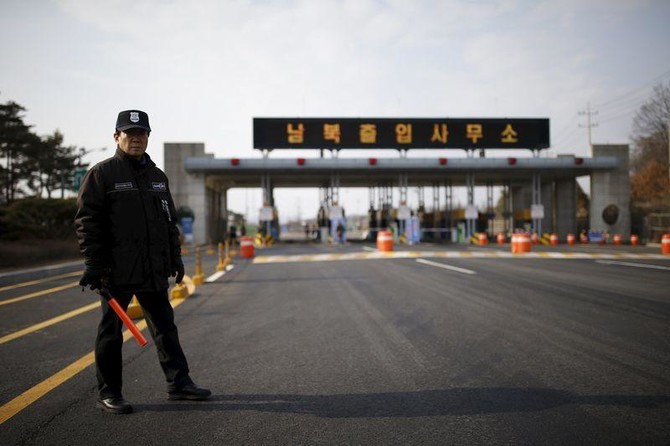
A security officer stands guard on an empty road which leads to the Kaesong Industrial Complex at South Korea’s Customs, Immigration and Quarantine zone, just south of the demilitarized zone separating the two Koreas. (Reuters)
Updated 06 October 2017
Follow

Pyongyang “restarts” operations at shuttered inter-Korean industrial complex

SEOUL: North Korea has restarted operations at the Kaesong industrial zone, state-run websites said on Friday, after the joint venture with South Korea was suspended last year amid disagreement over the North’s nuclear and missile programs.
The South ended more than a decade of cooperation at the factory park on the North Korean side of the demilitarized zone (DMZ) after the North launched a rocket that put an object into orbit, closing the last remaining window of interaction between the two sides, still technically at war.
At the time, South Korea said it would no longer allow funds paid for Kaesong to be used in the North’s missile and nuclear programs. Since then, a South Korean official has said there is no evidence that North Korea diverted wages paid to its workers by South Korean companies operating in the park to its weapons programs.
“They do not even see our proud workers laboring vigorously working in the Kaesong industrial complex,” North Korea’s propaganda web site Meari (arirangmeari.com) said in a post dated Friday.
Another propaganda web site, Uriminzokkiri, said “it is nobody’s business what we do in an industrial complex where our nation’s sovereignty is exercised.”
An official at South Korea’s Ministry of Unification said that North Korea must not violate South Korean firms’ property rights within the complex, wire service Yonhap reported.
The Ministry of Unification could not be immediately reached for comment.
Reclusive North Korea and the rich, democratic South are technically still at war because their 1950-53 conflict ended in a truce, not a peace treaty.
In recent weeks, North Korea has launched two missiles over Japan and conducted its sixth nuclear test, and may be fast advancing toward its goal of developing a nuclear-tipped missile capable of hitting the US mainland.
US Secretary of State Rex Tillerson said last weekend that Washington was directly communicating with Pyongyang on its nuclear and missile programs but that Pyongyang had shown no interest in dialogue.
US President Donald Trump later dismissed any prospect of talks with North Korea as a waste of time.


Saudi minister at Davos urges collaboration on minerals

Global collaboration on minerals essential to ease geopolitical tensions and secure supply, WEF hears. (Supplied)
Updated 20 January 2026
Follow

Saudi minister at Davos urges collaboration on minerals

  • The reason of the tension of geopolitics is actually the criticality of the minerals

LONDON: Countries need to collaborate on mining and resources to help avoid geopolitical tensions, Saudi Arabia’s minister of industry and mineral resources told the World Economic Forum on Tuesday.

“The reason of the tension of geopolitics is actually the criticality of the minerals, the concentration in different areas of the world,” Bandar Alkhorayef told a panel discussion on the geopolitics of materials.

“The rational thing to do is to collaborate, and that’s what we are doing,” he added. “We are creating a platform of collaboration in Saudi Arabia.”

Bandar Alkhorayef, Saudi Minister of Industry and Mineral Resources 

The Kingdom last week hosted the Future Minerals Forum in Riyadh. Alkhorayef said the platform was launched by the government in 2022 as a contribution to the global community. “It’s very important to have a global movement, and that’s why we launched the Future Minerals Forum,” he said. “It is the most important platform of global mining leaders.”

The Kingdom has made mining one of the key pillars of its economy, rapidly expanding the sector under the Vision 2030 reform program with an eye on diversification. Saudi Arabia has an estimated $2.5 trillion in mineral wealth and the ramping up of extraction comes at a time of intense global competition for resources to drive technological development in areas like AI and renewables.

“We realized that unlocking the value that we have in our natural resources, of the different minerals that we have, will definitely help our economy to grow to diversify,” Alkhorayef said. The Kingdom has worked to reduce the timelines required to set up mines while also protecting local communities, he added. Obtaining mining permits in Saudi Arabia has been reduced to just 30 to 90 days compared to the many years required in other countries, Alkhorayef said.

“We learned very, very early that permitting is a bottleneck in the system,” he added. “We all know, and we have to be very, very frank about this, that mining doesn’t have a good reputation globally.

“We are trying to change this and cutting down the licensing process doesn’t only solve it. You need also to show the communities the impact of the mining on their lives.”

Saudi Arabia’s new mining investment laws have placed great emphasis on the development of society and local communities, along with protecting the environment and incorporating new technologies, Alkhorayef said. “We want to build the future mines; we don’t want to build old mines.”