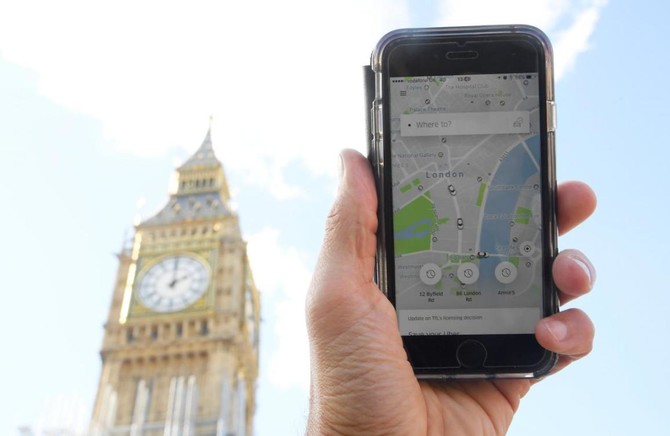
LONDON: Uber said on Monday it was not clear what concerns London’s transport regulator had for stripping it of its license as the taxi app battles to keep operating in one of the world’s wealthiest cities.
On Friday, the British capital’s regulator deemed Uber unfit to run a taxi service and decided not to renew its license to operate, which will end this week, citing the firm’s approach to reporting serious criminal offenses and background checks on drivers.
“Sitting down with TfL (Transport for London) representatives as soon as possible would be the most helpful thing to really understand their concerns to work out what they are,” Uber’s UK Head of Cities Fred Jones told BBC radio.
“It’s just not clear for us what their concerns might be.”

Uber says not clear what prompted London regulator to strip it of license
Families of Venezuelans detained for political activism demand their release outside infamous prison
- Those gathered Saturday outside the facility included political activists released from prison over the past month
CARACAS, Venezuela: Dozens of relatives and friends of Venezuelan opposition leaders, human rights defenders and others detained for their political activities protested Saturday outside a notorious prison in the capital to demand the immediate release of their loved ones.
The demonstration outside Helicoide prison in Caracas comes during mounting pressure on the government of acting President Delcy Rodríguez to release all people whose detentions months or years ago have been linked by their families and nongovernmental organizations to their political beliefs. Her government last month announced it would free a significant number of prisoners, but families and human rights watchdogs have criticized authorities for the slow pace of the releases.
Rodríguez last month also promised to close Helicoide, where torture and other forms of physical and psychological abuse of prisoners have been extensively documented. She said the facility, which was initially built to be a mall, would be turned into a cultural, social and sports center for police forces and adjacent neighborhoods.
Those gathered Saturday outside the facility included political activists released from prison over the past month. They joined families and friends in prayer before marching about two blocks to reach the doors of Helicoide, where they sang Venezuela’s national anthem and chanted “Freedom! Freedom!”
“We, as family members, and I personally on behalf of my husband, Freddy Superlano, feel this is a mockery, a lack of respect,” Aurora Silva, whose husband is a former lawmaker for the opposition, said. She was referring to the pace of releases since they were announced on Jan. 8 by Rodríguez’s brother and National Assembly leader, Jorge Rodríguez. “Releases have been carried out piecemeal, and I believe that’s only prolonging the suffering of all the families outside the detention centers.”
Silva’s husband is being held at a facility outside Caracas.
The ruling party-controlled National Assembly this week began debating an amnesty bill that could lead to the release of hundreds of prisoners. Such an amnesty is a central demand of the country’s opposition and human rights activists, who have so far reacted only with cautious optimism and with demands for more information on the contents of the proposal.
Jorge Rodríguez on Friday posted a video on Instagram showing him outside a detention center in Caracas and saying that “everyone” would be released no later than next week, once the amnesty bill is approved.
“Between next Tuesday and Friday at the latest, they’ll all be free,” he said from the location where the loved ones of detainees have spent weeks waiting for their release.
Delcy Rodríguez, who was sworn in as acting president after the capture of then-President Nicolás Maduro by the US military, has expressed hope that the law will help “heal the wounds left by the political confrontation” since the rise to power of the late Hugo Chávez, the self-proclaimed socialist leader who governed Venezuela from 1999 to 2013.