ANKARA: Iraq has suspended all international flights to and from Iraqi Kurdistan’s capital Irbil from Friday, as Baghdad cranked up the pressure on the Kurds over their independence referendum last Monday.
The cut in foreign air links, Baghdad’s first retaliatory measure against the referendum — in which 92 percent voted for independence from Iraq — was condemned on Thursday by the Kurdistan Regional Government (KRG) as “collective punishment against the Kurds.”
Irbil Airport Director Talar Faiq Salih said all international flights to and from the city would stop from 6 p.m. (1500 GMT) on Friday, following a decision by the Iraqi Cabinet.
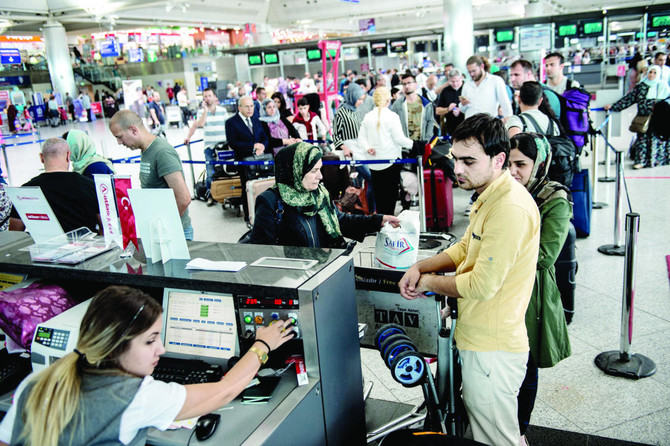
Thursday’s decision saw people, many of them foreigners, turn out in droves at Irbil Airport to avoid getting stuck in the autonomous Kurdish region of northern Iraq.
Measures adopted by Baghdad in the wake of the referendum “are illegal and unconstitutional… They deny the constitutional rights of the Kurds,” the KRG said, adding that it was “ready for dialogue to resolve problems” with Baghdad.
Since the referendum, Turkey — which has called it “illegitimate” — has been coordinating countermeasures with Baghdad.
The office of Iraqi Prime Minister Haider Al-Abadi on Thursday said Ankara agreed to deal only with Baghdad regarding crude oil exports.
Turkish Prime Minister Binali Yildirim on Thursday said Ankara, Tehran and Baghdad will soon hold a trilateral summit to coordinate measures against the KRG.
The Turkish and Iraqi armies have been conducting joint drills along their border since Sunday evening.
On Wednesday, the Turkish Foreign Ministry issued a second travel warning against Irbil, Dohuk and Sulaimaniyah provinces of Iraq due to potential security risks.
On the same day, Ankara held a high-level security summit over recent developments in northern Iraq and Syria, presided by President Recep Tayyip Erdogan.
In line with the Iraqi Civil Aviation Authority’s decision to execute an air embargo and suspend international flights, Turkey’s leading airlines — Turkish Airlines, AtlasGlobal and Pegasus — are to suspend flights to northern Iraq as of Friday until further notice.
Erdogan on Thursday said KRG President Masoud Barzani has “thrown himself into the fire” by holding the referendum.
Mehmet Akif Okur, a Middle East expert from Yildiz Technical University in Istanbul, said Ankara’s measures aim to show the KRG that any declaration of independence will have a cost.
“Although he has close relations with Ankara, Barzani didn’t negotiate with Turkish authorities before taking such a crucial decision as the referendum,” Okur told Arab News.
“Now Ankara wants to warn the KRG that any independence declaration might result in more serious consequences.”
On Thursday, Turkey said it had begun preparations to open a new border crossing in Ovakoy near the border with Iraq, as an alternative to the Habur crossing with the KRG.
“Trade revenue from Ovakoy will be taken by Baghdad. It’ll be an economic sanction on the KRG because Habur was the primary door for it to trade with the world,” Okur said.
“But sanctions should bear in mind that we have historical and cultural ties with northern Iraq. Humanitarian concerns should be taken into consideration.”
Galip Dalay, research director at Al-Sharq Forum in Istanbul, said Turkey should keep channels open with both Baghdad and the KRG.
“It shouldn’t burn bridges with the Iraqi Kurds,” he told Arab News. “In the end, Iraqi Kurds and the central government will sit down for talks.”
Dalay said some of the rhetoric from Baghdad is mostly meant for domestic consumption. “Elections are taking place in April, and there’s fierce rivalry between different groups and personalities within the Iraqi Shiite political establishment. This creates fertile ground for unfruitful discourse, but it’s untenable,” he said.
So Turkey should not be party to Iraqi internal politics, and should not adopt sanctions against the KRG, he added.
“Previous cases show that sanctions aren’t that effective as a foreign policy tool. Saddam Hussein’s sanctions against the Kurds in 1992 proved to be counterproductive for his regime, and paved the way for the Kurdish state-building process,” Dalay said.
“In Iraq, there aren’t just two options: Separation or the status quo. There are other options too, such as a confederation. Turkey should invest time and energy into such viable options.”


![]()
Iraq imposes flight ban on Irbil
Iraq imposes flight ban on Irbil
Latest updates


© 2026 SAUDI RESEARCH & PUBLISHING COMPANY, All Rights Reserved And subject to Terms of Use Agreement.