Iraq’s Kurds vote 'yes' to independent state in referendum — official results

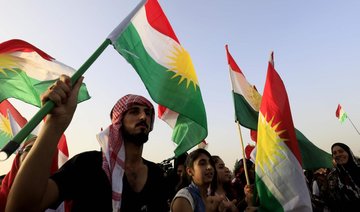
Syrian Kurds wave the Kurdish flag, in the northeastern Syrian city of Qamishli on September 26, 2017. (File photo by AFP)
Updated 28 September 2017
Follow

Iraq’s Kurds vote 'yes' to independent state in referendum — official results

IRBIL: Iraq’s Kurds announced a massive “yes” vote for independence on Wednesday following a referendum that has incensed Baghdad and sparked international concern.
Official results showed 92.73 percent of voters backing statehood in Monday’s non-binding referendum, which Iraq’s central government rejected as illegal. Turnout was put at 72.61 percent.
Longtime Iraqi Kurd leader Masoud Barzani said the vote would not lead to an immediate declaration of independence and should instead open the door to negotiations.
But Iraqi Prime Minister Haider Al-Abadi told lawmakers on Wednesday there was no question of using its results as the basis for talks.
“The referendum must be annulled and dialogue initiated in the framework of the constitution. We will never hold talks based on the results of the referendum,” Abadi said.
“We will impose Iraqi law in the entire region of Kurdistan under the constitution,” he said.
Pressure has been mounting on the Kurds since the vote, not just from Baghdad but also from Ankara, with Turkey threatening a range of measures including cutting off key export routes for the region.
An overwhelming “yes” vote had been widely expected from the electorate of 4.58 million.
Pursuing a long-cherished dream of statehood, the Kurds went ahead with the referendum in defiance of widespread objections, including from the United Nations and United States.
It has raised fears of unrest and the possibility of a military confrontation involving the Kurds, who are key allies in internationally backed offensives against the jihadists of the Daesh group.
In a televised address late on Tuesday, Barzani had urged Abadi “not to close the door to dialogue because it is dialogue that will solve problems.”
“We assure the international community of our willingness to engage in dialogue with Baghdad,” he said, insisting the referendum was not meant “to delimit the border (between Kurdistan and Iraq), nor to impose it de facto.”

Baghdad pushes back 
Lawmakers on Wednesday passed a resolution calling on Abadi to “take all necessary measures to maintain Iraq’s unity” including by deploying security forces to disputed areas.
The resolution also called for the closure of border posts with Turkey and Iran that are outside central government control.
Abadi said Tuesday he would ban all international flights to and from Kurdistan in three days unless airports in its main cities Irbil and Sulaimaniyah were placed under his government’s control.
Airlines from Turkey as well as Egypt, Jordan and Lebanon said Wednesday they will halt flights to and from Iraqi Kurdistan this week until further notice at the request of Baghdad.
Turkey fears the vote will stoke the separatist ambitions of its own sizeable Kurdish minority and on Tuesday President Recep Tayyip Erdogan warned that Iraq’s Kurds risked sparking an “ethnic war.”
“If Barzani and the Kurdistan Regional Government do not go back on this mistake as soon as possible, they will go down in history with the shame of having dragged the region into an ethnic and sectarian war,” he said.
Erdogan had earlier warned that Turkey would shut its border with Iraqi Kurdistan and threatened to block oil exports from the region through his country.

Erdogan even suggested the possibility of a cross-border incursion similar to the one Turkey carried out against IS and Kurdish fighters in Syria.
Monday’s vote took place across the three northern provinces of autonomous Iraqi Kurdistan — Irbil, Sulaimaniyah and Dohuk — and in disputed border zones such as the oil-rich province of Kirkuk.
Opponents have accused Barzani of seeking to empower himself through the vote, and said he should have accepted a UN-backed plan to postpone the referendum in favor of negotiations with Baghdad.
Iran, which also has a large Kurdish minority, condemned the vote as well and on Sunday stopped all flights from its territory to and from Iraqi Kurdistan.
Analysts say that despite their threats, Baghdad, Ankara and Tehran are proceeding cautiously in reacting to the vote, wary of sparking a serious confrontation with the Kurds that would further destabilize an already volatile region.
Closing their borders with Iraqi Kurdistan would also hurt Turkey, which exports more than $8 billion worth of goods every year to the region, and Iran, which exports about $6 billion.
Left without a state of their own when the borders of the Middle East were redrawn after World War I, the Kurds see themselves as the world’s largest stateless people.
The non-Arab ethnic group of between 25 and 35 million is spread across Iraq, Iran, Turkey and Syria.
Retouched images of Israel’s first lady, distributed by the state, ignite a fiery ethics debate

Updated 58 min 18 sec ago
Follow

Retouched images of Israel’s first lady, distributed by the state, ignite a fiery ethics debate

  • Since the manipulation of images was revealed, the government has taken the unprecedented step of crediting Sara Netanyahu in its releases that include manipulated images

JERUSALEM: The photos seemed destined for posterity in Israel’s state archives.
In the snapshots, Prime Minister Benjamin Netanyahu is joined by his wife, Sara, as well as US Ambassador Mike Huckabee and a group of Israeli soldiers, as they light Hannukah candles at Western Wall, the holiest site where Jews pray. The leaders exchange triumphant looks.
But something is off.
Sara Netanyahu’s skin is poreless, her eyes overly defined and her hair perfectly coiffed — a look officials acknowledge is the result of heavy retouching.
Critics say the issue isn’t the use of photo-editing software, which is common on the social media accounts of celebrities and public figures. They say it’s the circulation of the images in official government announcements, which distorts reality, violates ethical codes and risks compromising official archiving and record-keeping efforts.
“All the pictures to this day in the archives in Israel are authentic pictures of reality as it was captured by the lenses of photographers’ cameras since the establishment of the state,” said Shabi Gatenio, the veteran political journalist who broke the story in The Seventh Eye, an Israeli site that covers local media. “These images, if entered into the database, will forever infect it with a virtual reality that never existed.”
Since the manipulation of images was revealed, the government has taken the unprecedented step of crediting Sara Netanyahu in its releases that include manipulated images. And it’s not clear if official archive will include images of her taken during the second half of last year, when Gatenio said the editing appears to have begun.
The first lady’s personal spokesperson did not respond to a request for comment.
Nitzan Chen, director of the Government Press Office, told The Associated Press that images of the prime minister are never manipulated and that his office would not upload any retouched photos to the official archive.
Personal Photoshop habit enters political realm
Sara Netanyahu, 67, has long used photo-editing software on her images. Her social media account is filled with images in which her face appears heavily retouched.
But the topic raised eyebrows since her Photoshop habit entered the public record.
Gatenio said he first noticed this last July, when the couple visited President Donald Trump in Washington, D.C., and again in September, as Sara Netanyahu joined her husband on the tarmac ahead of a trip to New York for the UN General Assembly.
At the time, the prime minister’s office released a video of the send-off along with a photo, credited to Avi Ohayon, an official government photographer.
Comparing the photo to the raw video, Hany Farid, a digital forensics expert at the University of California, Berkeley, said the image had been post-processed, bearing local manipulations to smooth the first lady’s skin and remove wrinkles.
Since then, photos showing the first lady meeting with Vice President JD Vance and his wife, Usha, in Washington also appear to have been retouched, Farid said.
“There’s been some Photoshop editing to — let’s call it — ‘beautify,’ lighten, smooth the face,” Farid said.
“Is it nefarious? No. Is it a problem? Yes. This is about something bigger than, ‘she Photoshopped her face to make herself look younger.’ This is about trust. Why should I trust any official photo coming out of that administration?”
Chen, the head of the Government Press Office, said office lawyers are trying to determine how to handle and properly identify photos “processed by people other than GPO photographers.”
He said the Justice Ministry is also examining the “criteria, limitations and possibilities” of the edited images, though he stressed there is nothing illegal about touching up photos. The issue, he said, is being transparent when such changes are made.
For now, his office has decided to add Sara Netanyahu’s name to press releases that include retouched images. Since November, press releases showing photos of her smiling next to Trump and the family of the last hostage in Gaza in Washington, visiting a Miami synagogue and attending a funeral for an Israeli mayor have included this label.
At least one outlet, the Times of Israel, has said it will no longer carry official state photos that appear to have been manipulated. The Associated Press does not publish images that appear to have been retouched or digitally manipulated.
A broader phenomenon
Chen said the prime minister is never edited: “No Photoshop, no corrections, no color. Nothing.”
While his face may not be retouched, the prime minister’s official Instagram account tells another story.
The page has posted a bevy of content that appears to be AI-edited or generated, including a picture of the couple with Trump and first lady Melania Trump celebrating the new year in Washington.
The photo raised suspicions in Israel because it shows Sara Netanyahu wearing a black dress absent from other photos of the event, where she wore a dark red frock. Appearing in the sky above the couples are brightly colored fireworks and American and Israeli flags that Farid said were “almost certainly” generated by AI.
It is now marked with a tag on Instagram indicating that it may have been altered or generated using AI. It is not clear when the tag was added nor by whom.
Netanyahu is not alone. Many world figures, including Trump, use AI-generated image manipulation frequently in their public output.
Tehilla Shwartz Altshuler, who runs the “Democracy in the Digital Age Program,” at the Israel Democracy Institute, a Jerusalem think tank, called it “part of the populist playbook” and said there was “no question” that Netanyahu was emulating how Trump uses the technology.
Netanyahu’s official Instagram has posted video of Trump and Netanyahu in a B-2 bomber that appears entirely AI-generated. It is captioned “on our victory lap,” referencing the joint Israel-US attacks on Iran last year.
“This is exactly what Netanyahu and his surrounding circle have tried to do for many years,” she said. “Presenting himself as a superhero, his wife as a supermodel, their family as a super loyal family. Even when it wasn’t the case, even at the expense of actual political work, administrative work and social work.”
She said Israel has reached a critical point in official government record-keeping and communications.
“The question of archiving the truth, archiving history, will be one of the questions of our time.”