WASHINGTON: A vote by Iraq’s minority Kurds for independence is a blow to the US, which has spent years, billions of dollars and the lives of thousands of troops trying to hold Iraq together, former US officials and other policy experts said.
A diplomatic drive to forestall Monday’s referendum failed to persuade Kurdish leaders, some of the US’ closest Middle Eastern allies, in what likely will be seen as fresh proof of diminishing American power, they said.
The Kurds, who have ruled over a semi-autonomous region within Iraq since the 2003 US-led invasion that toppled Saddam Hussein, consider the result a historic step in a generations-old quest for a state of their own.
“This is a major setback,” said James Jeffrey, a former US ambassador to Iraq and now a senior fellow at the Washington Institute for Near East Policy. “It robs us of the argument that only the US can keep Iraq united.”
As a result, the US could find it harder to stop predominantly Shiite Muslim Iran from filling the vacuum left by Daesh defeat through Shiite militias and other allies in Iraq, Syria, and elsewhere, they said.
Moreover, the vote to give Kurdish leaders a mandate to negotiate independence for their region of more than 8.3 million threatens to ignite more strife. That could hinder US-backed efforts to stabilize Iraq, eliminate the remnants of Islamic State, or ISIS, and similar groups.
“We see considerable risk,” said a US official, who spoke on condition of anonymity.
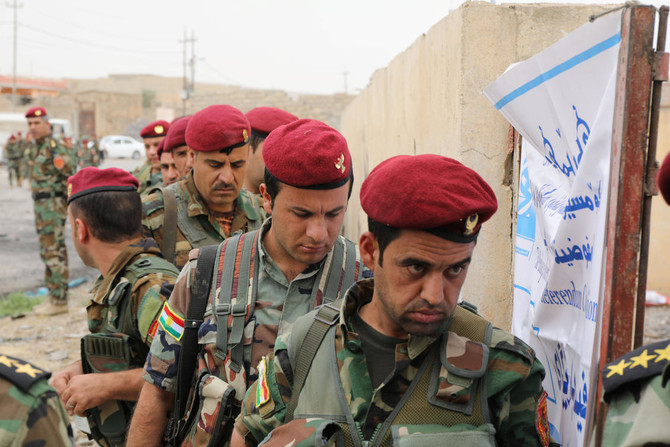
The gravest danger is a conflict over the disputed oil-rich city of Kirkuk and other ethnically mixed Kurdish-held areas pitting Iraqi troops and Iran-backed Shiite militias against the Peshmerga, the Kurdistan Regional Government’s US-trained paramilitary force.
Such bloodletting could foreclose Trump administration hopes of promoting negotiations between Baghdad and the KRG and avert a Kurdish declaration of independence.
“We say keep your eye on the ball,” State Department spokeswoman Heather Nauert said on Tuesday. “This kind of division right now could potentially hurt Iraq.”
A conflict also could halt US-backed operations to return home Sunnis displaced by the battles that have reclaimed nearly all the “caliphate” Islamic State declared in 2014.
“We are still hopeful of getting people to talk through this stuff rather than doing something more drastic,” said a second US official, who also requested anonymity.
The referendum was condemned by neighboring Turkey and Iran, which fear it will embolden independence demands by their Kurdish populations. Ankara and Tehran, trading partners of landlocked Iraqi Kurdistan, are threatening retaliation; fueling fears they could intervene militarily.
There were expectations that the US, which said it would not recognize the vote, could use its ties to the Iraqi Kurds to persuade KRG President Masoud Barzani to cancel the referendum in exchange for a guarantee of talks with Baghdad.
The US protected the Iraqi Kurds when they rebelled against Hussein after the 1991 Gulf War.
“The Americans are the midwife of Iraqi Kurdistan,” said Robert Ford, a retired US diplomat now with the Middle East Institute think tank, who served as deputy ambassador to Iraq. “The Kurds moving ahead (with the vote) is a sign of American credibility being much less than it used to be.”
The US bid to stop the referendum failed, experts said, in part because the aging Barzani sees fulfilling aspirations for an independent Kurdish state as his legacy.
Moreover, said Peter Galbraith, a former US diplomat with ties to Kurdish leaders, the Trump administration mistakenly thought Barzani could weather the backlash from canceling the referendum, which the White House demanded just 10 days before it was held.
“This was the most astonishingly inept diplomatic initiative I have ever seen,” Galbraith said.
Former ambassador Jeffrey said the administration also failed to account for Iran’s growing influence. “One thing that pushed the Kurds in this direction is the fear that Iraq is coming under the domination of Iran and the Shiite militias,” he said. “The underlying problem in Iraq is that the Shiite parties in Baghdad do not want to share power with the Sunni Arabs and the Kurds.”


![]()
Kurdish independence vote damages US efforts to preserve unified Iraq
Kurdish independence vote damages US efforts to preserve unified Iraq

Latest updates


© 2026 SAUDI RESEARCH & PUBLISHING COMPANY, All Rights Reserved And subject to Terms of Use Agreement.