ISLAMABAD: Ousted Pakistani Prime Minister Nawaz Sharif appeared before an anti-corruption court on Tuesday, kicking off trial proceedings that he says are biased and which threaten to dent his party’s chances at the next general election due in mid-2018.
Sharif briefly appeared before a National Accountability Bureau (NAB) court in Islamabad on three corruption charges. He did not enter a plea.
Local TV channels reported that Sharif is scheduled to be formally indicted on Oct. 2, about two months after his disqualification by the Supreme Court for not declaring a small source of income that he denied receiving.
A Supreme Court panel has also alleged Sharif family’s wealth far exceeds their legal income.
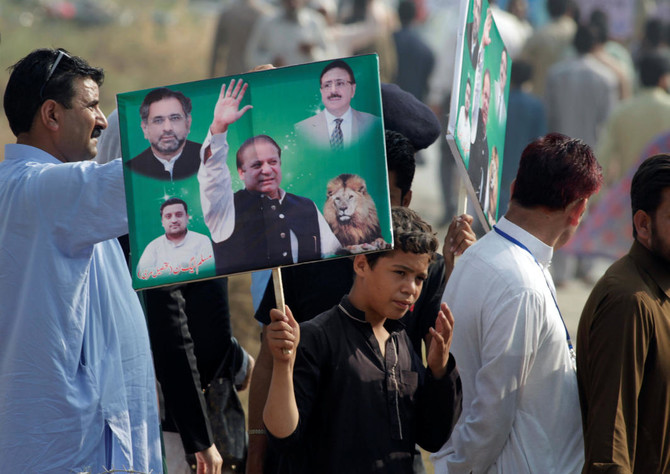
“He has appeared before the court and by appearing he has proved to be a lion,” said Marvi Memom, a lawmaker for Sharif’s ruling Pakistan Muslim League-Nawaz (PML-N)party.
Sharif, who returned from London on Monday after about a month in Britain, told the court his wife was being treated for cancer in London and needs his care.
He did not speak to the media after his court appearance but is due to hold a televised press conference at 3pm (1000 GMT).
Sharif has portrayed the corruption claims against him as politically motivated, while his allies, including daughter and heir-apparent Maryam, have hinted Pakistan’s powerful military had a hand in his toppling. The military denies any such action.
“It’s a good thing that finally NAB and such institutions are holding rich and powerful to the count,” said Shafqat Mahmood, a senior members of the opposition Pakistan Tehreek-e-Insaf (PTI) party.
PTI, led by cricketer-turned-politician Imran Khan who doggedly pushed the Supreme Court into launching a corruption probe into Sharif, has called for an early election but it is unlikely the government will agree to that.
Sharif’s returned to Pakistan quashed growing speculation that his long absense was the start of another period in exile for the veteran leader whose three stints as prime minister were all cut short, including one by a military coup in 1999.
“What kind of justice is this, what kind of accountability is this?” Sharif told reporters outside his upscale London apartment in London before departing for Islamabad on Sunday.
Two of Sharif’s sons are also due to appear before a NAB court, as well as Finance Minister Ishaq Dar, a long-time ally who is married into the Sharif family.
Analysts say Sharif’s return to Pakistan was in large part due to fears of defections within the PML-N, a common occurrence in a nation where politicians switch allegiances ahead of polls depending on which way the political winds are blowing.
Sharif kept control of PML-N after his ouster and installed loyalist Shahid Khaqan Abbasi as prime minister.
The Supreme Court has told the NAB courts that the trials into the Sharifs must be over within six months, with opponents betting that a flow of negative news from the trials will hurt PML-N’s popularity ahead at the next election.


![]()
Pakistan’s ex-PM Sharif appears before anti-corruption court, set to be indicted
Pakistan’s ex-PM Sharif appears before anti-corruption court, set to be indicted


Latest updates


© 2026 SAUDI RESEARCH & PUBLISHING COMPANY, All Rights Reserved And subject to Terms of Use Agreement.