LAHORE: Every afternoon for 20 years, Huzaifa Ahmad’s mother opened the door of her home in Lahore and fed dozens of people who had nothing to eat.
“All of us in the family were instructed not to take more than we could eat, so that no one would go back hungry,” said Huzaifa.
Eventually, the young man realized that his mother’s efforts alone could not eliminate hunger from Pakistan, and that more work was needed to address both hunger and food waste.
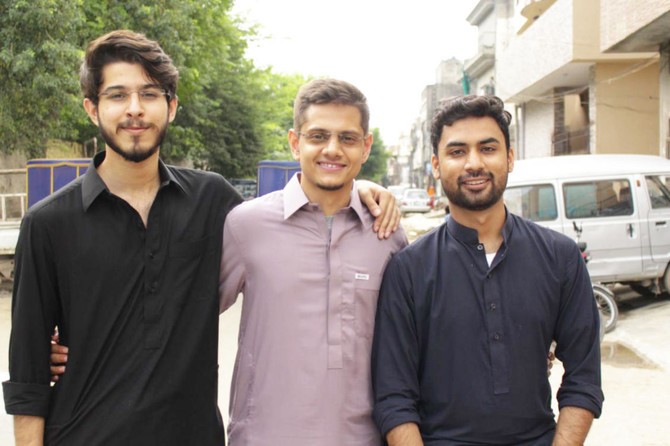
In 2015, Huzaifa, Qasim Javaid and Musa Aamir — friends from Lahore University of Management Sciences — set up Rizq, Pakistan’s first food recovery and distribution service. Since then, with the support of 720 volunteers, Rizq has collected more than 30,000kg of food, distributed more than 150,000 meals, saved food worth more than $85,000 and fed 200 families a day.
Before establishing a food bank, Rizq goes into communities that are seriously underprivileged and conducts feasibility surveys. “Families come to the food bank and register themselves for food support. All families are registered after proper verification,” Qasim said.
Rizq now has one food bank in Lahore and another in Islamabad, and aims to establish 50 more across the country in the next five years. “We want to establish food banks in some of the most food-insecure pockets of the country and hopefully make those pockets food secure,” Qassim said.
Their customized rickshaw bikes, which they call as Rizq-shaws, collect excess food from across the city and bring it to the food bank. “The food is then checked for quality, sorted, packed and then sold at a minimal cost, as low as 10 rupees per meal,” which is about 10 US cents. Families that can still not afford this are given food free.
The Rizq food bank also serves as a community center, Musa said. “When a family comes for food support, we investigate why they are food insecure. We help one of the family members to learn technical skills and earn a living. During the training program, the family receives free food support. Once the member graduates and finds a job, the family stops getting the free assistance. Thus, we focus not only on giving free handouts but also building human capacities.”
Rizq also provides free lunch boxes to underprivileged schoolchildren. “We have adopted two schools so far and are feeding 350 students on a daily basis. We design lunch boxes according to the nutritional deficiencies of the community children.”
Rizq is not a charity, but a business model, Musa said. “We are a company that makes food philanthropy smarter. We assist whoever wants to share excess food. We pick food from their doorstep for a fee and distribute it to the needy at a minimal cost. Similarly, if someone wants to feed school lunches to children, we design school lunches for them.”
Like his other two friends, Musa, 23, has no regrets about making philanthropy his career, although all three have now graduated. “We are earning decently. Perhaps a little less than the market rate but at least we are doing what we love.
“If I got anything right in my life until now, then this is it. I have learnt a lot and grown a lot, intellectually, emotionally and spiritually.”
The UN’s Food and Agriculture Organization says that although Pakistan produces enough food to feed its 180 million people, more than half of households can be classified as food insecure. Its figures suggest that the cost of a basket of food staples rose by 80 percent between 2007 and 2017. Pakistanis now spend 48.9 percent of their income on food. The province of Sindh is the poorest and most deprived food-deprived province, with 72 percent of families food insecure, followed by Baluchistan, with 63.5 percent.
OXFAM says about 40 percent of food in Pakistan is wasted. “Enough food is produced to feed the entire population but because of food waste an estimated 6 out of 10 people go to bed hungry,” it said.
“Food waste is a crime,” Musa said. “The government of Pakistan should take food waste seriously and introduce laws. Many governments in the West either incentivize restaurants and consumers to share more food, or penalize them for wasting food. Such attempts will go a long way to solving the problem.”


![]()
Fighting Pakistan’s food waste, one lunch box at a time
Fighting Pakistan’s food waste, one lunch box at a time

Latest updates


© 2026 SAUDI RESEARCH & PUBLISHING COMPANY, All Rights Reserved And subject to Terms of Use Agreement.