MANILA: Left-wing activists and political opponents of Philippine President Rodrigo Duterte held rallies on Thursday to warn against what they see as the emergence of a dictatorship under the no-nonsense but hugely popular leader.
Politicians, indigenous people, church leaders, businessmen, and leftists marched, staged rallies and attended masses to denounce Duterte, accusing him of abuses and authoritarianism similar to that of the late dictator Ferdinand Marcos.
The events were to mark the 45th anniversary of the declaration of martial law under Marcos, which lasted nine years and is remembered by many Filipinos as brutal and oppressive.
Vice President Leni Robredo appeared at a mass at the University of the Philippines, traditionally a hotbed of political activism, and was due to appear at a rally of the opposition Liberal Party she leads.
Robredo, who was not Duterte’s running mate, said Filipinos born after the Marcos era should not be complacent and should recognize signs of “rising tyranny”.
“If we do not remember the past, we are condemned to repeat it,” she said in a statement. “Sadly those who are deceived do not even know that they are walking a doomed path.”
Marcos declared martial law in 1972, a year ahead of elections in which he was ineligible to run, and held power for 14 years until his removal in a bloodless, army-backed “people’s power” uprising.
He abolished democratic institutions and was accused of killing, torturing and “disappearing” thousands of opponents.
Duterte has expressed admiration for Marcos several times and his fiercest critics are alarmed by the former mayor’s autocratic rhetoric and his disdain for those who oppose him.
However, many millions are drawn to Duterte’s down-to-earth style, his decisiveness and his imperfections, and see him as a champion of ordinary Filipinos and the country’s best hope for the long overdue change that presidents from the political elite failed to bring.
Duterte declared Thursday a holiday for government workers and schools to give them a chance to protest against him. Several thousand demonstrators took the opportunity to gather separately to show their support for him.
The anti-Duterte demonstrators were not rallying in the same place or around a single issue. Some denounced his ferocious war on drugs that has killed thousands of Filipinos, while others railed against what they see as his cozy relationship with the still-powerful Marcos family.
Others complained about his pro-China stance, his threats to impose martial law nationwide and destruction in southern Marawi City by air strikes targeting Islamist militants, using US military bombs and technical support.
“The people have not forgotten and will not allow a repeat of Marcosian rule,” said Renato Reyes, leader of the leftist Bayan (Nation) group.
Reyes decried widespread human rights violations under the government’s “fascist” war on drugs, and for letting the US military involvement in Philippine security issues.
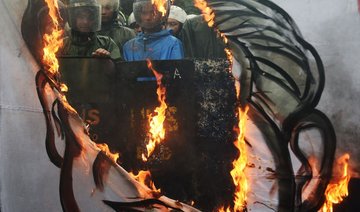
Demonstrators also planned to burn an effigy of Duterte on a throne, modeled on the evil character “Night King” in the popular television series “Game of Thrones”.


![]()

Thousands rally in the Philippines to warn of Duterte ‘dictatorship’
Thousands rally in the Philippines to warn of Duterte ‘dictatorship’


Latest updates





© 2026 SAUDI RESEARCH & PUBLISHING COMPANY, All Rights Reserved And subject to Terms of Use Agreement.