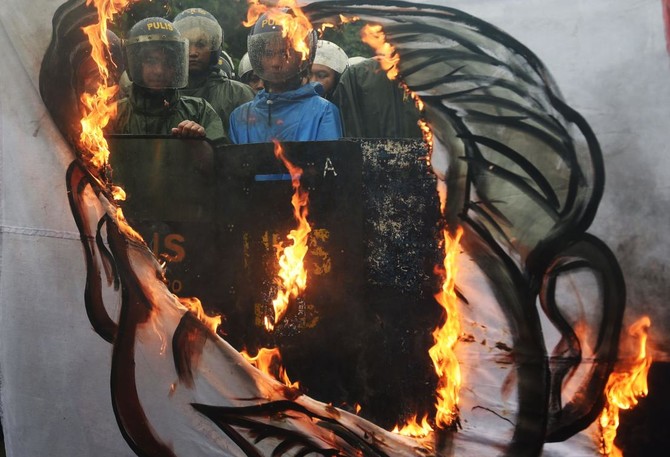
MANILA: Philippine President Rodrigo Duterte may declare nationwide martial law next week if threatened massive protests by communists and other leftists against his rule turn violent or disrupt the country, his defense chief said Friday.
“He said, if the left will try to have a massive protest, start fires on the streets, they will disrupt the country, then I might (declare martial law),” Defense Secretary Delfin Lorenzana told reporters, recounting a conversation with Duterte this week.
Lorenzana emphasized he thought the chances of Duterte declaring martial law were remote because he doubted the scheduled protests on Thursday next week would be as big as the organizers said they were planning.
“But the president is indeed very concerned because it might get out of hand. So he said I might declare martial law.”
A coalition of groups naming themselves the “Movement Against Tyranny” had announced it was planning protests on September 21, the 45-year anniversary of late dictator Ferdinand Marcos imposing his military rule.
It said the protests, to be held at a park in the capital of Manila, would voice opposition against Duterte’s war on drugs that has claimed thousands of lives, as well as the president’s attacks on democratic institutions.
The coalition also voiced outrage at Duterte’s public support for Marcos, who was overthrown in the “People Power” revolution in 1986 and died in US exile three years later.
The announcement for the protest said its theme was: “Stop the Killings! Never Again to Tyranny and Dictatorship!”
Duterte won last year’s presidential elections on a brutal law-and-order platform in which he promised an unprecedented campaign to eradicate illegal drugs in society by killing up to 100,000 traffickers and addicts.
Police have reported killing more than 3,800 people in anti-drug operations since he took office 15 months ago, while thousands of others have been murdered in unexplained circumstances.
Duterte has repeatedly threatened to impose martial law across the country, but neither he nor his aides have previously given a specific timeframe or event that would trigger it.
He imposed martial law across the southern third of the Philippines in May after Daesh group supporters occupied a major Islamic city there, leading to a conflict that has claimed more than 800 lives.

Philippines’ Duterte may declare martial law if planned protests turn violent
Trump administration labels 3 Muslim Brotherhood branches as terrorist organizations
- The State Department designated the Lebanese branch a foreign terrorist organization
- “These designations reflect the opening actions of an ongoing, sustained effort to thwart Muslim Brotherhood chapters’ violence,” Rubio said
WASHINGTON: President Donald Trump’s administration has made good on its pledge to label three Middle Eastern branches of the Muslim Brotherhood as terrorist organizations, imposing sanctions on them and their members in a decision that could have implications for US relationships with allies Qatar and Turkiye.
The Treasury and State departments announced the actions Tuesday against the Lebanese, Jordanian and Egyptian chapters of the Muslim Brotherhood, which they said pose a risk to the United States and American interests.
The State Department designated the Lebanese branch a foreign terrorist organization, the most severe of the labels, which makes it a criminal offense to provide material support to the group. The Jordanian and Egyptian branches were listed by Treasury as specially designated global terrorists for providing support to Hamas.
“These designations reflect the opening actions of an ongoing, sustained effort to thwart Muslim Brotherhood chapters’ violence and destabilization wherever it occurs,” Secretary of State Marco Rubio said in a statement. “The United States will use all available tools to deprive these Muslim Brotherhood chapters of the resources to engage in or support terrorism.”
Rubio and Treasury Secretary Scott Bessent were mandated last year under an executive order signed by Trump to determine the most appropriate way to impose sanctions on the groups, which US officials say engage in or support violence and destabilization campaigns that harm the United States and other regions.
Muslim Brotherhood leaders have said they renounce violence.
Trump’s executive order had singled out the chapters in Lebanon, Jordan and Egypt, noting that a wing of the Lebanese chapter had launched rockets on Israel after Hamas’ Oct. 7, 2023, attack in Israel that set off the war in Gaza. Leaders of the group in Jordan have provided support to Hamas, the order said.
The Muslim Brotherhood was founded in Egypt in 1928 but was banned in that country in 2013. Jordan announced a sweeping ban on the Muslim Brotherhood in April.
Nathan Brown, a professor of political science and international affairs at George Washington University, said some allies of the US, including the United Arab Emirates and Egypt, would likely be pleased with the designation.
“For other governments where the brotherhood is tolerated, it would be a thorn in bilateral relations,” including in Qatar and Turkiye, he said.
Brown also said a designation on the chapters may have effects on visa and asylum claims for people entering not just the US but also Western European countries and Canada.
“I think this would give immigration officials a stronger basis for suspicion, and it might make courts less likely to question any kind of official action against Brotherhood members who are seeking to stay in this country, seeking political asylum,” he said.
Trump, a Republican, weighed whether to designate the Muslim Brotherhood a terrorist organization in 2019 during his first term in office. Some prominent Trump supporters, including right-wing influencer Laura Loomer, have pushed his administration to take aggressive action against the group.
Two Republican-led state governments — Florida and Texas — designated the group as a terrorist organization this year.