MOSCOW: The Russian military denied claims on Sunday that it struck a US-backed force in eastern Syria, wounding six fighters.
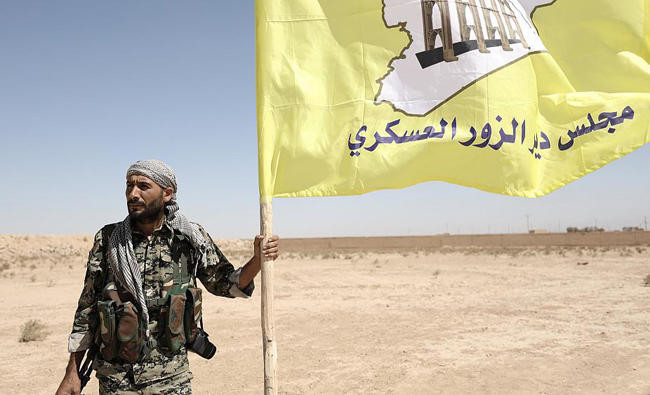
The Kurdish-led and US-supported Syrian Democratic Forces said Saturday that its fighters had been hit in the airstrike near the eastern city of Deir Ezzor in an industrial area that recently had been liberated from the Daesh group.
Western forces embedded with the SDF were not injured, the US military said. The SDF is supported by a US-led international coalition of forces to defeat Daesh militants in Syria and Iraq. An estimated 900 US troops are embedded with partner forces in Syria. They provide artillery support and can command air support.
Russian Defense Ministry spokesman Maj. Gen. Igor Konashenkov said: “Russian air forces carry out pinpoint strikes only on IS (Daesh) targets that have been observed and confirmed through several channels.”
SDF fighters have been advancing against Daesh fighters on the east bank of the Euphrates while Syrian government forces and their allies are pushing on the western side against the militants.
The march by the SDF aims to prevent Syrian troops and their allies from expanding their presence along the border with Iraq.
Also Sunday, the UN’s World Food Program halted its air drops to Deir El Zour after a convoy of its trucks was able to reach the city with food relief, for the first time since May 2014.
The five truck convoy brought with it enough wheat to feed 70,000 people, the organization said in a statement.
With the city besieged by militants from the Daesh group, the WFP began delivering aid through high-altitude air drops in April last year. It flew missions five times a week and completed 309 air drops before halting the program. Nearly 100,000 people were trapped under the siege.
Pro-government forces broke the siege on September 5 and secured the highway to the capital, Damascus, shortly after. They now control two-thirds of the city, according to the Britain-based Syrian Observatory for Human Rights monitoring group.
But the campaign has come at a high cost to civilian life, says the Observatory and the activist-run monitoring group, DeirEzzor 24.
Both groups say aircraft have been bombing river crossings, hospitals, and other civilian infrastructure along the Euphrates River Valley. The Observatory reported 34 civilian fatalities since Saturday, attributing four to coalition air strikes on the Daesh stronghold Mayadeen.
The claims could not be independently verified in real-time. The groups rely on local contacts to smuggle information out of Daesh-held territory.


![]()

Russia denies claim of airstrike on US-backed Syrian force
Russia denies claim of airstrike on US-backed Syrian force

School materials enter Gaza after being blocked for two years, UN agency says
- Thousands of kits, including pencils, exercise books and wooden cubes to play with, have now entered the enclave, UNICEF said
GENEVA: The UN children’s agency said on Tuesday it had for the first time in two-and-a-half years been able to deliver school kits with learning materials into Gaza after they were previously blocked by Israeli authorities.
Thousands of kits, including pencils, exercise books and wooden cubes to play with, have now entered the enclave, UNICEF said.
“We have now, in the last days, got in thousands of recreational kits, hundreds of school-in-a-carton kits. We’re looking at getting 2,500 more school kits in, in the next week, because they’ve been approved,” UNICEF spokesperson James Elder said.
COGAT, the arm of the Israeli military that oversees aid flows into the Gaza Strip, did not immediately respond to a request for comment.
Children in Gaza have faced an unprecedented assault on the education system, as well as restrictions on the entry of some aid materials, including school books and pencils, meaning teachers had to make do with limited resources, while children tried to study at night in tents without lights, Elder said. During the conflict some children missed out on education altogether, facing basic challenges like finding water, as well as widespread malnutrition, amid a major humanitarian crisis.
“It’s been a long two years for children and for organizations like UNICEF to try and do that education without those materials. It looks like we’re finally seeing a real change,” Elder stated. UNICEF is scaling up its education to support half of children of school age — around 336,000 — with learning support. Teaching will mainly happen in tents, Elder said, due to widespread devastation of school buildings in the enclave during the war which was triggered by Hamas’ assault on Israel on October 2023.
At least 97 percent of schools sustained some level of damage, according to the most recent satellite assessment by the UN in July.
Israel has previously accused Hamas and other militant groups of systematically embedding in civilian areas and structures, including schools, and using civilians as human shields. The bulk of the learning spaces supported by UNICEF will be in central and southern areas of the enclave, as it remains difficult to operate in the north, parts of which were badly destroyed in the final months of the conflict, Elder said.
The Hamas-led attack in October 2023 killed 1,200 people, according to Israeli tallies. Israel’s assault has killed 71,000 Palestinians, Gaza’s health authorities say. More than 20,000 children were reported killed, including 110 since the October 10 ceasefire last year, UNICEF said, citing official data.
Thousands of kits, including pencils, exercise books and wooden cubes to play with, have now entered the enclave, UNICEF said.
“We have now, in the last days, got in thousands of recreational kits, hundreds of school-in-a-carton kits. We’re looking at getting 2,500 more school kits in, in the next week, because they’ve been approved,” UNICEF spokesperson James Elder said.
COGAT, the arm of the Israeli military that oversees aid flows into the Gaza Strip, did not immediately respond to a request for comment.
Children in Gaza have faced an unprecedented assault on the education system, as well as restrictions on the entry of some aid materials, including school books and pencils, meaning teachers had to make do with limited resources, while children tried to study at night in tents without lights, Elder said. During the conflict some children missed out on education altogether, facing basic challenges like finding water, as well as widespread malnutrition, amid a major humanitarian crisis.
“It’s been a long two years for children and for organizations like UNICEF to try and do that education without those materials. It looks like we’re finally seeing a real change,” Elder stated. UNICEF is scaling up its education to support half of children of school age — around 336,000 — with learning support. Teaching will mainly happen in tents, Elder said, due to widespread devastation of school buildings in the enclave during the war which was triggered by Hamas’ assault on Israel on October 2023.
At least 97 percent of schools sustained some level of damage, according to the most recent satellite assessment by the UN in July.
Israel has previously accused Hamas and other militant groups of systematically embedding in civilian areas and structures, including schools, and using civilians as human shields. The bulk of the learning spaces supported by UNICEF will be in central and southern areas of the enclave, as it remains difficult to operate in the north, parts of which were badly destroyed in the final months of the conflict, Elder said.
The Hamas-led attack in October 2023 killed 1,200 people, according to Israeli tallies. Israel’s assault has killed 71,000 Palestinians, Gaza’s health authorities say. More than 20,000 children were reported killed, including 110 since the October 10 ceasefire last year, UNICEF said, citing official data.
Latest updates


© 2026 SAUDI RESEARCH & PUBLISHING COMPANY, All Rights Reserved And subject to Terms of Use Agreement.