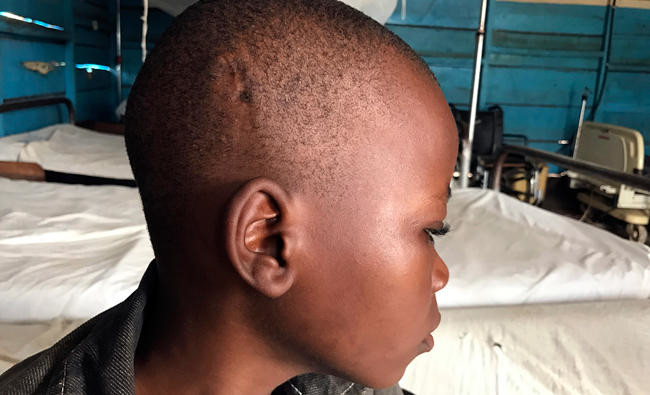
DAKAR, Senegal: Congo’s Kasai region is the latest deadly hotspot in the vast Central African country that has had violent rebellions for decades. Once again, children are among the most vulnerable victims.
Well over 1 million people have fled the fighting that began a year ago when Congo’s military killed the regional tribal leader of the Kamwina Nsapu militia. More than 3,300 people in the region have died, according to estimates by the Catholic church. The UN has counted more than 80 mass graves.
Across the once-peaceful region, children are forced to take up weapons, either recruited by militias or to defend their homes. Children make up more than half of the displaced people, said Yvon Edoumou, spokesman for the UN humanitarian office in Congo.
“We see families who say they are fleeing because militias were going into their villages, and most of the time we have one mother and two to four young kids, even toddlers and babies in their arms,” Edoumou said. “The men are almost nowhere to be seen. So children are taking a very heavy toll from all this violence.”
Children in the Kasai region are being forced to endure horrific ordeals such as abuse and recruitment into militia groups, the UN children’s agency says, with more than 850,000 left without basic services.
One 12-year-old told the agency he escaped from a militia group where he was a combatant. Now in a UN-backed safe house, he is trying to deal with the trauma.
“I was given things to swallow. Afterwards, they took a machete and hit me three times on the chest. Next they gave me plastic bags to swallow, saying that if I concentrate on something, I can become it,” he said. “After that, they hurt me all over to show that even if I am attacked, I can’t be hurt. In the end, they gave me a knife and stick to go and fight.”
He said he decided to leave “because promises weren’t kept. Also, lots of people had been killed.”
The boy wants to return to his family and go to school but faces the risk of stigma and violent reprisals.
About 440,000 children in the Kasai region could not complete their schooling last year, largely due to the violence and insecurity, UNICEF says. It has launched a campaign to get 150,000 children back into school.
Another boy, 16-year-old Edouard, was taking exams when the fighting reached his hometown. His school is among the 400 that UNICEF says have been attacked.
“There was the noise of gunfire. We had never experienced that in our lives. When we heard it for the first time, we were scared and we ran,” he told the agency. He said he lived in the forest with his family, surviving on leaves and edible roots.
With so many lives affected, the UN and other humanitarian organizations have been trying to gain a footing in the remote and impoverished Kasai region. And security concerns soared after the murder of two UN experts in March.
The biggest needs are water, food and medicine, particularly for children, Edoumou said. But funding is low. A $64.5 million UN request for support is not even halfway funded, he said.
Both Congolese and the international community are watching in dismay as the initial fighting between government forces and militias has shifted and made the region even more precarious.
“It has evolved into fighting between communities who up until months ago had been living together in a peaceful way,” Edoumou said.
Communities, including children, have turned to defending their homes and whatever ethnic rights their area demands, he said.
The UN’s human rights office has warned of ethnic cleansing and urged Congo’s government to prevent further violence in the Kasai region, which has been a stronghold of opposition to President Joseph Kabila’s administration. Security forces have been known to back local leaders seen as loyal to Kabila, while militia groups have supported those believed to back the opposition.
Congo’s long-delayed presidential elections contribute to the tensions. Though voter registration finally began this week for millions in the Kasai region, the electoral commission says the work won’t be completed until next year — defying an agreement with the opposition that called for a vote by the end of 2017.


![]()
Children flee, fight amid Congo’s growing Kasai violence
Children flee, fight amid Congo’s growing Kasai violence

Latest updates


Recommended


© 2026 SAUDI RESEARCH & PUBLISHING COMPANY, All Rights Reserved And subject to Terms of Use Agreement.