COX’S BAZAR, Bangladesh: Bangladesh authorities on Friday deployed hundreds of police to protect Buddhist temples in the region where about 400,000 Muslim Rohinygas have sought refuge from unrest in Myanmar.
The move came amid fears of attacks on the religious minority in revenge for events in Buddhist-dominated Myanmar.
Thousands of supporters of a hard-line Islamist group staged protests in the border town of Cox’s Bazar after Friday prayers, calling on Myanmar to halt what they called the “genocide” of the Rohingya – who are in the minority in Myanmar.
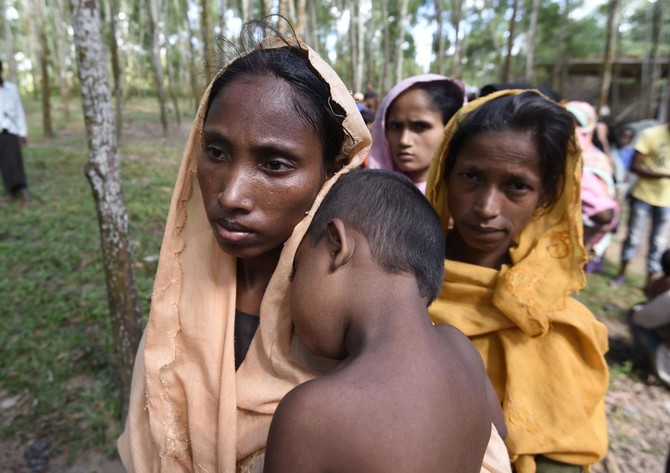
Most of the Rohingya refugees have fled to camps around the Bangladesh border city where there were already 300,000 Rohingya before the latest unrest erupted on August 25.
There has been a huge outpouring of sympathy in Bangladesh for the persecuted Muslim group, with media giving blanket coverage to accounts of massacres and torture by the Myanmar army and Buddhist militia.
Cox’s Bazar police chief Iqbal Hossain said 550 police have been deployed in the region, including at 145 Buddhist temples, to prevent ethnic violence.
He said police had stepped up security so local Buddhists, who have been established for centuries, “don’t feel panicked”.
“It’s a preventive measure,” he told AFP. “We’ve also set up check-posts across the district.”
The reinforcements have come from the port city of Chittagong to watch temples, including the 300-year-old Kendriya Shima Bihar at Ramu, which hosts important Buddhist relics.
Police were also patrolling outside Buddhist temples in Ukhia and Teknaf – the nearby towns where most of the newly arrived 400,000 Rohingya refugees took refuge.
District authorities have also set up an inter-religious communal harmony committee since the Rohingya crisis started.
Jyotirmoy Barua, a top lawyer from the Buddhist community, told AFP that some 20 armed police were at a temple at Ramu in Cox’s Bazar on Friday.
Buddhist leaders in Bangladesh have protested the anti-Rohingya violence in Myanmar’s Rakhine state and have urged Myanmar to resolve the crisis.
They said there have been some minor incidents targeting the Buddhist community.
“They (Bangladeshi Buddhists) are feeling insecure. There is uneasiness,” Barua said.
Police in neighboring Chittagong district have also stepped up security at dozens of Buddhist temples, a senior police official told local media.
Buddhists make up less than one percent of Bangladesh’s 160 million people. They are well integrated in society but have faced past attacks.
In 2012, some 25,000 Muslims attacked Buddhist temples and businesses around Cox’s Bazar after a Buddhist allegedly put an image defaming the Qur'an on Facebook.
At least 11 Buddhist temples were torched in the riot. There were allegations in the local press that some Rohingya joined the attack.


![]()
Bangladesh guards Buddhist temples amid Rohingya backlash fears
Bangladesh guards Buddhist temples amid Rohingya backlash fears
Latest updates




© 2026 SAUDI RESEARCH & PUBLISHING COMPANY, All Rights Reserved And subject to Terms of Use Agreement.