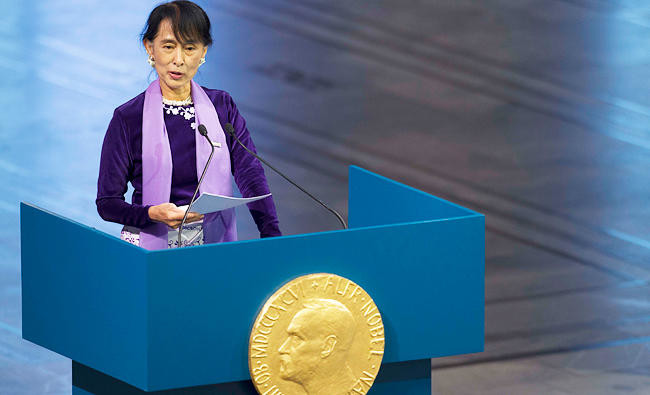
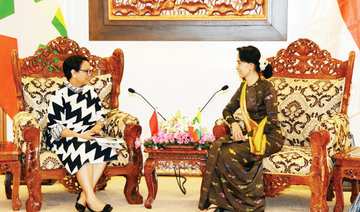
COPENHAGEN: The organization that oversees the Nobel Peace Prize said Friday the 1991 prize awarded to Myanmar’s Aung Sang Suu Kyi cannot be revoked.
Olav Njolstad, head of the Norwegian Nobel Institute said in an email to The Associated Press that neither the will of prize founder Alfred Nobel nor the Nobel Foundation’s rules provide for the possibility of withdrawing the honor from laureates.
“It is not possible to strip a Nobel Peace Prize laureate of his or her award once bestowed,” Njolstad wrote. “None of the prize awarding committees in Stockholm and Oslo has ever considered revoking a prize after it has been awarded.”
An online petition signed by more than 386,000 people on Change.org is calling for Suu Kyi to be stripped of her Peace Prize over the persecution of Myanmar’s Rohingya Muslim minority.
Suu Kyi received the award for “her non-violent struggle for democracy and human rights” while standing up against military rulers.
She became the country’s de facto leader after Myanmar held its first free election in 2012 and she led her party to a landslide victory.
On Thursday, former South African archbishop Desmond Tutu urged her to intervene to stop the persecution of the Rohingya. In an open letter, he told his fellow Nobel Peace Prize winner that it is “incongruous for a symbol of righteousness” to lead a country where violence against the Rohingya is being carried out.
Rohingya have described large-scale violence perpetrated by Myanmar troops and Buddhist mobs — setting fire to their homes, spraying bullets indiscriminately and ordering them to leave or be killed.
Suu Kyi has dismissed the Rohingya crisis as a misinformation campaign.

Suu Kyi can not be stripped of prize, says Nobel institute
Saudi Arabia and 7 other countries condemn Israel’s West Bank land grab
- Kingdom’s foreign minister joined by Jordan, UAE, Qatar, Turkiye, among others, denouncing Israel’s ‘grave escalation’
- Israeli Cabinet approved land registration measures on Sunday that will allow it to declare Palestinian areas as ‘state land’
LONDON: Saudi Arabia and seven other countries have severely condemned Israel’s decision to start land registration in parts of the occupied West Bank, which would allow large areas to be declared “state land.”
The Kingdom’s Foreign Minister Prince Faisal bin Farhan was joined on Tuesday by Jordan, the UAE, Qatar, Indonesia, Pakistan, Egypt, and Turkiye in denouncing the move as a “grave escalation” that will undermine the two-state solution.
The Israeli government approved the process on Sunday for the West Bank’s Area C for the first time since 1967. It would mean that if Palestinians cannot prove ownership, Israel would be able to register the land as property of the state.
The foreign ministers’ statement said the move was aimed at “accelerating illegal settlement activity, land confiscation, entrenching Israeli control, and applying unlawful Israeli sovereignty over the Occupied Palestinian Territory and undermining the legitimate rights of the Palestinian people.”
The statement added that the measures represented a “flagrant violation of international law,” including an International Court of Justice advisory opinion that deemed attempts to alter the legal, historical, and demographic status of the territory as illegal.
“This step reflects an attempt to impose a new legal and administrative reality designed to consolidate control over the occupied land, thereby undermining the two-state solution, eroding the prospects for the establishment of an independent and viable Palestinian State, and jeopardizing the attainment of a just and comprehensive peace in the region,” the ministers said.
They called on the international community to take action against Israel’s violations and protect the right of Palestinians to an independent state on the lines of the 1967 borders, with East Jerusalem as its capital.
Israel has been ramping up efforts to exert its control over the West Bank.
Earlier this month, the Security Cabinet approved measures that would make it easier for Jewish settlers to buy land in the territory and expand Israeli powers there.
The latest announcement has been widely condemned both by Arab and Islamic countries, the EU, the UN and Israeli human rights groups.