

Rohingya exodus puts Suu Kyi under pressure

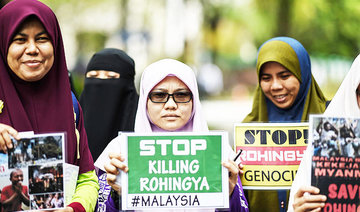
Rohingya Muslim refugees along with Indian supporters hold placards against human rights violationsin Myanmar during a protest in New Delhi on Tuesday. (AFP)
Updated 06 September 2017
Follow

Rohingya exodus puts Suu Kyi under pressure

SHAMLAPUR/DHAKA: Myanmar leader Aung San Suu Kyi has come under pressure from countries with large Muslim populations including Bangladesh, Indonesia and Pakistan to halt violence against Rohingya Muslims after nearly 125,000 of them fled to Bangladesh.
Reuters reporters saw hundreds of exhausted Rohingyas arriving on boats near the village of Shamlapur in Bangladesh near the Myanmar border. The village, facing the Bay of Bengal, appears to have become the newest receiving point for the refugees after authorities cracked down on human traffickers in a different part of the Teknaf peninsula.
Indonesian Foreign Minister Retno Marsudi was due in the Bangladeshi capital, Dhaka, on Tuesday after meeting the Nobel peace laureate and Army Chief Min Aung Hlaing to urge that Myanmar halt the bloodshed.
“The security authorities need to immediately stop all forms of violence there and provide humanitarian assistance and development aid for the short and long term,” Retno said after her meetings in the Myanmar capital.
The latest violence in Myanmar’s northwestern Rakhine state began on Aug. 25, when Rohingya insurgents attacked dozens of police posts and an army base. The ensuing clashes and a military counter-offensive have killed at least 400 people and triggered the exodus of villagers to Bangladesh.
The treatment of Buddhist-majority Myanmar’s roughly 1.1 million Muslim Rohingya is the biggest challenge facing Suu Kyi, who has been accused by Western critics of not speaking out for the minority that has long complained of persecution.
Myanmar says its security forces are fighting a legitimate campaign against “terrorists” responsible for a string of attacks on police posts and the army since last October.
Myanmar officials blamed Rohingya militants for the burning of homes and civilian deaths but rights monitors and Rohingya fleeing to neighboring Bangladesh say the Myanmar Army is trying to force them out with a campaign of arson and killings.
“Indonesia is taking the lead, and ultimately there is a possibility of ASEAN countries joining in,” H.T. Imam, a political adviser to Bangladesh Prime Minister Sheikh Hasina, told Reuters.
He was referring to the 10-member Association of South East Asian Nations that groups both Myanmar and Indonesia.
“If we can keep the pressure on Myanmar from ASEAN, from India as well, that will be good.”
Turkey called the violence against the Rohingya “genocide” and offered Bangladesh help with the refugee influx. Pakistan, home to a large Rohingya community, has expressed “deep anguish” and urged the world body, the Organization of Islamic Cooperation, to act.

Escape from Myanmar

New arrivals and residents in Shamlapur said hundreds of boats had arrived on Monday and Tuesday with several thousand people, after a crackdown on traffickers at an island about 50 km south.
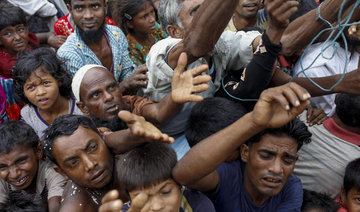
Reuters reporters saw men, women, children and their belongings, even live chickens, disembark from one boat.
“We fled to a hill when the shooting started. The army set fire to houses,” said Salim Ullah, 28, a farmer from Myanmar’s village of Kyauk Pan Du, gripping a sack containing his few remaining belongings, as he gazed exhausted at the beach.
“We got on the boat at daybreak. I came with my mother, wife and two children. There were 40 people on a boat, including 25 women.”
The latest estimate of the numbers who have crossed the border into Bangladesh since Aug. 25, based on calculations by UN workers in the south Asian country, is 123,600.
That takes to about 210,000 the number of Rohingya who have sought refuge in Bangladesh since October, when Rohingya insurgents staged much smaller attacks on security posts, triggering a major Myanmar army counteroffensive and sending about 87,000 people fleeing into Bangladesh.
The new arrivals — many sick or wounded with burns or bullet wounds — have strained the resources of aid agencies and communities already helping hundreds of thousands of refugees from previous spasms of violence in Myanmar.
“One camp, Kutapalong, has reached full capacity,” said Vivian Tan, the regional spokeswoman for the UN refugee agency, UNHCR.
“Nayapara saw several hundred people arrive in one day. This is stretching resources. We are doing what we can, but will need to seek more resources.”
In Shamlapur, refugees said about 40 people were packed into the curved hulls of fishing vessels three meters long.
Fishermen were demanding payment of as much as 10,000 taka ($124) for each adult, with Rohingyas who could not pay being detained, the refugees said.
Bangladesh pulled 53 dead from the Naf River separating it from Myanmar, and from the sea. Many more were suspected to have died on the journey.
Social worker Shahid Ullah said he feared another deadly capsize was inevitable, given the monsoon season.

Family of Palestine Action hunger-strike detainee warn she could die 

Updated 35 min 58 sec ago
Follow

Family of Palestine Action hunger-strike detainee warn she could die 

  • Teuta Hoxha, among 8 people held on remand for over a year, has not eaten in 43 days
  • Campaigners slam treatment of pro-Palestine prisoners on hunger strike 

LONDON: A Palestine Action prisoner in the UK could die if the government does not step in over her hunger strike, her family have warned, amid claims that authorities have been “deliberately negligent” in the treatment of other detained hunger strikers.

Teuta Hoxha, 29, is on day 43 of her strike, having been held on remand in prison for 13 months over charges relating to a break-in at an Israel-linked arms manufacturing facility in August 2024. 

She is one of eight people on hunger strike who were detained for their part in the incident at the Elbit Systems UK site.

Her sister Rahma said she can no longer stand to pray, and suffers from headaches and mobility issues. 

“I know that she’s already instructed the doctors on what to do if she collapses and she’s instructed them on what to do if she passes away,” Rahma, 17, told Sky News.

“She’s only 29 — she’s not even 30 yet and nobody should be thinking about that,” Rahma added. “She’s been on remand for over a year, her trial’s not until April next year and bail keeps getting denied.”

The eight hunger strikers charged over the Elbit Systems break-in, who deny all charges against them, are demanding an end to the operation of weapons factories in the UK that supply Israel.

They are also calling for Palestine Action, which is banned in the UK, to be de-proscribed, and for their immediate bail.

They are not the only members of Palestine Action in prison carrying out hunger strikes. Amu Gib, imprisoned over a break-in at a Royal Air Force base earlier this year, was taken to hospital last week, having not eaten in 50 days. 

Gib was initially denied access to a wheelchair after losing mobility, and campaigners said it was “completely unacceptable” that this had led to a missed doctor’s appointment, adding that Gib was also denied access to the vitamin thiamine.

Campaign group Prisoners for Palestine said: “At this trajectory, the hunger strikers will die unless there is urgent intervention by the government.

“It is completely unacceptable and deliberately negligent to pretend the hunger strike is not happening, or to dismiss the prisoners’ demands.

“They are in the custody of the state, and any harm that comes to them is a deliberate outcome of the government’s negligence and the politicisation of their detention.”

A relative of Gib told The Independent: “We wouldn’t know if Amu is in a coma or had a heart attack. I’m the next of kin and it’s on Amu’s medical record that I am to be contacted in the event of their hospitalisation.

“But it’s been complete agonising silence for 57 hours. I’m furious and outraged that the prison was withholding thiamine from the hunger strikers, without which they are at high risk of brain damage.”

The treatment of the hunger strikers has drawn high-profile criticism, with Dr. James Smith, an emergency physician and lecturer at University College London, telling The Independent that they “are dying” and would require specialist medical help.

Around 900 medical professionals in the UK have written to government ministers David Lammy and Wes Streeting urging them to facilitate medical treatment for the strikers.

Jeremy Corbyn, former leader of the governing Labour Party, posted on Instagram that he had visited Gib in prison.

Seven hunger strikers have so far been hospitalized since Nov. 2, when the first prisoners began to refuse food.

Jon Cink and Umar Khalid both ended their strikes for medical reasons, having been hospitalized, while Kamran Ahmed told the Sunday Times last week that dying for his cause would be “worthwhile.”

He added: “Every day I’m scared that potentially I might die. I’ve been getting chest pains regularly … There have been times where I felt like I’m getting tasered — my body’s vibrating or shaking. I’ll basically lose control of my feelings.

“I’ve been scared since the seventh day when my blood sugars dropped. The nurse said: ‘I’m scared you’re not going to wake up (when you go to sleep). Please eat something.’

“But I’m looking at the bigger picture of perhaps we can relieve oppression abroad and relieve the situations for my co-defendants … Yes, I’m scared of passing away. Yes, this may have lifelong implications. But I look at the risk versus reward. I see it as worthwhile.”

Under UK law, time limits are set out for those in custody awaiting trial to prevent excessive periods in pre-trial detention.

But UK Prisons Minister Lord Timpson said in relation to the Palestine Action detainees: “These prisoners are charged with serious offences including aggravated burglary and criminal damage.

“Remand decisions are for independent judges, and lawyers can make representations to the court on behalf of their clients.

“Ministers will not meet with them — we have a justice system that is based on the separation of powers, and the independent judiciary is the cornerstone of our system.

“It would be entirely unconstitutional and inappropriate for ministers to intervene in ongoing legal cases.”

Rahma says her sister calls her from prison every day, despite her predicament, to help with her studies.

“Our mother passed away when I was really young. Teuta took care of me and my siblings and made sure to read us bedtime stories.

“She’s always there for me and even from prison, she’s helping me do my homework and revise for exams.”

Rahma added: “My sister is a caring and loving person It feels like the state has taken a piece of me.”

She continued: “The only form of resistance she has is her body and that’s what she is using against the state.”
