YANGON: Muslim countries in Asia led a growing chorus of criticism on Monday aimed at Myanmar and its civilian leader Aung San Suu Kyi over the plight of its Rohingya Muslim minority.
Nearly 90,000 Rohingya have flooded into Bangladesh in the past 10 days following an uptick in fighting between militants and Myanmar’s military in strife-torn western Rakhine state.
The impoverished region bordering Bangladesh has been a crucible of communal tensions between Muslims and Buddhists for years, with the Rohingya forced to live under apartheid-like restrictions on movement and citizenship.
The recent violence, which kicked off last October when a small Rohingya militant group ambushed border posts, is the worst Rakhine has witnessed in years with the UN saying Myanmar’s army may have committed ethnic cleansing in its response.
De facto leader Suu Kyi, a former political prisoner of Myanmar’s junta, has come under increasing fire over her perceived unwillingness to speak out against the treatment of the Rohingya or chastise the military.
The growing crisis threatens Myanmar’s diplomatic relations, particularly with Muslim-majority countries in Southeast Asia where there is profound public anger over the treatment of the Rohingya.
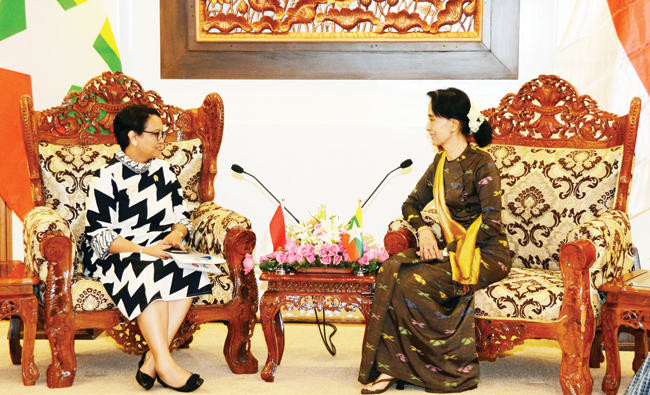
Indonesia’s Foreign Minister Retno Marsudi met Suu Kyi as well as Myanmar’s Army Chief Gen. Min Aung Hlaing in Naypyidaw on Monday in a bid to pressure the government to do more to alleviate the crisis.
“Once again, violence, this humanitarian crisis has to stop immediately,” Indonesian President Joko Widodo told reporters on Sunday as he announced Retno’s mission there.
Hours before Widodo spoke, a petrol bomb was thrown at Myanmar’s embassy in Jakarta.
Iranian Foreign Minister Javad Zarif added in a recent tweet: “Global silence on continuing violence against #Rohingya Muslims. Int’l action crucial to prevent further ethnic cleansing — UN must rally.”
Muslim-majority Malaysia has also seen public protests since the latest round of Rakhine violence began.
“We urge for calm and restraint,” Prime Minister Najib Razak tweeted. “The dire situation facing our Rohingya brothers and sisters must be alleviated for good of Myanmar and region.”
Despite years of persecution, the Rohingya largely eschewed violence until October’s attacks by the little-known Arakan Rohingya Salvation Army.
Analysts have long warned that Myanmar’s treatment of the Rohingya would lead to homegrown militancy.
Since the latest fighting broke out, Al-Qaeda’s offshoot in Yemen has called for retaliatory attacks against Myanmar while the Afghan Taliban posted a statement on Facebook calling on Muslims to “use their abilities to help Myanmar’s oppressed Muslims.”
Defenders of Suu Kyi say she is severely limited in her ability to control Myanmar’s notoriously abusive military.
The Rohingya are also widely loathed by a huge section of Myanmar’s population, dismissed as Bangladeshi interlopers despite many tracing their lineage back generations.
That makes supporting them hugely unpopular.
But detractors say Suu Kyi is one of the few people in Myanmar with the mass appeal and moral authority to swim against the tide on the issue.

Suu Kyi and Myanmar face chorus of anger over Rohingya crisis

Geoeconomic confrontation tops global risks in 2026: WEF report
- Also armed conflict, extreme climate, public polarization, AI
- None ‘a foregone conclusion,’ says WEF’s MD Saadia Zahidi
DUBAI: Geoeconomic confrontation has emerged as the top global risk this year, followed by state-based armed conflict, according to a new World Economic Forum report.
The Global Risks Report 2026, released on Wednesday, found that both risks climbed eight places year-on-year, underscoring a sharp deterioration in the global outlook amid increased international competition.
The top five risks are geoeconomic confrontation (18 percent of respondents), state-based armed conflict (14 percent), extreme weather events (8 percent), societal polarization (7 percent) and misinformation and disinformation (7 percent).
The WEF’s Managing Director Saadia Zahidi said the report “offers an early warning system as the age of competition compounds global risks — from geoeconomic confrontation to unchecked technology to rising debt — and changes our collective capacity to address them.
“But none of these risks are a foregone conclusion.”
The report assesses risks across three timeframes: immediate (2026); short-to-medium term (next two years); and long term (next 10 years).
Economic risks show the largest overall increase in the two-year outlook, with both economic downturn and inflation jumping eight positions.
Misinformation and disinformation rank fifth this year but rise to second place in the two-year outlook and fourth over the 10-year horizon.
The report suggests this reflects growing anxiety around the rapid adoption of artificial intelligence, with adverse outcomes linked to AI surging from 30th place in the two-year timeframe to fifth in the 10-year outlook.
Uncertainty dominates the global risk outlook, according to the report.
Surveyed leaders and experts view both the short- and long-term outlook negatively, with 50 percent expecting a turbulent or stormy global environment over the next two years, rising to 57 percent over the next decade.
A further 40 percent and 32 percent, respectively, describe the outlook as unsettled across the two- and 10-year timeframes, while just 1 percent anticipate a calm global outlook in either period.
Environmental risks ease slightly in the short-term rankings. Extreme weather fell from second to fourth place and pollution from sixth to ninth. Meanwhile, critical changes to Earth systems and biodiversity loss dropped seven and five positions, respectively.
However, over the next decade, environmental threats re-emerge as the most severe, with extreme weather, biodiversity loss, and critical changes to Earth systems topping the global risk rankings.
Looking ahead over the next decade, around 75 percent of respondents anticipate a turbulent or stormy environmental outlook, making it the most pessimistic assessment across all risk categories.
Zahidi said that “the challenges highlighted in the report underscore both the scale of the potential perils we face and our shared responsibility to shape what comes next.”
Despite the gloomy outlook, Zahidi signaled a positive shift in global cooperation.
“It is also clear that new forms of global cooperation are already unfolding even amid competition, and the global economy is demonstrating resilience in the face of uncertainty.”
Now in its 21st year, the Global Risks Report highlights a core message: global risks cannot be managed without cooperation.
As competition intensifies, rebuilding trust and new forms of collaboration will be critical, with the report stressing that today’s decisions will shape future outcomes.
The report was released ahead of WEF’s annual meeting, which will be held in Davos from Jan. 19 to 23.