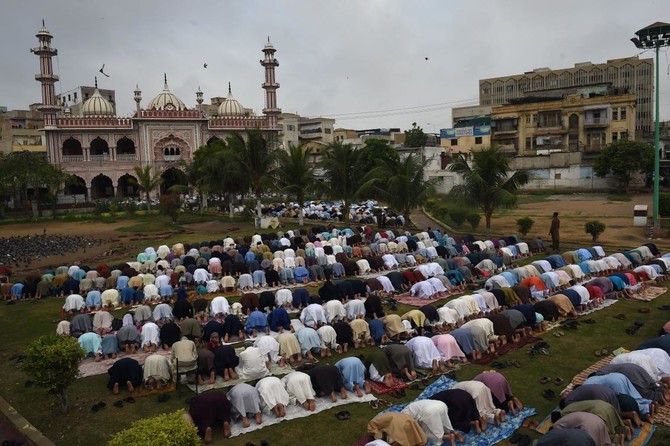
KARACHI: Muslims in Pakistan crowded mosques and prayer grounds across the country to offer prayers and sacrifice goats and cows for Eid Al-Adha holiday on Saturday, marking the second major religious festival of Islam.
Security was tight, with authorities on guard from any possible attack by religious extremists who have carried out bombings across the country in recent years.
“Today, we are here to offer Eid prayers,” said worshipper Saleem Ahmed at a ceremony in Karachi, Pakistan’s largest city. “The security arrangements were very good. May Allah approve our prayers.”
Eid Al-Adha commemorates the Qur’anic tale of the Prophet Abraham’s willingness to sacrifice his son as an act of obedience to Allah, before Allah replaced the son with a ram to be sacrificed instead. A similar story involving Abraham is recounted in the holy books of Judaism and Christianity.
It is tradition for those who can afford it to sacrifice domestic animals as a symbol of Abraham’s willingness to sacrifice his only son.
The result is a booming pre-holiday trade in goats, cows and sheep. In Pakistan alone, nearly 10 million animals, worth more than $3 billion, are slaughtered during the two days of Eid Al-Adha, according to the Pakistan Tanners’ Association.
“We are presenting sacrifices to follow the path of the prophet Abraham. We should not forget our poor and needy Muslim brethren on this occasion,” Karachi resident Mohamad Muzammil said at the prayer ground where cows and goats were being slaughtered.
Eid Al-Adha marks the end of an annual Hajj, or pilgrimage to Makkah, which is one of the five pillars of Islam, and should be undertaken by every Muslim who can afford to do so.
With a population of about 208 million people, Pakistan is the sixth most-populous country in the world, and has the second largest Muslim population after Indonesia. About 97 percent of Pakistanis are Muslims.


![]()
With prayer, sacrifices, Pakistani Muslims celebrate Eid Al-Adha
With prayer, sacrifices, Pakistani Muslims celebrate Eid Al-Adha
Latest updates


Recommended


© 2026 SAUDI RESEARCH & PUBLISHING COMPANY, All Rights Reserved And subject to Terms of Use Agreement.