GENEVA: Daesh’s remaining Syrian strongholds are likely to fall by the end of October, which must be the trigger for the international community to push for free and fair elections, UN's Syria envoy Staffan de Mistura said on Friday.
“What we are seeing is in my opinion the beginning of the end of this war … what we need to make sure is that this becomes also the beginning of peace. And that is where the challenge starts at this very moment,” he said in a BBC radio interview.
Three places were still far from stabilized, de Mistura said: Raqqa, Deir Al-Zor and Idlib.
“After Raqqa and Deir Al-Zor, and that is a matter of a few months, there will be a moment of truth. If the international community will be helping both the opposition and the government by pushing the government to accept a real negotiation, then within a year it would be a possibility of having a truly credible election.”
The city of Deir Al-Zor has been under siege by Daesh fighters for years, forcing the UN to conduct an unprecedented and expensive high-altitude airdrop campaign to supply the population.
“The Syrian government and the Russians are very likely between now and the end of this month or perhaps early October, latest, to actually liberate it,” de Mistura said.
The US and the US-backed Syrian Democratic Forces “will probably liberate Raqqa by the end of October.”
The third area, Idlib, is “full of al Nusra, which is Al-Qaeda,” de Mistura said, referring to the Nusra Front, a one-time Al-Qaeda affiliate. It has been renamed and merged with other groups, but remains the only force in Syria’s war, apart from Daesh, that is designated by the UN as “terrorists.”
The lesson from the Iraqi city of Mosul, taken over by Daesh a decade after the US declared “mission accomplished” in the war in Iraq, was that Syria’s war needed to be followed by a fair UN-managed election, without neglecting minorities.
An unrepresentative peace deal would leave the door open to a resurgence of Daesh.
“Even those who believe they won the war — that is the government — they will need to make a gesture, otherwise Daesh will come back in a month or two months’ time.”
Nobody had an interest in a resurgence of Daesh in Syria, de Mistura said. Assad’s allies in Moscow, recalling the Soviet experience of war in Afghanistan, “certainly want an exit strategy.”
“We are getting close to some kind of understanding even among those who have been involved in the conflict that the priority is to close it. What we need to do is wrap it up in a way that is stabilized, not just close the conflict.”


UN sees election possibility in Syria after Daesh defeat
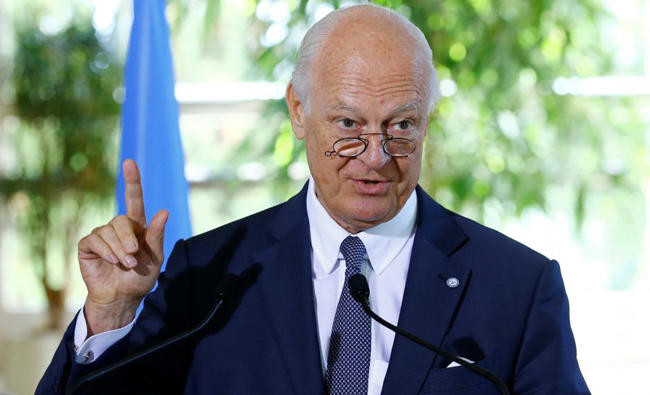
UN sees election possibility in Syria after Daesh defeat


UN rights chief Shocked by ‘unbearable’ Darfur atrocities
- Mediation efforts have failed to produce a ceasefire, even after international outrage intensified last year with reports of mass killings, rape, and abductions during the RSF’s takeover of El-Fasher in Darfur
PORT SUDAN: Nearly three years of war have put the Sudanese people through “hell,” the UN’s rights chief said on Sunday, blasting the vast sums spent on advanced weaponry at the expense of humanitarian aid and the recruitment of child soldiers.
Since April 2023, Sudan has been gripped by a conflict between the army and the paramilitary Rapid Support Forces that has left tens of thousands of people dead and around 11 million displaced.
Speaking in Port Sudan during his first wartime visit, UN Human Rights commissioner Volker Turk said the population had endured “horror and hell,” calling it “despicable” that funds that “should be used to alleviate the suffering of the population” are instead spent on advanced weapons, particularly drones.
More than 21 million people are facing acute food insecurity, and two-thirds of Sudan’s population is in urgent need of humanitarian aid, according to the UN.
In addition to the world’s largest hunger and displacement crisis, Sudan is also facing “the increasing militarization of society by all parties to the conflict, including through the arming of civilians and recruitment and use of children,” Turk added.
He said he had heard testimony of “unbearable” atrocities from survivors of attacks in Darfur, and warned of similar crimes unfolding in the Kordofan region — the current epicenter of the fighting.
Testimony of these atrocities must be heard by “the commanders of this conflict and those who are arming, funding and profiting from this war,” he said.
Mediation efforts have failed to produce a ceasefire, even after international outrage intensified last year with reports of mass killings, rape, and abductions during the RSF’s takeover of El-Fasher in Darfur.
“We must ensure that the perpetrators of these horrific violations face justice regardless of the affiliation,” Turk said on Sunday, adding that repeated attacks on civilian infrastructure could constitute “war crimes.”
He called on both sides to “cease intolerable attacks against civilian objects that are indispensable to the civilian population, including markets, health facilities, schools and shelters.”
Turk again warned on Sunday that crimes similar to those seen in El-Fasher could recur in volatile Kordofan, where the RSF has advanced, besieging and attacking several key cities.
Hundreds of thousands face starvation across the region, where more than 65,000 people have been displaced since October, according to the latest UN figures.


