GENEVA: Territory still controlled by Daesh in Raqqa is “the worst place” in Syria, the UN said on Thursday, as fresh reports emerged of more civilians killed by US-led coalition airstrikes.
The Syrian Observatory for Human Rights said 21 children were among at least 59 civilians killed since Monday in the airstrikes aimed at dislodging the terrorists from Raqqa.
“The worst place probably today in Syria is the part of Raqqa that is still held by the so-called Islamic State (Daesh),” the UN’s humanitarian pointman for Syria, Jan Egeland, told reporters in Geneva.
The UN estimates there are up to 25,000 civilians trapped inside Raqqa, the terrorist group’s erstwhile de facto Syrian capital.
“They are encircled by the SDF (Syrian Democratic Forces) fighters and they are used seemingly as human shields” by Daesh, Egeland added, noting the “constant air raids” by the US-led coalition.
“We are therefore urging the coalition, the SDF whom we can deal with to allow as much as they can people to escape,” the UN official added.
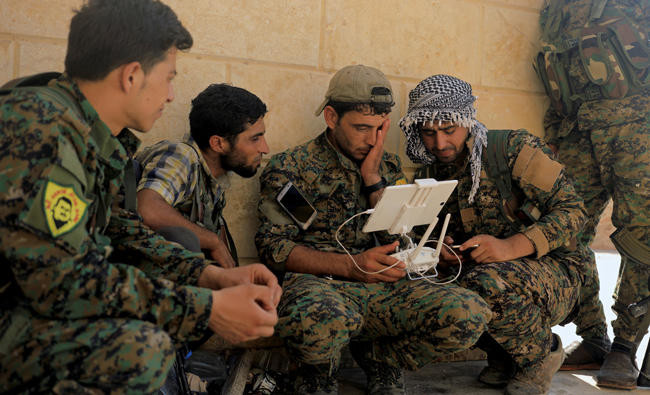
The SDF, a Kurdish-Arab alliance backed by the multinational coalition, was on Thursday battling the terrorists in Raqqa’s Old City, of which it now controls 70 percent, according to the Britain-based Observatory.
The SDF also fought Daesh in the western district of Al-Dariya and the northwestern neighborhood of Al-Barid, as well as on the outskirts of the central district of Al-Murur, it said.
The coalition has repeatedly stressed it takes every precaution to avoid civilian casualties. But it has recognized 624 such deaths in its airstrikes since 2014.
The SDF launched an operation to capture Raqqa province from Daesh last year, and in June the alliance broke into Raqqa city for the first time.
It now holds more than half of the city, but the fighting has proved fierce and civilians have been killed both in the crossfire and while trying to flee.
Humanitarian workers believe “the situation couldn’t be worse for these women, children (and) civilians who are now in this crossfire,” said Egeland.
Talal Silo, SDF spokesman, told Reuters that the US military will remain in northern Syria long after Daesh is defeated, predicting enduring ties with the Kurdish-dominated region.
Strategic interest
The SDF believes the US has a “strategic interest” in staying on, said Silo.
“They have a strategy policy for decades to come. There will be military, economic and political agreements in the long term between the leadership of the northern areas (of Syria) ... and the US administration,” Silo said.
The US-led coalition against Daesh has deployed forces at several locations in northern Syria, including an air base near the town of Kobani.
Asked about long-term strategy, Col. Ryan Dillon, spokesman for the coalition, referred Reuters to the Pentagon. He said there was “still a lot of fighting to do, even after ISIS (Daesh) has been defeated in Raqqa.”
Daesh remained in strongholds along the Euphrates River Valley, he added, in a reference to its stronghold in Deir Al-Zor province southeast of Raqqa.
“Our mission ... is to defeat ISIS in designated areas of Iraq and Syria and to set conditions for follow-on operations to increase regional stability,” Dillon said.
Eric Pahon, a Pentagon spokesman, said in Washington: “The Department of Defense does not discuss timelines for future operations. However, we remain committed to the destruction of ISIS and preventing its return.”


Daesh-held Raqqa ‘worst place in Syria’
Daesh-held Raqqa ‘worst place in Syria’


US condemns RSF drone attack on World Food Programme convoy in Sudan’s North Kordofan
- Denise Brown, the UN Humanitarian Coordinator for Sudan, also expresses concern over the drone attack
WASHINGTON: The US has condemned a drone attack by Rapid Support Forces on an aid convoy in Sudan’s North Kordofan state that killed one person and injured three others.
“The United States condemns the recent drone attack on a World Food Program convoy in North Kordofan transporting food to famine-stricken people which killed one and wounded many others,” US Senior Adviser for Arab and African Affairs Massad Boulos wrote on X.
“Destroying food intended for people in need and killing humanitarian workers is sickening,” the US envoy wrote.
“The Trump Administration has zero tolerance for this destruction of life and of U.S.-funded assistance; we demand accountability and extend our condolences to all those affected by these inexcusable events and terrible war,” he added.
The Sudan Doctors Network said the convoy was struck by RSF drones in the Allah Karim area as it headed toward displaced people in El-Obeid, the state capital, Anadolu Agency reported.
The network described the attack as a “clear violation of international humanitarian law,” warning that it undermines efforts to deliver life-saving aid to civilians amid worsening humanitarian conditions across the country.
There was no immediate comment from the rebel group.
The United States condemns the recent drone attack on a World Food Program convoy in North Kordofan transporting food to famine-stricken people which killed one and wounded many others. This follows an attack earlier this week in Blue Nile state that injured a @WFP staff member.…
— U.S. Senior Advisor for Arab and African Affairs (@US_SrAdvisorAF) February 6, 2026
Denise Brown, the UN Humanitarian Coordinator for Sudan, in a statement also expressed concern over the drone attack which hit the aid trucks in North Kordofan.
“I am deeply concerned by a drone attack earlier today on trucks contracted by the World Food Programme (WFP) in North Kordofan, the aftermath of which I came across a few hours later, as I left the state capital, El Obeid.”
“The trucks were en route from Kosti to deliver life-saving food assistance to displaced families near El Obeid when they were struck, tragically killing at least one individual and injuring many more. The trucks caught fire, destroying food commodities intended for life-saving humanitarian response.”
Brown added that “Humanitarian personnel, assets and supplies must be protected at all times. Attacks on aid operations undermine efforts to reach people facing hunger and displacement.”
“Safe and unimpeded humanitarian access remains critical to ensure assistance reaches the most vulnerable people across Sudan.”
Since April 2023, the conflict between Sudan’s army and the paramilitary forces has killed tens of thousands, displaced 11 million and which the UN has described as one of the world’s worst humanitarian crises.
An alert issued by the Integrated Food Security Phase Classification (IPC), confirmed famine conditions in El-Fasher and Kadugli, the capital of South Kordofan, about 800 kilometers to the east.
The IPC said that 20 more areas in Sudan’s Darfur and neighboring Kordofan were at risk of famine.
Of Sudan’s 18 states, the RSF controls all five states in the western Darfur region, except for parts of North Darfur that remain under army control. The army holds most areas of the remaining 13 states across the south, north, east and center of the country, including the capital, Khartoum.
The conflict between the army and the RSF, which erupted in April 2023, has killed thousands of people and displaced millions.