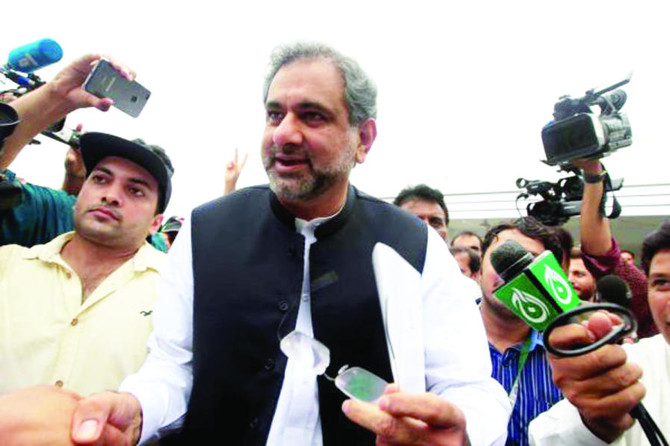
ISLAMABAD: Forty-three members of new Pakistani Prime Minister Shahid Khaqan Abbasi’s Cabinet were sworn in on Friday by President Mamnoon Hussain.
Abbasi was elected interim prime minister on Aug. 1, winning an unprecedented number of votes in Parliament after then-Prime Minister Mohammed Nawaz Sharif was ordered disqualified on July 28 by Pakistan’s Supreme Court over concealment of assets which he should have declared to the Election Commission of Pakistan when submitting nomination papers for the country’s 2013 elections.
Sources have suggested Abassi could remain in power beyond the 45-day interim period.
With only a few portfolios reshuffled, several members of Sharif’s Cabinet retained their positions.
Siddiqul Farooq, leader of the Pakistan Muslim League (Nawaz) (PML-N) and a trusted aide to Sharif, declined to comment on the new Cabinet when contacted by Arab News.
Khawaja Muhammad Asif has been appointed minister for foreign affairs. He was previously defense minister. Following the 2013 elections, Sharif failed to name a foreign minister, and filled the roll himself.
“The decision to appoint (Sharif’s) trusted lieutenant (Asif), will help streamline much of the work at the foreign office,” political analyst Qamar Cheema told Arab News.
He said the appointment of a foreign minister shows a shift in PML-N’s strategy, adding that Sharif kept the vital portfolio to himself to avoid military intervention in foreign affairs.
Cheema concluded that, unlike Sharif, neither Abbasi nor Asif has any grievance with the country’s military.
Elsewhere in the Cabinet, Khurram Dastgir Khan has been appointed defense minister, and his former portfolio as minister for commerce has been handed to Muhammad Pervaiz Malik.
Ishaq Dar, although facing allegations of money laundering and tax evasion, will continue as minister for finance.
Ahsan Iqbal, formerly minister for planning and development, has taken over from Chaudhry Nisar Ali Khan as minister for interior, while Mushahid Ullah Khan has been given charge of the Ministry of Climate Change.
Prime Minster Abbasi, in his post-election address to Parliament, vowed to improve the country’s situation: "I am the country’s prime minister. If I am here for 45 days, I will do 45 months work in this time.”
He also promised to rid the country of its gun culture, stressing that he will do away with automatic weapons.
“News of Abbasi continuing as prime minister would definitely boost the confidence of people,” Cheema concluded. “This is a good sign, and hopefully detrimental policies will be avoided by this new government.”

Pakistan’s new Cabinet takes oath after Nawaz Sharif’s removal
Southeast Asian countries repatriate nationals from Cambodia as thousands flee scam centers
- Almost 2,800 Indonesians have sought consular support to return home since mid-January
- Malaysia, Philippines also repatriate citizens after Cambodian PM orders crackdown on crime networks
Southeast Asian countries are repatriating their nationals from Cambodia, as thousands are estimated to have fled scam compounds over recent weeks following Phnom Penh’s pledge for a fresh crackdown on the multibillion-dollar industry.
Scam centers have flourished in parts of Southeast Asia in recent years, with hundreds of thousands of people lured to work in illicit operations in countries like Cambodia and Myanmar, according to a 2023 report by the UN Office of the High Commissioner for Human Rights.
A wave of foreign nationals who were either released or have escaped from scam compounds across Cambodia since mid-January have returned to their home countries in the past week after seeking consular support from their respective embassies, officials said.
“The number of Indonesians formerly involved with online scam syndicates who are reporting to the Indonesian Embassy in Phnom Penh continues to increase. Since Jan. 16 to Jan. 30, we have recorded 2,795 Indonesian nationals,” the Indonesian Embassy in Phnom Penh said in a statement on Saturday.
At least 36 Indonesian nationals were repatriated on Friday, while another 30 are scheduled to return to Indonesia over the weekend.
Malaysia has also “rescued and repatriated” 29 Malaysians from Cambodia who were “victims of an online syndicate,” its embassy in Phnom Penh said earlier this week, while the Philippines repatriated 13 Filipinos identified as human trafficking victims last Sunday, the Department of Migrant Workers in Manila said in a statement.
Human rights organization Amnesty International estimated that thousands of people have been released or escaped from at least 17 scamming compounds across Cambodia in recent weeks, with interviews indicating that some were “subjected to grave abuses including rape and torture.”
The survivors are also from countries beyond the region, including Brazil, Nigeria, and Bangladesh, Amnesty said, as it called out the Cambodian government for ignoring the growing humanitarian crisis.
“This mass exodus from scamming compounds has created a humanitarian crisis on the streets that is being ignored by the Cambodian government. Amid scenes of chaos and suffering, thousands of traumatized survivors are being left to fend for themselves with no state support,” said Montse Ferrer, Amnesty International’s regional research director.
“This is an international crisis on Cambodian soil. Our researchers have met people from Asia, Africa, Europe, and the Americas. They are in urgent need of consular assistance in order to help get them home and out of harm’s way.”
The latest development comes after Cambodian Prime Minister Hun Manet ordered authorities to step up efforts to eradicate online scam networks in the country, a directive that was followed with the arrest of several key figures.
Among those arrested was Chen Zhi, a Chinese-born Cambodian tycoon, who was extradited to China earlier this month.
Chen was sanctioned by the UK and the US in October last year, with the US Department of Treasury accusing him of running “a transnational criminal empire through online investment scams targeting Americans and others worldwide.”
The Global Anti-Scam Alliance estimates that $442 billion was lost to scammers in 2025.