LAS VEGAS: Officers were checking on a stolen cellphone that its owner traced to a car in Las Vegas when the suspect tried to flee and then opened fire, leading to a shootout that wounded an officer and left the gunman dead, authorities said.
It marked the 15th shooting involving Las Vegas officers so far this year, including seven since June 20. That is a sharp increase from the 10 shootings by police in all of 2016, including seven that were deadly.
The officer wounded in Tuesday’s gunbattle was hospitalized in stable condition with a wound to the abdomen after a bullet missed his ballistic vest, police Capt. Kelly McMahill said.
He was improving Wednesday and is expected to be released within the next few days, Officer Laura Meltzer said.
After the gunfire ended, a second officer realized that he had been hit but not injured, McMahill said during a recorded briefing Tuesday night.
“His gun belt actually stopped a bullet that was fired by the suspect,” she said.
The gunman was shot at least once by police and also had a self-inflicted gunshot wound, McMahill said. The coroner did not immediately identify the suspect, pending notification of family members.
The officers, who also have not been identified, were following up on a report from a man whose cellphones had been taken from a vehicle Sunday and he had traced to a pickup truck parked outside a business in an industrial area.
The suspect initially spoke with the officers, but then tried to start the truck at least twice before pulling a handgun and opening fire. McMahill didn’t say how many shots were fired.
A police sergeant arrived and drove the wounded officer to a hospital. Police said the bullet went through his abdomen and out his lower back.
The officers were put on paid leave pending reviews of the shooting by police and prosecutors.
The recent increase in officer-involved shootings comes five years after the department underwent a first-in-the-nation review by the US Department of Justice’s Community Oriented Policing Services. The voluntary review followed 25 police shootings in 2010. Federal investigators recommended 80 reforms and later credited the police department with adopting almost all of them.
An officer was last wounded on duty in Las Vegas in December 2015, when a veteran patrol officer was hit in the torso and arm while responding to a disturbance call at an apartment complex.
Officers Alyn Beck and Igor Soldo were the last officers killed on duty. They were shot to death while eating at a pizza shop in June 2014 by a man and a woman who later died during a shootout with officers at a Wal-Mart.

Vegas police shootout wounds officer, leaves suspect dead
India accelerates free trade agreements against backdrop of US tariffs
- India signed a CEPA with Oman on Thursday and a CETA with the UK in July
- Delhi is also in advanced talks for trade pacts with the EU, New Zealand, Chile
NEW DELHI: India has accelerated discussions to finalize free trade agreements with several nations, as New Delhi seeks to offset the impact of steep US import tariffs and widen export destinations amid uncertainties in global trade.
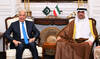
India signed a Comprehensive Economic Partnership Agreement with Oman on Thursday, which allows India to export most of its goods without paying tariffs, covering 98 percent of the total value of India’s exports to the Gulf nation.
The deal comes less than five months after a multibillion-dollar trade agreement with the UK, which cut tariffs on goods from cars to alcohol, and as Indian trade negotiators are in advanced talks with New Zealand, the EU and Chile for similar partnerships.
They are part of India’s “ongoing efforts to expand its trade network and liberalize its trade,” said Anupam Manur, professor of economics at the Takshashila Institution.
“The renewed efforts to sign bilateral FTAs are partly an after-effect of New Delhi realizing the importance of diversifying trade partners, especially after India’s biggest export market, the US, levied tariff rates of up to 50 percent on India.”
Indian exporters have been hit hard by the hefty tariffs that went into effect in August.
Months of negotiations with Washington have not clarified when a trade deal to bring down the tariffs would be signed, while the levies have weighed on sectors such as textiles, auto components, metals and labor-intensive manufacturing.
The FTAs with other nations will “help partially in mitigating the effects of US tariffs,” Manur said.
In particular, Oman can “act as a gateway to other Gulf countries and even parts of Eastern Europe, Central Asia, and Africa,” and the free trade deal will most likely benefit “labor-intensive sectors in India,” he added.
The chances of concluding a deal with Washington “will prove to be difficult,” said Arun Kumar, a retired economics professor at the Jawaharlal Nehru University.
“With the US, the chances of coming to (an agreement) are a bit difficult, because they want to get our agriculture market open, which we cannot do. They want us to reduce trade with Russia. That’s also difficult for India to do,” he told Arab News.
US President Donald Trump has threatened sanctions over India’s historic ties with Moscow and its imports of Russian oil, which Washington says help fund Moscow’s ongoing war with Ukraine.
“President Trump is constantly creating new problems, like with H-1B visa and so on now. So some difficulty or the other is expected. That’s why India is trying to build relationships with other nations,” Kumar said, referring to increased vetting and delays under the Trump administration for foreign workers, who include a large number of Indian nationals.
“Substituting for the US market is going to be tough. So certainly, I think India should do what it can do in terms of promoting trade with other countries.”
India has free trade agreements with more than 10 countries, including comprehensive economic partnership agreements with South Korea, Japan, and the UAE.
It is in talks with the EU to conclude an FTA, amid new negotiations launched this year for trade agreements, including with New Zealand and Chile.
India’s approach to trade partnerships has been “totally transformed,” Commerce and Industry Minister Piyush Goyal said in a press briefing following the signing of the CEPA with Oman, which Indian officials aim to enter into force in three months.
“Now we don’t do FTAs with other developing nations; our focus is on the developed world, with whom we don’t compete,” he said. “We complement and therefore open up huge opportunities for our industry, for our manufactured goods, for our services.”