

South Africa’s Ramaphosa re-elected as president after coalition deal

1 / 2
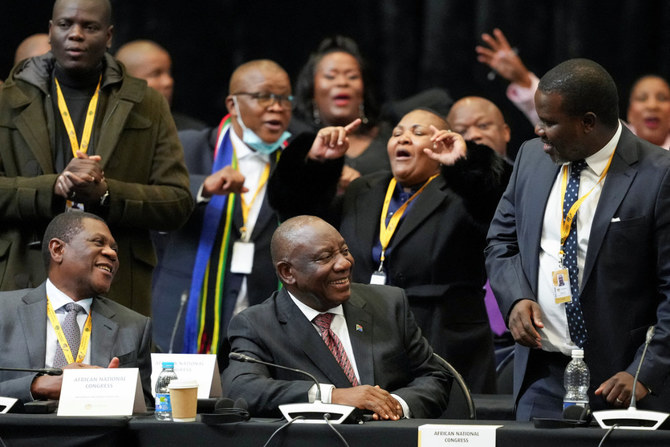
South African president Cyril Ramaphosa reacts after being re-elected as president of South Africa during the first sitting of the National Assembly in Cape Town on June 14, 2024. (REUTERS)
2 / 2
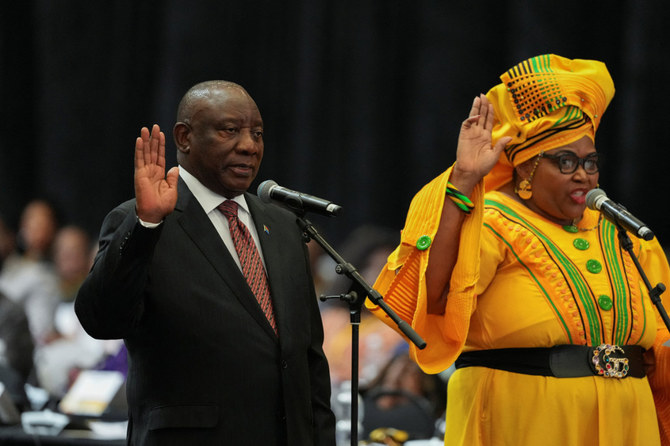
South African President Cyril Ramaphosa is sworn into the National Assembly during the first sitting of the National Assembly in Cape Town on June 14, 2024. (REUTERS)
Short Url
Updated 15 June 2024
Follow

South Africa’s Ramaphosa re-elected as president after coalition deal

  • Lawmakers voted overwhelmingly to put Ramaphosa, back in office for another five years after the May 29 general election
  • The ANC-led broad coalition brings together a majority of the 18 parties in the 400-seat National Assembly

CAPE TOWN: South Africa’s President Cyril Ramaphosa was re-elected for a second term on Friday, after his humbled ANC cobbled together an unprecedented coalition government.

Lawmakers in Cape Town voted overwhelmingly to put Ramaphosa, 71, back in office for another five years after the May 29 general election that produced no outright winner.
“I am humbled and honored that you, as members of the National Assembly, have... decided to elect me to be the President of the Republic of South Africa,” Ramaphosa said in his acceptance speech.
Last month’s election marked a historic turning point for South Africa, ending three decades of dominance by the African National Congress of the late Nelson Mandela.
The party that led the anti-apartheid struggle won only 40 percent of the vote and, for the first time, lost its absolute majority in parliament.
It has now struck a deal to form what it calls a government of national unity.
“This is a historic juncture in the life of our country, which requires that we must work and act together,” Ramaphosa said.
ANC Secretary General Fikile Mbalula said on Friday the broad coalition brings together a majority of the 18 parties that won representation in the 400-seat National Assembly.
These include the center-right Democratic Alliance (DA), the Zulu nationalist Inkatha Freedom Party and other smaller groups.
Ramaphosa was re-elected by fellow MPs with 283 votes in a secret ballot.
He saw off a last-minute challenge by Julius Malema, the firebrand leader of the radical leftist Economic Freedom Fighters (EFF), whose candidacy gained 44 votes.
Ramaphosa will be sworn in next week in Pretoria and then unveil his new cabinet.
Earlier, Chief Justice Raymond Zondo had opened the parliament’s first sitting, swearing in MPs in batches ahead of votes on the election of a speaker and deputy speaker.
The first post went to the ANC’s Thoko Didiza and, in a first sign the power-sharing deal was working, the second went to the DA’s Annelie Lotriet. Both are women and Lotriet is from South Africa’s white minority.

Lawmakers cast their ballot one by one in a lengthy ceremony held in a Cape Town convention center, as the parliament building is being rebuilt after a 2022 fire.
EFF members took the oath wearing red overalls and in some cases rubber boots and plastic construction worker helmets.
They declined to support the incoming administration, having refused to countenance joining an alliance with right-wing or white-led parties.
“This is not a government of national unity, this is a grand coalition between the ANC and white monopoly capital. History will judge you harshly,” Malema said, after conceding defeat.
Graft-tainted former president Jacob Zuma’s new party uMkhonto weSizwe (MK), which came third in the election, has disputed the results and its MPs boycotted Friday’s sitting.
“The sitting of the national assembly today as far as we’re concerned is illegal and unconstitutional,” MK spokesman Nhlamulo Ndhlela told AFP.
A former trade unionist turned millionaire businessman, Ramaphosa will preside over a government combining radically different political views.
The ANC is a historically pan-Africanist, progressive party of the left that has overseen welfare and economic empowerment programs for poor, black South Africans.
The largest coalition party, the DA, pushes a liberal, free-market agenda. Smaller parties that are understood to have agreed to join the government range from the left to the far right.
“At the heart of this government of national unity statement is a shared respect and defense of our constitution and the rule of law,” DA leader John Steenhuisen said.

The agreement extended to regional coalitions in Johannesburg’s Gauteng province and in KwaZulu-Natal.
Zuma’s MK won the most votes in the latter but was left empty-handed as coalition members managed to get a wafer-thin majority of 41 out of 80 provincial councillors.
Steenhuisen added that the coalition agreement included a consensus mechanism to deal “with the disagreements that will inevitably arise.”
“This is not the end of the process. And the road ahead will not be an easy one,” Steenhuisen said, explaining that the two-week deadline imposed by the constitution to form a government did not leave enough time to iron out all details.
Ramaphosa first came to power in 2018 after Zuma was forced out under the cloud of corruption allegations.
Under his watch South Africa suffered from record power cuts, the economy languished and crime remained rife. Unemployment is at almost 33 percent.
He will now have the arduous task to bridge conflicting views within government to turn around South Africa’s economic fortunes.
“Rapid, inclusive and sustainable economic growth” was listed as a top priority in a draft of the coalition deal.
GDP grew by only 0.6 percent in 2023 and was down 0.1 percent in the first three months of 2024.


How decades of deforestation led to catastrophic Sumatra floods

Updated 9 sec ago
Follow

How decades of deforestation led to catastrophic Sumatra floods

  • At least 1.4m hectares of forest in flood-affected provinces were lost to deforestation since 2016
  • Indonesian officials vow to review permits, investigate companies suspected of worsening the disasters

JAKARTA: About a week after floods and landslides devastated three provinces in Indonesia’s Sumatra island, Rubama witnessed firsthand how the deluge left not only debris and rubble but also log after log of timber.

They were the first thing that she saw when she arrived in the Beutong Ateuh Banggalang district of Aceh, where at least two villages were wiped out by floodwaters.

“We saw these neatly cut logs moving down the river. Some were uprooted from the ground, but there are logs cut into specific sizes. This shows that the disaster in Aceh, in Sumatra, it’s all linked to illegal forestry practices,” Rubama, empowerment manager at Aceh-based environmental organization HAKA, told Arab News.

Monsoon rains exacerbated by a rare tropical storm caused flash floods and triggered landslides across Aceh, North Sumatra, and West Sumatra in late November, killing 969 people and injuring more than 5,000 as of Wednesday, as search efforts continue for 252 others who remain missing.

In the worst-hit areas, residents were cut off from power and communication for days, as floodwater destroyed bridges and torrents of mud from landslides blocked roads, hampering rescue efforts and aid delivery to isolated villages.

When access to the affected regions gradually improved and the scale of the disaster became clearer, clips of washed-up trunks and piles of timber crashing into residential areas circulated widely online, showing how the catastrophic nature of the storm was compounded by deforestation.

“This is real, we’re seeing the evidence today of what happens when a disaster strikes, how deforestation plays a major role in the aftermath,” Rubama said.

For decades, vast sections of Sumatra’s natural forest have been razed and converted for mining, palm oil plantations and pulpwood farms.

Around 1.4 million hectares of forest in Aceh, North Sumatra and West Sumatra were lost to deforestation between 2016 and 2025 alone, according to Indonesian environmental group WALHI, citing operations by 631 permit-holding companies.

Deforestation in Sumatra stripped away natural defenses that once absorbed rainfall and stabilized soil, making the island more vulnerable to extreme weather, said Riandra Purba, executive director of WALHI’s chapter in North Sumatra.

Purba said the Sumatra floods should serve as a “serious warning” for the government to issue permits more carefully.

“Balancing natural resource management requires a sustainable approach. We must not sacrifice natural benefits for the financial benefit of a select few,” he told Arab News.

“(The government) must evaluate all the environmental policies in the region … (and) implement strict monitoring, including law enforcement that will create a deterrent effect to those who violate existing laws.”

In Batang Toru, one of the worst-hit areas in North Sumatra where seven companies operate, hundreds of hectares had been cleared for gold mining and energy projects, leaving slopes exposed and riverbeds choked with sediment.

When torrential rains hit last month, rivers in the area were swollen with runoff and timber, while villages were buried or swept away.

As public outrage grew in the wake of the Sumatra floods, Indonesian officials, including Environment Minister Hanif Faisol Nurofiq, have moved to review existing permits and investigate companies suspected of worsening the disaster. 

“Our focus is to ensure whether company activities are influencing land stability and (increasing) risks of landslides or floods,” Nurofiq told Indonesian magazine Tempo on Saturday.

Sumatra’s natural forest cover stood at about 11.6 million hectares as of 2023, or about 24 percent of the island’s total area, falling short of the 30 to 33 percent forest coverage needed to maintain ecological balance.

The deadly floods and landslides in Sumatra also highlighted the urgency of disaster mitigation in Indonesia, especially amid the global climate crisis, said Kiki Taufik, forest campaigner at Greenpeace Indonesia. 

Over two weeks since floods and landslides inundated communities in Sumatra, a few villages remain isolated and over 800,000 people are still displaced. 

“This tropical cyclone, Senyar, in theory, experts said that it has a very low probability of forming near the equator, but what we have seen is that it happened, and this is caused by rapid global warming … which is triggering hydrometeorological disasters,” Taufik told Arab News.

“The government needs to give more attention, and even more budget allocation, to mitigate disaster risks … Prevention is much more important than (disaster) management, so this must be a priority for the government.”
