



WASHINGTON: Donald Trump made a triumphant return to Capitol Hill on Thursday, his first with lawmakers since the Jan. 6, 2021 attacks, embraced by energized House and Senate Republicans who find themselves reinvigorated by his bid to retake the White House.
Despite pending federal charges against Trump for conspiring to overturn the 2020 election, and his recent guilty verdict in an unrelated hush money trial, the Republican former president arrived emboldened as the party’s presumptive nominee. He has successfully purged the GOP of critics, silenced most skeptics and enticed once-critical lawmakers aboard his MAGA-fueled campaign.
A packed room of House Republicans sang “Happy Birthday” to Trump in a private breakfast meeting at GOP campaign headquarters across the street from the Capitol. The lawmakers gave him a baseball and bat from the annual congressional game, and senators later presented an American flag cake with “45” candles — and then “47” — referring to the next presidency. Trump bragged that even his telephone rallies for lawmakers could draw bigger crowds than mega-popstar Taylor Swift, who has yet to make any endorsement.
In one remarkable moment, Trump and his most prominent Republican critic, Senate GOP leader Mitch McConnell, shook hands, and fist-bumped.
“There’s tremendous unity in the Republican Party,” Trump said in brief remarks at Senate GOP headquarters.
Trump spent about an hour each with House and Senate Republicans delivering free-wheeling remarks, fielding questions and discussing issues — including Russia and immigration, tax cuts and other priorities for a potential second term.
During the morning session, Trump said House Speaker Mike Johnson is doing a “terrific job,” according to a Republican in the private meeting and granted anonymity to discuss it. Trump asked Rep. Marjorie Taylor Greene, the speaker’s chief Republican critic, if she was being “nice” to Johnson, another Republican said.
“President Trump brought an extraordinary amount of energy, excitement and enthusiasm this morning,” Johnson said afterward, noting high fund-raising tallies since the guilty verdict. “We’re feeling good.”
The Republican speaker had demurred earlier over whether he’s asked Trump to respect the peaceful transfer of presidential power and commit to not doing another Jan. 6. “Of course he respects that, we all do, and we’ve all talked about it, ad nauseum.”
Many potential priorities for a new White House administration are being formulated by a constellation of outside groups, including Project 2025, laying the groundwork for executive and legislative actions, though Trump has made clear he has his own agenda.
“Anybody who thought that this president was going to be down after the sham trial. it’s only giving him even more energy,” said Rep. Tom Emmer, the GOP whip. “Donald Trump is crushing this election.”
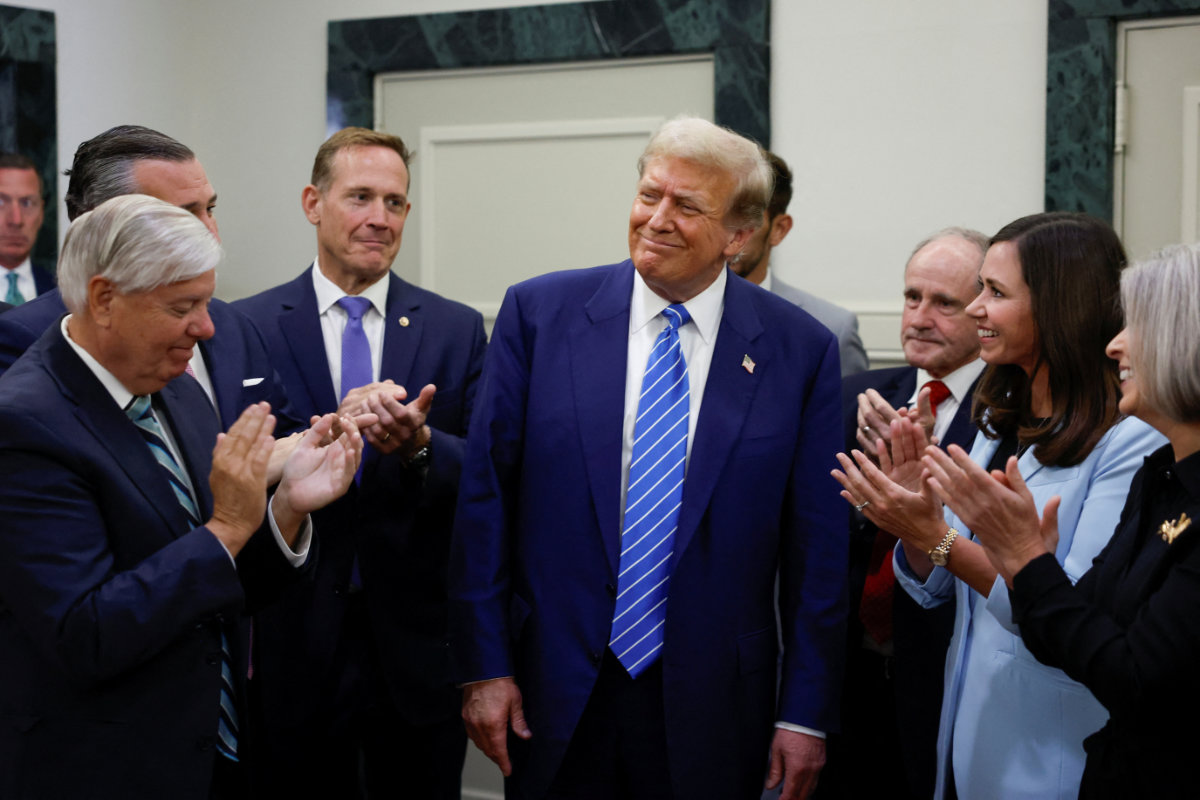
Donald Trump reacts as he is applauded by Republicans at the National Republican Senatorial Committee headquarters in Washington, DC, on June 13, 2024. (REUTERS)
But Trump’s private meetings with House and Senate Republicans so close to the Capitol were infused with the symbolism of his return as the US president who threatened the American tradition of the peaceful transfer of power.
“It’s frustrating,” said former US Capitol Police officer Harry Dunn, who made his own unsuccessful run for Congress as a Maryland Democrat in the aftermath of Jan. 6, the day when police engaged in hand-to-hand fighting to stop Trump supporters who stormed the building in an effort to overturn President Joe Biden’s election.
Dunn spoke of the “irony” of Trump returning to the area and lawmakers now embracing him. “It just shows the lack of backbone they have when they’re truly putting party and person over country,” he said. “And it’s sad.”
Biden was overseas Thursday attending a summit of the Group of Seven leading industrialized nations, but the president’s campaign unveiled a new ad blaming Trump for lighting the “fire” of Jan. 6 and threatening democracy.
Many of those who once stood up to Trump are long gone from office and the Republicans who remain seem increasingly enthusiastic about the possibility of him retaking the White House, and the down-ballot windfall that could mean for their own GOP majorities in Congress.
Thursday afternoon offered the first encounter in years between Trump and McConnell, who once blamed Trump for the “disgraceful” attack that he called an “insurrection” but now endorses the party’s presumptive nominee.
Trump addressed the situation directly, saying he intends to work with everyone and that McConnell had “done his best” as leader, said Sen. Markwayne Mullin, R-Oklahoma, an ally of the former president.
According to Sen. John Barrasso, R-Wyoming, who organized the conference meeting, after Trump addressed the group McConnell gave a thumbs up and the two approached each other and exchanged the fist-bump.
“We had a really positive meeting,” McConnell said. “He and I got a chance to talk a little bit, shook hands a few times.”
As democracies around the world come under threat from a far-rightward shift, some analysts warn that the US system, once seemingly immune from authoritarian impulses, is at risk of populist and extremist forces like those that Trump inspired to sack the Capitol.
“This is just another example of House Republicans bending the knee to Donald Trump,” said Rep. Pete Aguilar of California, the chairman of the House Democratic caucus.
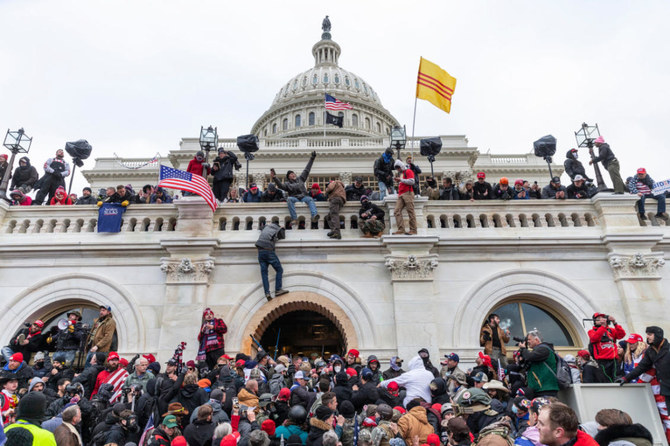
In this photo taken during on January 6, 2021, rioting pro-Trump supporters occupy parts of the attack on the US Capitol building to protest Joe Biden's victory in the 2020 presidential election. Returning to the Capitol for the first time since the riot, Trump described as "patriots" those rioters. some of whom had been charged or sentenced to prison for insurrection. (Shutterstock)
Making Jan. 6 a cornerstone of his reelection campaign, Trump celebrates those who stormed the Capitol as “warriors” and “patriots,” and he has vowed to pardon any number of the more than 1,200 people charged with crimes for the assault on the seat of US democracy.
Moreover, Trump has vowed to seek retribution by ousting officials at the US Justice Department, which is prosecuting him in a four-count indictment to overturn the election ahead of the Jan. 6 attack and another case over storing classified documents at his Mar-A-Largo home.
Republicans, particularly in the House but increasingly in the Senate, are vigorously following his lead, complaining of an unfair justice system. It’s having noticeable results: the House and Senate GOP campaign arms scored some of their highest fundraising periods yet after a jury found him guilty in the New York hush money case.
When former GOP Speaker Paul Ryan on Fox News reiterated this week that he wouldn’t be voting for Trump and wished Republicans had another choice for president, he was immediately ostracized by Trump allies.
“Paul Ryan, you’re a piece of garbage,” said Rep. Troy Nehls, R-Texas. “We should kick you out of the party.”
Of the Republicans who voted to impeach Trump over Jan. 6 and convict him on the charge of inciting the insurrection, only a few remain in office.
Sen. Susan Collins, R-Maine, and Sen. Lisa Murkowski, R-Alaska, had not been expected to attend Thursday’s closed-door session with Trump. But Sen. Mitt Romney, R-Utah, joined as did Sen. Bill Cassidy, R-Louisiana
Cassidy said he’s attending the Trump meeting expecting “he’s going to be the next president, so you have to work” together.
Asked if he was concerned about the direction of the Trump Republican Party, Cassidy said: “Let the day’s own troubles be sufficient for the day. You can fill yourself up with anxiety about tomorrow, but will it change a thing? No.”


