

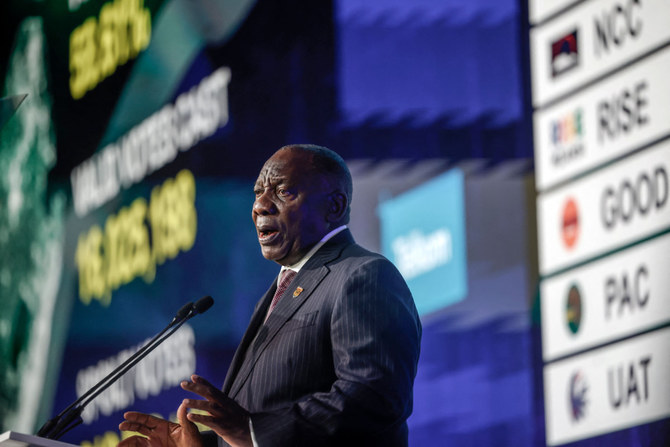

JOHANNESBURG: South African President Cyril Ramaphosa called Sunday for parties to overcome their differences and find “common ground” to form the first national coalition government in the country’s young democracy.
His comments came in a speech straight after final election results were announced confirming that no party won a majority in last week’s vote. Unprecedented coalition talks were set to start to find a way forward for Africa’s most advanced economy.
Ramaphosa’s African National Congress party had already lost its 30-year majority after more than 99 percent of votes were counted by Saturday and showed it couldn’t surpass 50 percent. The ANC received 40.18 percent of the votes in last week’s election in the final count, the largest share.
Without a majority it will need to agree on a coalition with another party or parties for the first time to co-govern and reelect Ramaphosa for a second term. South Africa’s national elections decide how many seats each party gets in Parliament and lawmakers elect the president later.
“Our people have spoken,” Ramaphosa said. “Whether we like it or not, they have spoken. We have heard the voices of our people and we must respect their choices and their wishes.”
“The people of South Africa expect their leaders to work together to meet their needs. This is a time for all of us to put South Africa first.”
At least 26 political parties, including the uMkhonto weSizwe Party led by former President Jacob Zuma, have lodged objections and complaints with the electoral body over allegations of voting irregularities, which it has promised to address.
The ANC was the party of Nelson Mandela and freed South Africa from the apartheid system of white minority rule in 1994. It had governed with a comfortable majority since then. This election saw an unprecedented slump in its support, with voters seen to be deserting the party due to its failure to solve widespread poverty and extremely high unemployment levels, as well as problems with the delivery of basic government services to many in a nation of 62 million.
The ANC had said earlier Sunday that it was starting its negotiations with all major parties. More than 50 took part in the election, and at least eight had significant shares of the vote.
ANC Secretary-General Fikile Mbalula said the party was open to all negotiations, even with the main opposition Democratic Alliance, which has led the chorus of criticism of the ANC for years but is viewed by many analysts as the most stable coalition option for South Africa.
The DA won the second most votes with around 21.81 percent and the two parties would hold a majority together and be able to govern. DA leader John Steenhuisen said his party was also initiating talks with parties. The ANC won 159 seats in the 400-seat Parliament, down from the 230 it won in the last election. The DA increased slightly to 87 seats.
There is some time pressure for coalition talks to progress and for the uncertainty to be minimized given South Africa’s new Parliament needs to sit for the first time and elect a president within 14 days of the election results being declared.
Ramaphosa is seeking a second and final term and Mbalula said his position as leader of the ANC was not in question despite the election result. Mbalula said the ANC would not consider the demands by the MK Party of former President Jacob Zuma that Ramaphosa step down as a condition for talks.
“No political party will dictate terms to us, the ANC. They will not ... You come to us with that demand, forget (it),” Mbalula said.
He said that the ANC would not be arrogant though. “The elections have humbled us, they have brought us where we are,” he said.
South Africa is a leading voice for its continent and the developing world on the global stage and is due to take over the presidency of the Group of 20 rich and developing nations late this year. It’s the only African nation in that group.
“Everyone is looking to see if South Africa can weather the storm and come out the other side,” political analyst Oscar van Heerden said on the eNCA news network.
Amid many coalition options, the ANC could also join with MK and the far-left Economic Freedom Fighters, although they have been cast as partners that would make investors uneasy. Both have pledged to nationalize parts of South Africa’s economy, including its gold and platinum mines, among the world’s biggest producers.
The DA has long said it will not work with the EFF and MK, calling them a “doomsday coalition” for South Africa. Steenhuisen repeated that stance Sunday in a speech on national television but said his party was starting talks with others and would approach them “with cool heads and open minds.”
Political analyst van Heerden said an ANC-DA coalition would “possibly give stability” but there were some within the ANC who would oppose it. Other smaller parties could be involved to dilute it and make it more palatable for the ANC, some commentators said.
“The DA has approached the ANC as the enemy over many, many years,” van Heerden said. “The next few days is going to be a very difficult period. People will have to be mature behind closed doors.”


