Indian military veterans condemn violence against Muslims, Dalits in letter to Modi

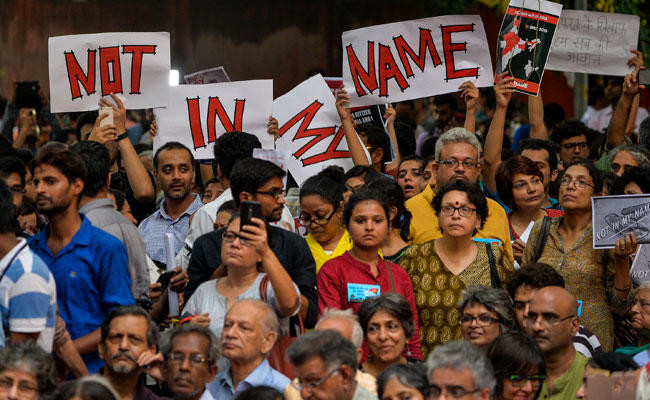
The veterans said they stand with the “Not In My Name” campaign. (File photo: AFP)
Updated 31 July 2017
Follow

Indian military veterans condemn violence against Muslims, Dalits in letter to Modi

DUBAI: More than 100 military veterans in India have penned a letter to Prime Minister Narendra Modi condemning the targeting of Muslims and Dalits, the lowest caste in Hindu tradition, in the country.
The letter comes a month after protesters took to the streets in cities across India to protest a surge in mob violence against minorities.
“We have spent our careers working for the security of our country. Collectively, our group holds no affiliation with any single political party, our only common commitment being to the Constitution of India,” said the letter which was signed by 114 veterans.
“We can no longer look away... Our diversity is our greatest strength. Dissent is not treason; in fact, it is the essence of democracy.”
The veterans said they stand with the “Not in My Name” campaign, sparked by the recent killing of a 16-year-old Muslim boy near Delhi, apparently over his consumption of beef.
“We stand with the ‘Not in My Name’ campaign that mobilized thousands of citizens across the country to protest against the current climate of fear, intimidation, hate and suspicion... What is happening in our country today strikes at all that the Armed Forces, and indeed our Constitution, stand for... We are witness to unprecedented attacks on society at large by the relentless vigilantism of self-appointed protectors of Hinduism,” the letter said.
“We condemn the targeting of Muslims and Dalits... We condemn the clampdowns on free speech by attacks on media outlets, civil society groups, universities, journalists and scholars, through a campaign of branding them anti-national,” it adds.
Earlier this month, Modi condemned the killings, saying: “Killing people in the name of Gau Bhakti (cow devotion) is not acceptable.


Fourth Palestine Action activist ends hunger strike in UK prison

Protesters take part in a demonstration in support of "Defend Our Juries" and their campaign against the ban on Palestine Action
Updated 24 December 2025
Follow

Fourth Palestine Action activist ends hunger strike in UK prison

  • Amy Gardiner-Gibson began eating again after 49 days of protest
  • Govt rejects claims it ignored prison safety protocols

LONDON: A fourth Palestine Action activist imprisoned in the UK has ended her hunger strike.

Amy Gardiner-Gibson, who also uses the name Amu Gib, began eating again after 49 days of fasting, the campaign group Prisoners for Palestine said.

Qesser Zuhrah, another activist, ended her hunger strike last week after 48 days but said she might resume it next year, Sky News reported.

Four Palestine Action activists have now ended their hunger strikes while in prison, while four others are continuing to fast.

All of them are in prison on remand, awaiting trial for a series of high-profile alleged break-ins and criminal damage.

Palestine Action was proscribed as a terrorist organization and banned earlier this year.

On Tuesday, Swedish climate activist Greta Thunberg was arrested in central London at a rally in support of the hunger strikers.

The protesters are demanding that weapons factories in Britain with ties to Israel be shut down, as well as the removal of Palestine Action’s proscription.

They are also calling for immediate bail to be given to imprisoned pro-Palestine activists and an end to the alleged mistreatment of prisoners in custody.

Seven imprisoned members of Palestine Action have been transferred to hospital over the course of the hunger strike campaign. Doctors have highlighted concerns about the long-term impact of fasting on the activists.

Lawyers representing the group on Monday initiated legal action against the government over its alleged failure to follow prison safety regulations.

The government, however, has rejected this accusation, Sky News reported.

A Ministry of Justice spokesperson said: “Ministers do not intervene in individual cases. Where individuals are on remand, doing so would risk prejudicing ongoing legal proceedings and undermine the independence of the justice system.

“Concerns about welfare and process can be raised through established legal and administrative channels, including prison governors and ultimately the prison and probation ombudsman.

“Healthcare decisions are taken independently by qualified NHS professionals and appropriate care and oversight frameworks remain in place.”

The activists still on hunger strike include Heba Muraisi and Teuta Hoxha. Hoxha has been on remand for 13 months and her family told Sky News they feared she would die in prison.

Another of the activists, Kamran Ahmad, is believed to have been on hunger strike for 45 days and hospitalized three times.

Lewie Chiaramello, who has Type 1 diabetes, is on day 31 of his strike and taking part by fasting every other day.