MOSUL: Special forces have recaptured more of Mosul’s historic heart as they press the final stages of an assault to drive Daesh from Iraq’s second city, the military said Sunday.
More than eight months since the country’s forces launched an operation to retake Mosul, Daesh has gone from fully controlling the city to holding a few neighborhoods on its western side.
Counter-terrorism forces liberated the Makawi area of the Old City, the joint operations command announced on Sunday, in a further blow at the heart of the terrorists’ cross-border “caliphate.”
Iraqi forces have been closing in on the Old City for months, but its narrow streets and closely spaced buildings combined with a large civilian population made for an extremely difficult fight.
Security forces recaptured a series of nearby districts, cornering the terrorists, before launching an assault inside the Old City on June 18.
They have since made significant progress.
On Saturday, officers announced the recapture of a hospital and its surroundings north of the Old City, removing a nearby but unconnected pocket of Daesh resistance.
Interior Ministry forces recaptured the Ibn Sina hospital along with other medical facilities including a blood bank and a clinic, Staff Lt. Gen. Abdulamir Yarallah said in a statement.
Daesh has occupied several of Mosul’s hospitals during the battle for the city.
Some security personnel have complained that restrictions on using heavy weapons against hospitals, intended to protect the facilities, have made operations riskier and more time-consuming.
Lt. Gen. Raed Shakir Jawdat, federal police chief, said the area around the hospital, Al-Shifaa, had been completely retaken, limiting Daesh’s presence in Mosul to the Old City.
“Our forces are advancing from three sides and are pursuing the terrorist groups in the few remaining areas of the Old City,” Jawdat said in a statement.
On Thursday, Iraqi forces retook the remains of the Grand Mosque of Al-Nuri in their greatest symbolic victory since the battle began.
Daesh chief Abu Bakr Al-Baghdadi gave a triumphal sermon at the mosque after the terrorists captured Mosul in 2014, calling on Muslims to obey him.
The mosque thus became a symbol of Baghdadi’s rule and Daesh’s self-declared cross-border “caliphate.”
Daesh made sure that the Al-Nuri mosque was not captured intact, blowing it up along with its famed leaning minaret — known affectionately as “Al-Hadba” (The Hunchback) — as Iraqi forces closed in.
Daesh claimed on its Amaq propaganda agency that the site was hit in a US airstrike, but the US-led coalition said it was the terrorists who had “destroyed one of Mosul and Iraq’s great treasures.”
Even though it lies in ruins, the mosque’s recapture has provided a boost to Iraq’s forces and its government. Prime Minister Haider Al-Abadi declared that the terrorists’ “caliphate” was coming to an end.
The following day, a senior Iraqi commander said victory in Mosul would be declared within the “next few days.”
Daesh overran large areas north and west of Baghdad in 2014, but Iraqi forces backed by US-led coalition air strikes have since regained much of the territory they lost.
The recapture of Mosul will not however mark the end of the war against Daesh.
The terrorist group still holds territories in both Iraq and Syria, where it has been able to carry out attacks in government-held areas.
Daesh terrorists and “lone wolf” attackers inspired by the group’s ideology have also carried out multiple operations overseas.


![]()
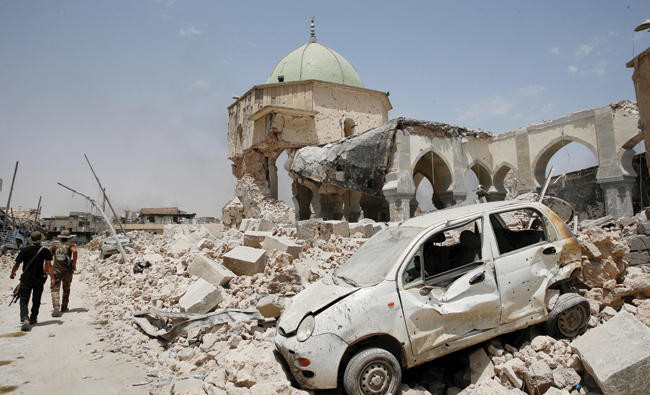

Iraq gains ground in Mosul’s Old City as it presses assault on Daesh
Iraq gains ground in Mosul’s Old City as it presses assault on Daesh
Israel expands Lebanon strikes, killing 11
- Israel expanded its air strikes in Lebanon on Wednesday, targeting the area around the presidential palace near Beirut and other areas south of the capital
BEIRUT: Israel expanded its air strikes in Lebanon on Wednesday, targeting the area around the presidential palace near Beirut and other areas south of the capital as well as strongholds of the Iran-backed militant group Hezbollah, killing at least 11 people.
Lebanon was drawn into the Middle East war on Monday when Hezbollah attacked Israel in response to the killing of Iranian supreme leader Ayatollah Ali Khamenei during US-Israeli strikes over the weekend.
An air strike hit a hotel in Hazmieh on Wednesday, the first reported Israeli attack on the predominantly Christian area in Beirut’s suburbs near the presidential palace and several embassies.
Some rooms were gutted in the strike, while wounded people received treatment in the lobby, AFP images showed.
People also fled through debris carrying suitcases past the Comfort Hotel’s sign, which had fallen broken to the ground. It was not possible to determine who was targeted in the attack.
The southern suburbs of Beirut, a Hezbollah stronghold, were targeted again on Wednesday morning, following an evacuation order from Israel’s military.
Smoke rose over the densely populated area, where some residents fled when the violence erupted.
In Aramoun and Saadiyat south of Beirut — two towns outside Hezbollah’s traditional strongholds — the health ministry said Israeli strikes killed six people and wounded eight others. It cautioned that this was a “preliminary toll.”
AFP footage from Aramoun showed damaged cars and rescue workers carrying a wounded person on a stretcher.
Strikes also targeted a four-story building in the city of Baalbek, in Lebanon’s east far from the border where Hezbollah also has a strong presence.
Five people were killed, 15 were wounded and three remain missing, Lebanon’s state-run National News Agency reported.
One side of the building collapsed. AFP correspondents saw rescue workers searching through the rubble for survivors.
- Ground incursion -
The Israeli military called on people to “immediately” leave 13 towns and villages in southern Lebanon on Wednesday morning ahead of strikes against Hezbollah, the military’s Arabic-language spokesman Avichay Adraee said on X.
A similar evacuation warning had earlier been issued for 16 other southern towns and villages.
Hezbollah carried out a series of strikes against Israel on Tuesday, claiming to have targeted sites including the northern Haifa naval base in retaliation for Israeli strikes in southern Beirut.
Since Monday, Israeli strikes have killed at least 50 people and wounded 335 in Lebanon, the health ministry said before the overnight strikes.
World Health Organization chief Tedros Adhanom Ghebreyesus said three paramedics were killed and six injured “while recovering people injured by explosions” in Lebanon’s southern Tyre district.
“Warring parties must abide by international humanitarian law and protect health workers, facilities and patients,” he said on X.
Lebanese authorities on Monday recorded the displacement of more than 58,000 people from areas targeted by strikes.
The Israeli military has said it will continue to strike Hezbollah until the Lebanese group disarms.
Israeli forces also launched a ground incursion on Tuesday, advancing into a border area in southern Lebanon, a Lebanese army source told AFP.
Lebanon was drawn into the Middle East war on Monday when Hezbollah attacked Israel in response to the killing of Iranian supreme leader Ayatollah Ali Khamenei during US-Israeli strikes over the weekend.
An air strike hit a hotel in Hazmieh on Wednesday, the first reported Israeli attack on the predominantly Christian area in Beirut’s suburbs near the presidential palace and several embassies.
Some rooms were gutted in the strike, while wounded people received treatment in the lobby, AFP images showed.
People also fled through debris carrying suitcases past the Comfort Hotel’s sign, which had fallen broken to the ground. It was not possible to determine who was targeted in the attack.
The southern suburbs of Beirut, a Hezbollah stronghold, were targeted again on Wednesday morning, following an evacuation order from Israel’s military.
Smoke rose over the densely populated area, where some residents fled when the violence erupted.
In Aramoun and Saadiyat south of Beirut — two towns outside Hezbollah’s traditional strongholds — the health ministry said Israeli strikes killed six people and wounded eight others. It cautioned that this was a “preliminary toll.”
AFP footage from Aramoun showed damaged cars and rescue workers carrying a wounded person on a stretcher.
Strikes also targeted a four-story building in the city of Baalbek, in Lebanon’s east far from the border where Hezbollah also has a strong presence.
Five people were killed, 15 were wounded and three remain missing, Lebanon’s state-run National News Agency reported.
One side of the building collapsed. AFP correspondents saw rescue workers searching through the rubble for survivors.
- Ground incursion -
The Israeli military called on people to “immediately” leave 13 towns and villages in southern Lebanon on Wednesday morning ahead of strikes against Hezbollah, the military’s Arabic-language spokesman Avichay Adraee said on X.
A similar evacuation warning had earlier been issued for 16 other southern towns and villages.
Hezbollah carried out a series of strikes against Israel on Tuesday, claiming to have targeted sites including the northern Haifa naval base in retaliation for Israeli strikes in southern Beirut.
Since Monday, Israeli strikes have killed at least 50 people and wounded 335 in Lebanon, the health ministry said before the overnight strikes.
World Health Organization chief Tedros Adhanom Ghebreyesus said three paramedics were killed and six injured “while recovering people injured by explosions” in Lebanon’s southern Tyre district.
“Warring parties must abide by international humanitarian law and protect health workers, facilities and patients,” he said on X.
Lebanese authorities on Monday recorded the displacement of more than 58,000 people from areas targeted by strikes.
The Israeli military has said it will continue to strike Hezbollah until the Lebanese group disarms.
Israeli forces also launched a ground incursion on Tuesday, advancing into a border area in southern Lebanon, a Lebanese army source told AFP.
Latest updates


© 2026 SAUDI RESEARCH & PUBLISHING COMPANY, All Rights Reserved And subject to Terms of Use Agreement.