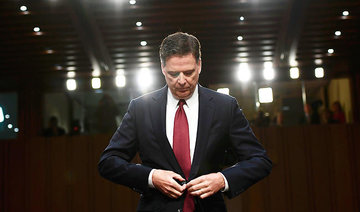
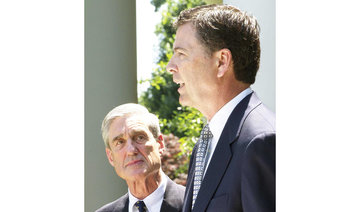
BEDMINSTER, US: President Donald Trump on Sunday intensified his effort to discredit ousted FBI director James Comey, accusing him of cowardice in leaking an eye-popping account of their private meetings.
In an angry early-morning tweet from his New Jersey golf club, the embattled president questioned Comey’s character and whether he had broken the law in revealing their conversations.
Comey had been leading an FBI investigation into several Trump aides and their contacts with the Russian government — which US intelligence agencies say tried to tilt the 2016 election in Trump’s favor — before being fired.
After his dismissal, Comey leaked shocking details of a series of meetings with Trump, in which the president allegedly asked for Comey’s “loyalty” and suggested that he shelve an FBI investigation into Trump’s national security adviser.
Trump critics said that was evidence that the president may have obstructed justice, possible grounds for impeachment.
The White House has repeatedly tried to shift the focus away from the content of Comey’s allegations and onto the manner of their release.
“I believe the James Comey leaks will be far more prevalent than anyone ever thought possible,” Trump wrote in an early morning tweet. “Totally illegal? Very ‘cowardly!’“
It was not clear exactly what Trump meant by “prevalent” — a point made in a flurry of Twitter postings by critics of the president. And legal experts have questioned whether Comey’s leak broke any law.
Trump’s lawyer Marc Kasowitz has indicated he will file a complaint about Comey to the Justice Department, which oversees the FBI.
In sworn testimony to the Senate on Thursday, Comey painted Trump as untrustworthy and admitted he asked a “friend,” identified as a Columbia University law professor, to release a memo of his conversations with the president to the press.
Comey said he had hoped releasing the information via the media would prompt the appointment of a special counsel to handle the Russia probe, a ploy that ultimately proved successful.
He also branded the president a liar and said Trump urged him to abandon the investigation into former national security adviser Michael Flynn, an allegation Trump has denied.
Not man enough
On Friday, Trump’s former campaign manager Corey Lewandowski criticized Comey as not “man enough” for having leaked the memo via his friend rather than doing it himself.
“He gave his notes to a Columbia law professor because he wasn’t man enough to give the notes directly to the media,” Lewandowski told NBC’s morning show “Today.”
Though Trump has lambasted Comey as a “leaker,” he also claimed “total and complete vindication” following the ex-FBI chief’s testimony, focusing on Comey’s confirmation that Trump was not personally being probed.
Comey “leaking his own memos to manipulate the system is exactly why people dislike the swamp,” said Trump ally Newt Gingrich. During his campaign, Trump often said it was time to “drain the swamp” in Washington of corrupt and self-dealing insiders.
But Trump’s denunciations of Comey have only fueled demands that the president — who has denied asking for loyalty or asking for the investigation to be shelved — give his account under oath.
On Friday, Trump indicated that he was willing to do that, a highly unusual step for a sitting president and one fraught with legal hazard.
Trump has also suggested several times that there might be recordings of his conversations with Comey.
Republican Senator Susan Collins called on Sunday for Trump to “voluntarily turn them over” to the Senate Intelligence Committee and to the special counsel, Robert Mueller, investigating possible collusion between Trump aides and Russia.
“I would be fine with issuing a subpoena, but that most likely would come from the special counsel’s office,” Collins told CNN.
Another Republican senator, Lindsey Graham of South Carolina, told CBS he thought it would be “inappropriate for the president to testify publicly.”
He said he tended to believe Trump’s denial of having done “anything wrong with the Russians,” wryly adding: “He can’t collude with his own government. Why do you think he’s colluding with the Russians?“
More seriously, former White House spokesman Ari Fleischer voiced the growing concern among Trump allies that the president is digging himself into a legal hole, offering this advice to the president:
“You have not been vindicated. U won’t be unless Bob Mueller says so. Stop talking. You’re heading into a giant perjury trap.”