WASHINGTON: Members of key congressional committees pledged to proceed with aggressive investigations into Russia’s meddling in the US election, saying the American people need a full airing as to why James Comey, former FBI director, was ousted.
Comey was fired by President Donald Trump earlier recently. The former director agreed to testify before the Senate intelligence committee after the Memorial Day holiday.
Republican Sen. Marco Rubio of Florida, a member of that committee, said he wants to press Comey as to whether he ever believed the White House was interfering with his work, in light of a spate of news reports that Comey had kept detailed records of his interactions with Trump.
The New York Times and other news outlets reported last week on a Comey memo indicating Trump had urged him to drop an investigation into former national security adviser Michael Flynn. Separately, another Times report said Trump had told Russian officials in a closed-door meeting at the Oval Office that firing Comey “had relieved great pressure on him.”
“Did he keep these memos? What do those memos say? And why did he write it? And how did he feel? Did he ever feel like he was being put in a position where he couldn’t do his job?” Rubio asked. “There’s no doubt that that’s the questions that are going to get asked, and asked repeatedly.”
Rubio said White House officials had told him they had no transcripts nor notes of Trump’s meeting with Russian officials but “apparently someone has discussed them, or leaked them.”
“This cloud is impacting everything else,” Rubio said, describing a number of questions, such as possible obstruction of justice, that are hanging over the White House. “So, we need to get over this once and for all.”
Leaders of the House oversight committee, Republican Rep. Jason Chaffetz of Utah and Democrat Rep. Elijah Cummings of Maryland, said they would demand Comey’s notes. Cummings also is urging Chaffetz, who is resigning from his job next month, to subpoena the White House for any documents relating to Flynn.
Chaffetz said he expects to speak with Comey on Monday and that if there are any notes of White House meetings, “we’re certainly pursuing them.”
“There have been so many lies, so many contradictions,” Cummings said, adding that he expects parallel investigations from Congress to proceed fully after the Justice Department last week appointed former FBI director Robert Mueller as special counsel to head an investigation into possible Russian coordination with the Trump campaign during the 2016 presidential election.
Referring to the whole sequence of events leading to Comey’s firing, Cummings added: “I think that there may be quite a few people that may have some problems with the law.”
The White House has repeatedly insisted that a “thorough investigation will confirm that there was no collusion between the campaign and any foreign entity.” It has not denied the Times report that Trump was critical of Comey to the Russians the day after he fired him. But White House spokesman Sean Spicer has called the president’s rhetoric part of his deal-making, contending that Comey had created “unnecessary pressure” on Trump’s ability to negotiate with Russia on a range of issues.
White House national security adviser H.R. McMaster underscored that point in an interview that aired Sunday, saying Trump had felt “hamstrung.”
“The president feels as if he is hamstrung in his ability to work with Russia to find areas of cooperation because this has been obviously so much in the news,” said McMaster, who was present at the meeting.
Sen. Dianne Feinstein, a member of the intelligence committee, said she also plans to press Comey regarding what was discussed with Trump about Flynn and whether he was asked by Trump to alter the FBI investigation. The California Democrat said public hearings should ferret out what has been a flurry of apparently contradictory comments by many of the parties involved.
“I really think that rather than have all these memorandums and issues circulating around, that we need to put the facts before the American people,” she said. “Did the president fire Comey because of his investigation and was he worried about what the investigation might conclude? If so, that borders on a very serious charge.”
“And it’s got to come from Director Comey himself,” Feinstein said.
Rubio appeared on CNN’s “State of the Union” and CBS’ “Face the Nation,” Feinstein also was on CBS’ “Face the Nation,” and Chaffetz, Cummings and McMaster spoke on ABC’s “This Week.”


![]()
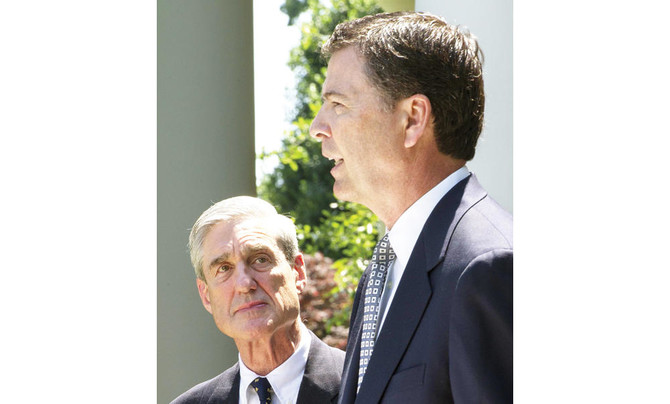
Congressional panels pledge thorough probe into Comey firing
Congressional panels pledge thorough probe into Comey firing
Latest updates


© 2026 SAUDI RESEARCH & PUBLISHING COMPANY, All Rights Reserved And subject to Terms of Use Agreement.